Showing posts with label Africa. Show all posts

Friday, July 15, 2011

In a Stew

Sudan Image


A piece of bread which tastes nonexistence.
Pic : James Nachteway/Magnum:Famine victims received rehydration salts and food from volunteer aid workers

Saturday, April 30, 2011

Libyan Forces Chase Rebel Convoy Into Tunisia


The fighting in Libya briefly spilled into neighboring Tunisia on Friday when troops loyal to Col. Muammar el-Qaddafi forced rebels from a border crossing in the northwest of Libya and pursued them into a nearby Tunisian town, according to a rebel spokesman and fighter who witnessed the events
Government forces attacked a convoy of rebel fighters and supply trucks at the checkpoint at Wazen in midmorning, said Tarek Bodrani, the fighter, who was reached by telephone. Mr. Bodrani said a pro-Qaddafi force with about 30 vehicles struck from the north and south, and seven pickup trucks carrying antiaircraft machine guns followed rebels toward the Tunisian town, Dhiba, roughly three miles away.
One government pickup truck crashed and the others were stopped, and the pro-Qaddafi soldiers were detained after being confronted by a roadblock operated by the Tunisian military and local residents. Col. Ahmed Omar Bani, a rebel spokesman, said Colonel Qaddafi’s forces fired mortar shells onto Tunisian soil during the chase.
Outraged Tunisian officials summoned a Libyan envoy to complain about the incursion, Al Jazeera reported. Libyan ordnance reportedly fell in Tunisian territory on Thursday as well, when fighting for control of the Wazen post began, wounding some civilians and potentially further imperiling the Libyan government, which is already fighting on multiple fronts and facing a NATO air campaign.
In an address broadcast live early on Saturday, Colonel Qaddafi called for negotiations with NATO, Reuters reported. “Let us negotiate with you, the countries that attack us,” he said.
The rebels had captured the border post at Wazen with hopes of opening a supply route for opposition fighters battling Colonel Qaddafi’s troops in Libya’s western mountains. The fate of that ambition is now unclear, as was the status of the captured Libyan soldiers.
In Libya’s most violent area, in the besieged coastal city of Misurata, fighting erupted across a broad front along the city’s south and west, as rebel fighters pressed toward the city’s airport and faced a fresh ground attack on their western flank.
The fighting in Misurata began early in the morning and raged throughout the day. The city’s edge became a cacophony of machine-gun and mortar fire, punctuated by the rolling explosions of ground-to-ground rocket strikes in neighborhoods behind the front lines.
As the two sides fought, Misurata’s troubles appeared to deepen further as NATO said that pro-Qaddafi forces had been caught Friday mining the waters around the harbor to harass traffic from the sea, which has been the sole lifeline for a city otherwise cut off by loyalist ground troops.
Three mines were discovered and were being disposed of, NATO said in a statement, adding that the devices were being laid two to three kilometers offshore when the inflatable boats on which they were being carried were deliberately sunk.
At least one vessel with humanitarian aid scheduled to enter the port on Friday delayed its arrival and waited off the coast for an all-clear sign from NATO, medical officials in the city said.
Supplies from the sea have been integral to the city’s survival during the two-month siege, as internationally chartered aid ships have delivered food, water, medicine and ambulances, and evacuated thousands of migrant workers and many wounded Libyans in need of treatment not available in the city.
A flotilla of rebel fishing vessels and tugboats have also smuggled in weapons, ammunition and other military equipment, allowing the sparsely supplied rebels to push forward against Colonel Qaddafi’s conventionally equipped troops.
The fighting on two fronts in the Misurata area on Friday appeared to signal simultaneous thrusts, in different places — one by the rebels and the other by loyalist troops.
The loyalists, backed by at least three tanks, struck first, trying to push into and through the village of Zawit al-Mahjoub early in the morning, fighters and medical officials said. The rebels repelled the attack, but not before three tanks entered the village, six rebel fighters were killed and at least 10 more were wounded, a doctor treating them said.
As the battle in the village continued, rebel groups were pushing southward toward the airport, which is still held by the loyalists, and meeting stiff resistance from Colonel Qaddafi’s troops dug in around the airfield or garrisoned within.
By midmorning, a large battle had been joined, and mortar fire was landing, in explosion after explosion, near rebels clustered and hiding in buildings and behind walls.
Most of the pro-Qaddafi forces inside the city have been killed or chased out. But the Qaddafi units control the city’s approaches and many remain at Misurata’s edges, from where they have been shelling the city at will. A rebel commander, who said he had been a lieutenant colonel in the Libyan military before joining the opposition, said the immediate goal of the southern thrust was to push the pro-Qaddafi units from the airport and ultimately out of rocket range.
“Right now nowhere in the city is safe, and we worry about our mothers, our wives and our daughters,” he said. The commander, who provided his name, asked that it be withheld from publication to prevent retaliation against his family.
As machine-gun fire crackled and mortar rounds landed in the neighborhood, a second officer, whose fighters identified him as a police colonel who had defected from the government’s side, said the rebels did not know how many loyalist troops were defending the airport.
The rebels have not managed to encircle the airfield, he said, and the Qaddafi forces control an access road to the airport that connects them to the rest of Libya. Their numbers, the officer said, seemed to fluctuate each day.
The fighting built in intensity as the hours passed. Shortly after 1 p.m. the Qaddafi forces struck the city with a heavy barrage of rockets, which landed in a civilian neighborhood, miles away from the fighting. The smoke and dust of multiple explosions could be seen from afar.
A few minutes later, a shoe factory near the airport was struck by munitions and set ablaze. A dense column of black smoke rose, forming a cloud that drifted over Misurata.
The smoke continued to rise at sunset, when funeral processions for many rebels and civilians killed in the day’s fighting wound through the city.
In Benghazi, the rebel capital, the National Transitional Council, as the de facto rebel government calls itself, pledged in a communiqué that “no forces under its command” would use antipersonnel or antivehicular land mines.
Whether the council and its forces have the means or command-and-control capacity to live up to these pledges remains to be seen; many rebel groups have demonstrated poor discipline in the field, especially in eastern Libya, and the council’s ability to supervise the forces is not always evident.
By C. J. CHIVERS and SCOTT SAYARE
@NYTIMES

Wednesday, March 30, 2011

Libya Updates

• Coalition aircraft attacked vessels which were preventing aid reaching Misrata yesterday, sinking four and beaching another. The attacks have allowed two ships to deliver humanitarian aid. However a rebel spokesman said that Gaddafi's forces killed 18 civilians in Misrata on Tuesday, and that troops are still shelling and fighting skirmishes with rebels.

• Britain has expelled five pro-Gaddafi Libyan diplomats from London, the foreign secretary, William Hague said. He added that a UK diplomat, Christopher Prentice, had met Libyan rebel leaders in Benghazi on Monday and Tuesday.
• Rebels have been forced to retreat from the oil town of Ras Lanuf after Gaddafi's forces attacked the city. Reports suggested Nato planes flew over the zone where the heaviest fighting was under way, with explosions heard, however the revolutionaries were still forced back in their 4x4s

Thursday, March 24, 2011

Turkey-France Clash


Recep Tayyip Erdogan
Turkey has launched a bitter attack on French president Nicolas Sarkozy's and France's leadership of the military campaign against Libyan leader Muammar Gaddafi, accusing the French of lacking a conscience in their conduct in the Libyan operations.
The vitriolic criticism, from both the prime minister, Recep Tayyip Erdogan, and the president, Abdullah Gül followed attacks from the Turkish government earlier this week and signalled an orchestrated attempt by Ankara to wreck Sarkozy's plans to lead the air campaign against Gaddafi.
With France insisting that Nato should not be put in political charge of the UN-mandated air campaign, Turkey has come out emphatically behind sole Nato control of the operations.
The row came as France confirmed that one of its fighter jets had destroyed a Libyan air force plane, the first to breach the no-fly zone since it was imposed on 19 March. The Libyan G2/Galeb trainer aircraft was destroyed by an air-to-ground missile just after it landed at an air base near the rebel-held town of Misrata, a French military spokesman said.
The clash between Turkey and France over Libya is underpinned by acute frictions between Erdogan and Sarkozy, both impetuous and mercurial leaders who revel in the limelight, by fundamental disputes over Ankara's EU ambitions, and by economic interests in north Africa.
The confrontation is shaping up to be decisive in determining the outcome of the bitter infighting over who should inherit command of the Libyan air campaign from the Americans and could come to a head at a major conference in London next week of the parties involved.
Using incendiary language directed at France in a speech in Istanbul, Erdogan said: "I wish that those who only see oil, gold mines and underground treasures when they look in [Libya's] direction, would see the region through glasses of conscience from now on."
President Gül reinforced the Turkish view that France and others were being driven primarily by economic interests. "The aim [of the air campaign] is not the liberation of the Libyan people," he said. "There are hidden agendas and different interests."
Earlier this week, Claude Guéant, the French interior minister who was previously Sarkozy's chief adviser, outraged the Muslim world by stating that the French president was "leading a crusade" to stop Gaddafi massacring Libyans.
Erdogan denounced the use of the word crusade yesterday, blaming those, France chief among them, who are opposed to Turkey joining the EU.
Senior Nato officials are meeting in Brussels for the fourth day in a row to try to hammer out an agreement on who should assume command of the no-fly zone over Libya from the Americans who are determined to relinquish command within days.
Sarkozy has agreed to give Nato military planners operational command of the campaign, but refused to grant the alliance political and strategic control, insisting this should be vested in the broader "coalition of the willing" taking part.
Turkey has responded by blocking Nato planning operations for Libya while stressing that Nato should be given "sole command", senior Nato diplomats said.
Turkey, Nato's second biggest army after the US and its only Muslim member, appears bent on winning the argument. It is already taking part in Nato patrols in the Mediterranean to police an arms embargo on Libya. It wants to limit and shorten the air campaign and proscribe ground attacks on Libya by Nato aircraft. If Nato is given political command of the air effort, Turkey would be able to exercise a veto in a system run on consensus.
The US's top military officer in Europe, Admiral James Stavridis, Nato's supreme commander Europe, has gone to Ankara to try to mediate a deal.
The Turks are incensed at repeated snubs by Sarkozy. The French failed to invite Turkey to last Saturday's summit in Paris which presaged the air strikes. French fighters taking off from Corsica struck the first blows. The Turkish government accused Sarkozy of launching not only the no-fly zone, but his presidential re-election campaign.
While the dispute over Libya is substantive and political, it also appears highly personal, revealing the bad blood simmering between the French president and the Turkish prime minister.
Sarkozy went to Turkey last month for the first time in four years as president. But the visit was repeatedly delayed and then downgraded from a state presidential event. He stayed in Turkey for five hours.
"Relations between Turkey and France deserve more than this," complained Erdogan. "I will speak with frankness. We wish to host him as president of France. But he is coming as president of the G20, not as that of France."
While the German chancellor, Angela Merkel, is also opposed to Turkey joining the EU, she has voiced her objections moderately. Sarkozy has declared loudly that culturally Turkey does not belong in Europe, but in the Middle East.
France has blocked tranches of Ankara's EU negotiations on the grounds that it should not be seen as ever-fit for membership.

Friday, March 18, 2011

Libya Updates

Libyans celebrate in Benghazi
The Libyan announcement of a unilateral ceasefire made by foreign minister Moussa Koussa leaves several important questions unanswered. Is it simply a ploy to divide the UN after the approval of the security council resolution? And how will a ceasefire be monitored and verified? Will the UN be allowed in? Fighting was reported from the port of Misrata shortly before his press conference in Tripoli. His offer of dialogue has already been rejected by the Benghazi-based rebels. The Gaddafi regime is pretty low on credibility so there will be plenty of scepticism about this statement. And Koussa pointedly refused to answer any questions after dropping his bombshell.
Ian Black in Tripoli (Guardian)
pic : Another picture of Libyans celebrating in Benghazi after the UN vote. Photograph: Patrick Baz/AFP/Getty Images

Saturday, December 25, 2010

Elusive Saharan Cheetah Captured In Photos

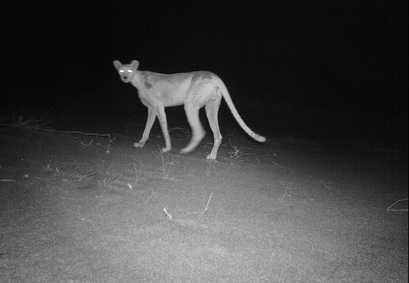
An elusive Saharan cheetah recently came into the spotlight in Niger, Africa, where a hidden camera snapped photos of the ghostly cat, whose pale coat and emaciated appearance distinguish it from other cheetahs.
In one of the images the sleek, light-colored cat with small spots on its coat and a small head is turning in the direction of the camera, its eyes aglow.
Its appearance, and how the Saharan cheetah (Acinonyx jubatus hecki) is genetically related to other cheetahs is open to question, said John Newby, CEO of the Sahara Conservation Fund (SCF), who is part of the team, along with SCF's Thomas Rabeil and others, who captured the camera-trap snapshots between July ad August. What they know about this species comes from the few photos they've managed to capture.

"I think we were more happy than surprised when the images turned up, because we knew cheetahs were in the general area because we had seen their tracks on several occasions," Newby said. "However, the area is so vast that picking up an animal as rare as this always entails a lot of luck and good judgment on where to place the cameras."
The animal is so rare and elusive scientists aren't sure how many even exist, though they estimate from the few observations they've made of the animal and tracks that fewer than 10 individuals call the vast desert of Termit and Tin Toumma in Niger home. Fewer than 200 cheetahs probably exist in the entire Sahara. [10 Species You Can Kiss Goodbye]
Losing this cheetah would also mean losing important genetic and biological diversity, as these animals have adaptations for survival in extreme desert conditions.
Their home can reach sizzling temperatures up to 113 degrees Fahrenheit (45 degrees Celsius), and is so parched no standing water exists. "They probably satisfy their water requirements through the moisture in their prey, and on having extremely effective physiological and behavioral adaptations," Newby said.
In an effort to conserve water and stay out of the heat, the Saharan cheetah is even more nocturnal than other cheetahs.
Spotting these cats in the wild has been a challenge. "They are incredibly shy and elusive animals," Newby said. In addition, they likely have broad home ranges since their prey - gazelles, hares, large birds and smaller rodents - are relatively scarce. Observations that have been made suggest they prefer caves and rock shelters as breeding dens.
Among the threats to the pale cat are scarcity of prey due to poaching and overuse, and conflicts with herders over stock harassment and killing of their animals, according to SCF. Apparently cheetah skins are prized as prayer rugs or used to make slippers.
"They are suspected of taking goats and even baby camels, and as a result are persecuted just like most other large predators," Newby said. "Work underway with local nomads is putting together the true picture of livestock predation in an attempt to reduce the arbitrary slaughter of carnivores that has massively reduced populations of cheetah and striped hyenas."
Newby and Rabeil say the camera-trap study will provide tangible evidence for the cheetah's existence in the Termit area.
"The more we know about the animal the better we can conserve it, including pinpointing key areas for extra protection," Newby said. "The cheetah's presence adds weight to arguments for the entire zone's protection as a nature reserve and strengthens our ability to raise support for conservation activities."
The Saharan cheetah is listed as critically endangered on the 2009 IUCN Red List of Threatened Species. (IUCN stands for International Union for Conservation of Nature.)

A hind image showing the Saharan cheetah in the Termit region of Niger, Africa, was captured recently by a camera trap. Credit: Sahara Conservation Fund/WildCRU.


The Saharan cheetah is smaller with a paler coat than other cheetahs. Here a photo of the Saharan cheetah captured by a camera trap in a vast desert in Niger, Africa. Credit: Sahara Conservation Fund/WildCRU.


Credit: Sahara Conservation Fund/WildCRU
A camera trap recently captured the elusive Saharan cheetah in a vast desert in Niger, Africa. Credit: Sahara Conservation Fund/WildCRU.


By Jeanna Bryner, LiveScience Managing Editor