Showing posts with label Germany. Show all posts

Thursday, December 16, 2021

Erich Ohser: The Burden of Art


This is the sad story of a pioneer, light years ahead of the contemporary trend.
Erich Ohser (aka E.O. Plauen) was born in 1903 in Adorf,  small outlaying in Vogtland.  During a short professional career, he worked for magazines such as Vorwärts (=Forward), illustrating satirical representations of Joseph Goebbels and Adolf Hitler. Obviously, these endeavors earned him the enmity of the Nazis, and he was prohibited from practicing his trade under an order of professional disqualification (=Berufsverbot). He continued to work under pseudonyms, and from 1940, began again to produce cartoons on political themes. He was arrested on charges of expressing anti-Nazi opinions (reichsfeindliche Äußerungen). Sadly, Ohser committed suicide in jail 24 hours before his trial.

I accidentally discovered some of his comic strips dating back to the 1930s. His art has been an intriguing subject for me. Elements of his political orientation were interwoven into his modern aesthetic flavor. His satirical caricatures or cartoons, frequently accompanied by Erich Knauf's articles, expressed his political stance against National Socialism. The interesting aspect is how an artist channels ideas under a rigid censorship regime. The notorious Father and Son series is probably the most popular work by Ohser that captivated readers between 1934 to 1937. The adventures of the funnily depicted duo gave the artist a veiled platform to express his views.

Pedram, 12/16/2021

Saturday, May 5, 2012

My Author of The Month (January 2012)

File:Nietzsche and Philosophy.JPG

I read "Nietzsche and Philosophy" by french Gilles Deleuze. The key point is the novel and sharp interpretation of then-underrated and unknown german philosopher. The book is concise and fluent, handling the difficult issue masterfully. To me it was an expert synopsis of major themes in Nietzsche's works.
pedram, May 2012

Monday, January 2, 2012

My Album of The Month (November 2011)


A decent post-rock album by german band "Collapse Under The Empire". The duo manage to conjure up a perfect blend.Shoulders & Giants is the first half of a two-part concept work that thematically deals with the human existence, the dream of advancement, a life of absolute freedom, isolation, and death. The album is bleak and severe, but subtly lit from within with touches of hope and beauty. It immerses the listener in the sensation of being alone in the mountains and crevasses of an arctic environment – the harshness of the bitter solace, the joy at the soaring beauty of nature’s splendour.

Thursday, December 15, 2011

My Author of The Month (November 2011)


I finished "The Buddenbrooks" in november and i dedicate this post to its great creator Thomas Mann. The drama is a twisted epic about the decline of a family. It conveys many dimensions which can be analyzed and studied. I attached an article from Ian Sansom, explaining the term "the Buddenbrooks effect", an extension of Mann's novel to fields like economics, history, etc. He intends to formulate a great dynasty through this. pedram 


Historians and economists sometimes refer to the Buddenbrooks effect. The term derives from Thomas Mann's 1901 novel, Buddenbrooks, in which he depicted the decline of a bourgeois family (which rather resembled Mann's own). The Buddenbrooks effect refers to the tendency among family businesses to decline over a period of about three generations. All good things, in other words, must come to an end. And all good columns also.

In our discussion of family dynasties we have covered princes and politicians, kings, queens and emperors, movie stars, musicians, writers, artists and wrestlers. We never quite got round to the Capetians, the Merovingians or the Carolingians. Many families of dictators got away, including the Gaddafis and the Kabilas. As for banking and business families, there were just too many: the Barings never got a look in, or the Fords, or the Gettys.
We barely mentioned the French – the Mitterrands, the Le Pens, the De Gaulles – let alone the Swiss Bernoulli family of mathematicians, or the English Knott family of lighthouse keepers. Among the fictional families, the Simpsons got a mention, but Tolkein's Tooks and JD Salinger's Glass family failed to make the cut.
For some of the families we surveyed, as well as many whose stories are untold, the Buddenbrooks effect certainly seems to apply. The classic Buddenbrooks downcurve looks like this. There is a founder of the dynasty. They achieve great success: they build a better mousetrap. Their son or daughter then struggles to achieve similar or greater success: there are only so many amazing things one family can do with a mousetrap. Then along come the grandchildren, who turn out to be nogoodniks who squander the inheritance, sully the family name, and sell the mousetrap business. And so back to square one.
This pattern applies particularly to family business dynasties: capitalism triumphs over hearth and home. But for others, the Buddenbrooks effect is only the beginning of a much longer and more complicated story, or simply does not apply at all. The Mughals, for example, ruled for generations, demonstrating, if anything, a kind of double Buddenbrooks effect. And there were dozens of Bachs who excelled as musicians from the 16th to the 19th century. The great Khan squash dynasty were more like a sprawling clan than a family. And the Holy Family abide by rules entirely of their own.
In his book Dynasties: Fortunes and Misfortunes of the World's Great Family Businesses (2006), economist David S Landes quotes from a set of rules drawn up by Robert Peugeot, scion of the French car manufacturing dynasty. Peugeot sought to secure the family future and fortune by insisting that "Shares in the enterprise would be passed only to sons, never to daughters or sons-in-law" and that "Black sheep had to be put aside, where they could make no trouble". It is one way of avoiding the Buddenbrooks effect. There are others.
Stephen R Covey, in his book The Seven Habits of Highly Effective Families (1998), suggests that families write their own mission statement, which may be worth considering, though try explaining your Latin motto – Virtus Repulsae Nescia, say, or Nec pluribus impar – to your Xbox-addicted teen. Versions of the Covey approach can be found in Matthew Kelly's Building Better Families: A Practical Guide to Raising Amazing Children (2008) and Steve Stephens' 20 Surprisingly Simple Rules and Tools for a Great Family (2006), where the first rule is simply, "Plan ahead".
Other ways to ward off the Buddenbrooks effect include: not having children; not allowing your children to have children; or simply ensuring that any children you do have inherit only your good humour, tolerance and a capacity to muddle through.
 by: Ian Sansom

Thursday, June 16, 2011

The Katyn Wood Massacre


The first news of a massacre at Katyn Wood came in April 1943 when the Germans found a mass grave of 4,500 Polish soldiers in German-occupied Russia. The discovery at Katyn Wood was to greatly embarrass the Russian government.
The Russians responded to the German claims that Russia's secret police did it, by claiming that the massacre was carried out by the Germans themselves. In the context of the war - the Allies were fighting the Nazi war machine and Russia was a valued ally - the German version was not accepted by the British or other Allied governments. However, in the era of the Cold War, the Russian version was heavily scrutinised and questionned.
The first announcement of what had been found at Katyn Wood was made on Radio Berlin on April 13th, 1943.
"A report has reached us from Smolensk to the effect that the local inhabitants have mentioned to the German authorities the existence of a place where mass executions have been carried out by the Bolsheviks and where 10,000 Polish officers have been murdered by the Soviet Secret State Police. The German authorities went to a place called the Hill of Goats, a Russian health resort situated twelve kilometers west of Smolensk, where a gruesome discovery was made." Radio Berlin broadcast


The Germans claimed that they found a ditch 28 meters long and 16 meters wide at the Hill of Goats in which were 3,000 bodies piled up in layers of twelve. All the bodies were fully dressed in military uniform; some were bound and all had pistol shots to the back of their heads. The Germans believed that they would find 10,000 bodies (hence the figure in the broadcast) but eventually the final total was 4,500.
The Germans claimed that the bodies were in good condition and they even recognised a general Smorawinsky as one of the victims. The soil had done a great deal to preserve the bodies and any documentation found on them.
However, any information relating to this massacre made public during the war came from Goebbel's propaganda ministry and had to be treated as suspect by the Allies. In January 1943, the Russians had turned the tide of the war with the defeat of the Germans at Stalingrad - a victory Churchill had urged all on the Allied side to celebrate. As if in a knee-jerk reaction, any criticism about the Russians in Easter 1943 would not have been acceptable. Any connection between the massacre and the Germans, however, would have been more readily accepted by all those fighting against the Nazis.
But what exactly did happen at Katyn Wood?
When German forces attacked Poland in September 1939, the Blitzkrieg tactic tore great holes in the Polish defence. However, on September 17th, as part of the Ribbentrop-Molotov Pact, Russian forces also invaded Poland. The Russian leadership called on the Polish soldiers to rise up against their officers and political leaders as a punishment for getting the country into an unjust war. Those Polish officers and senior NCO's captured by the Red Army were arrested and deported to Russia.
It is known that they were taken to three camps in Russia - Kozelsk, Starobelsk and Ostashkov. One of the camps, Kozelsk, contained more than just officers. It contained arrested Polish university lecturers, surgeons, physicians, barristers and lawyers. One woman prisoner was held at Kozelsk - Janina Lewandowski. Her body was found at Katyn clothed in the uniform of the Polish Air Force. Ostashkov held officers - but it also held anybody from Poland who was considered to be 'bourgeois'. It seems that only Starobelsk held only officers from the Polish military.
To start with, the Russians attempted to 're-educate' the Poles in all three camps. Brigadier Zarubin of the Soviet Secret State Police was put in charge of this task. His efforts to promote the Soviet way of life probably had no chance. The Poles in the camp were forbidden to say Mass - which for a devout Roman Catholic nation was a major blow and it was almost certainly done secretly. Therefore, it is untenable to think that there were any takers for the Soviet view point which Zarubin was trying to sell. It seems that Zarubin reported his failure to Moscow and shortly after this a colonel from the Soviet Secret State Police turned up at all three camps. Just after the visit of this colonel, groups of prisoners were taken from the camps to an unknown destination.
In April 1940, all three camps were simultaneously cleared.
On June 22nd, 1941, Nazi Germany launched 'Operation Barbarossa'. The German military swept aside the Russian army and penetrated deep into Russia. Stalin, alarmed by the collapse of the Red Army, ordered that an amnesty should be granted to all Polish prisoners who were willing to fight against the Germans. On August 14th 1941, a Polish-Soviet military agreement was signed. However, no-one could account for the whereabouts of the officers held in Kozelsk, Starobelsk and Ostashkov. Winston Churchill himself wrote about the embarrassment such a disclosure brought on the Russian authorities.
The Polish government in exile, based in London, was especially concerned that the Russians explain where these men were. Stalin gave two answers. Initially, he claimed that the men had escaped to Manchuria. However, the authorities in Moscow - which was effectively Stalin - claimed that the men were held in territory that the Germans had taken in their lightning attack in June 1941 and that only the Germans could account for their whereabouts. This was to become the standard Moscow answer to the problem - the Germans were responsible.
Locals at Katyn Forest had long known that it was an area used by the secret police to execute those who had fallen out with Stalin's government. As early as 1929, the Soviet secret police had built a dacha there surrounded by barbed wire and armed guards. To keep out the locals, the secret police also used guard dogs to patrol the perimeter of the dacha.
On July 16th, 1941, Smolensk fell to the Germans. The Russian authorities had fled from Katyn and for the first time in years, the area was open 'to the public'. In 1942, Poles from the Todt Organisation arrived in the area to collect any form of scrap. As they worked on the Hill of Goats, they found the body of a dead Polish officer who was later buried in a dignified service. However, the winter for 1942-43 was severe and the ground at the Hill of Goats was frozen over.
In the Spring of 1943, a Russian peasant, Ivan Krivozertzev, read an article in a newspaper ('Novyj Put') regarding General Sikorski and his search for thousands of Polish officers whom he could not account for. Despite communism in Russia, Krivozertzev had maintained his religious beliefs and re-called what he had seen in Smolensk in 1940.
He had seen rail wagons coming into Smolensk station but being shunted into screened sidings. He had seen men being herded under armed guard into 'Black Ravens' - the local nickname for prison vehicles. Krivozertzev had also seen 'normal' prisoners being driven from Smolensk city in lorries with shovels and pick axes. Krivozertzev went to the Germans and told them that he believed the Polish officers would be found at the Hill of Goats. The Germans went to the forest and dug up mounds that had young fir trees on the top of them. These trees gave away an obvious secret as the rings on them indicated that they had been planted in April 1940.
The Germans started digging in the Hill of Goats and found the bodies of many men, still in military uniform, who had been shot in the back of the head with their hands tied behind their backs. The Germans also found the bodies of Russian men and women who had been shot long before 1940. Curiously, the Germans claimed that the way the Russians and Poles had been tied was identical and that whoever did both sets of murders was the same organisation. The 4,500 bodies that were exhumed came from Kozelsk - no-one knows what happened to the men held at Starobelsk and Ostashkov. Moscow announced its stance on April 14th 1943:

"The Polish prisoners in question were interned in the vicinity of Smolensk in special camps and were employed in road construction. In was impossible to evacuate them at the time of the approach of the German troops and, as a result, they fell into their hands. If, therefore, they have been found murdered, it means that they have been murdered by the Germans who, for reasons of provocation, now claim that the crime was committed by Soviet authorities."

On April 15th, the British government publically stated via the BBC that the Germans had told lies and that it accepted the Russian version. This caused the Polish government in exile to call for an independent inspection of Katyn - something the International Red Cross in Switzerland could do. The German and Polish government (in exile) agreed to this; Moscow did not. The Russians broke off all relations with Poland and set up a puppet Polish government in Moscow.
When Russia advanced into Europe and re-captured Katyn, it seemed as if the issue was solved as it was clear that the Russians were not going to allow any investigation into what happened at Katyn. At the Nuremburg trials, the murders were linked to the indictment against Goering and the Russians presented their evidence to 'prove' it was the Germans, but they were never probed and Katyn drifted into obscurity. At the final judgment of the International Tribunal, Katyn was not even mentioned.
For their part the Russians claimed that the massacre took place after it became obvious that the Wehrmacht was in full retreat after their defeat at Stalingrad and that it was carried out by the Nazis. They put up the following evidence gathered at Nuremburg:
The Germans did not allow any external authority to fully examine either the bodies or the grave sites. The Polish Commission, set up by the Nazis to examine the evidence, was only allowed to see what the Germans wanted them to see. One Bulgarian professor, Marko Markov, claimed that he was only allowed to dissect one body that was presented to him and that he could not conclude from this body that it had been in the ground for three years – as the Nazis tried to suggest to him that it had been. In his written report, Markov only wrote about what he found on the body – he did not give a conclusion as to how the body got into its state.
He and seven other experts were only allowed two half-a-day visits to the grave sites by the Germans. “It reminded me of a tourist trip”, claimed Markov.
The Russians also claimed that the issue of the three year old saplings was also easy to explain. They claimed that there was no evidence that they came from the grave mounds themselves and that they could have been gathered at any point from Katyn Wood and handed in as ‘evidence’.
The Russians also claimed that all the bullets found on the bodies were made by the German firm Geko. It was claimed that they were all Geko 7.65 mm bullets which only the German would have had access to.
Who committed the murders remained a mystery until 1990 when the Russian authorities admitted that it was the Russian Secret police (NKVD), that then spent much time and effort in attaching blame on the Germans.
@historylearningsite.co.uk

Pic : General Mieczyslaw Smorawinski

Saturday, April 30, 2011

The Royals Need To Earn Their Keep


Amid the flag-waving and the street parties to celebrate the marriage of Prince William and Kate Middleton today, bigger questions about the relevance of the monarchy to modern Britain lurk like uninvited guests. Extravagant living in a time of austerity abrades public sensibilities; unearned privilege is resented, while snobbery and elitism are seen as dangerously outmoded. The usual arguments in support of the monarchy — continuity, tradition and dignity — are no longer enough. The royals need to earn their keep.
While only a small minority here favor a republican government, many Britons hope the wedding might signal the dawning of a more populist monarchy. This is the marriage of a senior royal prince and a commoner — the first in 350 years — that spans the class divide and is, it seems, a marriage for love. These two met in college, have lived in a shared house with friends, and plan to spend at least the first few years of their married life in northern Wales, with William continuing his service as a search-and-rescue pilot for the Royal Air Force. They have caught the public’s imagination not because of outdated deference to royalty but because of their appearance of normality and togetherness even amid the strictures of royal protocol and the frenzy of press coverage.
Comparisons have of course been drawn to the wedding of William’s parents, Prince Charles and Lady Diana Spencer. Diana was young, aristocratic, naïve and intimidated, whereas Kate is older, middle-class, educated, respected by her groom and undoubtedly wiser to the pressures that will surround her. But the circumstances are similar: in 1981, as now, Britain was mired in economic difficulty and the public was expected to welcome the opulence of the ceremony as a respite from hardship.
To understand how a wedding could accomplish that, it is instructive to look much further back than 1981 — to a time before royal weddings meant much at all to ordinary Britons.
Consider Mary Tudor’s 1554 marriage to Philip of Spain. Officials feared that the public might object to the queen, herself half-Spanish, marrying a Spanish prince. And so the nuptials were performed some 50 miles from London, at Winchester Cathedral. It was an alliance born of the mutual strategic interest forged by the marriage of Mary’s parents, Henry VIII and Katherine of Aragon.
Royal marriages had long been arranged for diplomatic and political reasons. In 1420, Henry V married Catherine of Valois in an attempt at peace with France during the Hundred Years’ War; in 1589, James I married Anne of Denmark to establish a strong Protestant alliance in Europe; in 1625, Charles I married Henrietta Maria of France during a brief period when England’s pro-Spanish policy was replaced by a pro-French one.
Under the Stuarts, royal brides were mainly Catholic, which jarred a Protestant nation. The monarchs of the German House of Hanover, which acceded in 1714, invariably wed Germans of similar rank.
What finally changed all this was a remaking — indeed a rebranding — of the monarchy in 1917. England and Germany were at war, so another marriage to a German was out of the question. Instead, what was then the House of Saxe-Coburg-Gotha was renamed the House of Windsor, and George V decreed that his children could now “marry English men and English women.” In that moment the all-British monarchy was born. And royal weddings became big events to be celebrated publicly and patriotically.
When the future George VI married Lady Elizabeth Bowes-Lyon in 1923, wedding fever engulfed the country. Newspapers and magazines scrutinized every detail: the dress, the guests, the venue. A million people lined the route from Buckingham Palace to Westminster Abbey. There were fireworks and parties in the streets.
The wedding of Charles and Diana followed this tradition. The ceremony was moved from the abbey to the larger St. Paul’s Cathedral, and much of the country watched on television. Celebratory merchandise, from mugs and plates to plastic trays and tea towels, were sold worldwide. The royal family had become the ultimate British brand.
As the wedding unfolds today, many people here will be keenly aware that this is a spectacle to which they, the taxpayers, have contributed. Britons want to see their royals demonstrating “value for money,” to be seen to be in touch, to have a greater ethos of service and to be more than vacuous figureheads propped up by pomp and pageantry. In a democratic age of mass media, maintaining public favor has never been more critical.
Queen Elizabeth II’s longevity — next year will be her 60th on the throne — has in many ways suspended public discussion of the reform and modernization of the monarchy.
This might prove to be the biggest threat to the royal future: more than half of Britons now believe William should succeed the queen. With Charles first in line, there is a real prospect that William and Kate will not become king and queen until they are middle-aged. By then, the honeymoon will be over, their public appeal will surely have waned and the new “classless” monarchy that their marriage symbolized may well have arrived too late.
@NYTIMES

Thursday, March 24, 2011

Turkey-France Clash


Recep Tayyip Erdogan
Turkey has launched a bitter attack on French president Nicolas Sarkozy's and France's leadership of the military campaign against Libyan leader Muammar Gaddafi, accusing the French of lacking a conscience in their conduct in the Libyan operations.
The vitriolic criticism, from both the prime minister, Recep Tayyip Erdogan, and the president, Abdullah Gül followed attacks from the Turkish government earlier this week and signalled an orchestrated attempt by Ankara to wreck Sarkozy's plans to lead the air campaign against Gaddafi.
With France insisting that Nato should not be put in political charge of the UN-mandated air campaign, Turkey has come out emphatically behind sole Nato control of the operations.
The row came as France confirmed that one of its fighter jets had destroyed a Libyan air force plane, the first to breach the no-fly zone since it was imposed on 19 March. The Libyan G2/Galeb trainer aircraft was destroyed by an air-to-ground missile just after it landed at an air base near the rebel-held town of Misrata, a French military spokesman said.
The clash between Turkey and France over Libya is underpinned by acute frictions between Erdogan and Sarkozy, both impetuous and mercurial leaders who revel in the limelight, by fundamental disputes over Ankara's EU ambitions, and by economic interests in north Africa.
The confrontation is shaping up to be decisive in determining the outcome of the bitter infighting over who should inherit command of the Libyan air campaign from the Americans and could come to a head at a major conference in London next week of the parties involved.
Using incendiary language directed at France in a speech in Istanbul, Erdogan said: "I wish that those who only see oil, gold mines and underground treasures when they look in [Libya's] direction, would see the region through glasses of conscience from now on."
President Gül reinforced the Turkish view that France and others were being driven primarily by economic interests. "The aim [of the air campaign] is not the liberation of the Libyan people," he said. "There are hidden agendas and different interests."
Earlier this week, Claude Guéant, the French interior minister who was previously Sarkozy's chief adviser, outraged the Muslim world by stating that the French president was "leading a crusade" to stop Gaddafi massacring Libyans.
Erdogan denounced the use of the word crusade yesterday, blaming those, France chief among them, who are opposed to Turkey joining the EU.
Senior Nato officials are meeting in Brussels for the fourth day in a row to try to hammer out an agreement on who should assume command of the no-fly zone over Libya from the Americans who are determined to relinquish command within days.
Sarkozy has agreed to give Nato military planners operational command of the campaign, but refused to grant the alliance political and strategic control, insisting this should be vested in the broader "coalition of the willing" taking part.
Turkey has responded by blocking Nato planning operations for Libya while stressing that Nato should be given "sole command", senior Nato diplomats said.
Turkey, Nato's second biggest army after the US and its only Muslim member, appears bent on winning the argument. It is already taking part in Nato patrols in the Mediterranean to police an arms embargo on Libya. It wants to limit and shorten the air campaign and proscribe ground attacks on Libya by Nato aircraft. If Nato is given political command of the air effort, Turkey would be able to exercise a veto in a system run on consensus.
The US's top military officer in Europe, Admiral James Stavridis, Nato's supreme commander Europe, has gone to Ankara to try to mediate a deal.
The Turks are incensed at repeated snubs by Sarkozy. The French failed to invite Turkey to last Saturday's summit in Paris which presaged the air strikes. French fighters taking off from Corsica struck the first blows. The Turkish government accused Sarkozy of launching not only the no-fly zone, but his presidential re-election campaign.
While the dispute over Libya is substantive and political, it also appears highly personal, revealing the bad blood simmering between the French president and the Turkish prime minister.
Sarkozy went to Turkey last month for the first time in four years as president. But the visit was repeatedly delayed and then downgraded from a state presidential event. He stayed in Turkey for five hours.
"Relations between Turkey and France deserve more than this," complained Erdogan. "I will speak with frankness. We wish to host him as president of France. But he is coming as president of the G20, not as that of France."
While the German chancellor, Angela Merkel, is also opposed to Turkey joining the EU, she has voiced her objections moderately. Sarkozy has declared loudly that culturally Turkey does not belong in Europe, but in the Middle East.
France has blocked tranches of Ankara's EU negotiations on the grounds that it should not be seen as ever-fit for membership.

Friday, February 18, 2011

Cochrane Review Advises Chemo+RT For Early Hodgkin's


Chemotherapy followed by radiation therapy (RT) is the standard treatment for patients with early-stage Hodgkin's lymphoma, and it should remain so, according to a review published February 16 by the Cochrane Collaboration of Oxford, U.K.

A review of the outcomes of 1,245 patients who participated in five randomized clinical trials, published in the Cochrane Library, sought to answer the question of whether radiation therapy, with its risk of causing secondary cancers from radiation exposure, could be eliminated. The conclusion of the multi-institutional team from Denmark, Germany, and Switzerland was that from a short-term perspective, patients who received both treatments were less likely to die or have local recurrence compared to those who only received chemotherapy.

The clinical trials took place from the 1970s to 2004 and used a variety of chemotherapy agents, as well as diverse doses and types of radiation therapy. Initial responses by patients to treatments were equally effective in eliminating cancer in large part or entirely, according to lead author Christine Herbst, MD, of the department of internal medicine of the University Hospital of Cologne in Germany.
However, data from the meta-analysis identified differences in outcomes when patients were followed between two and 11.4 years. Patients who received the combined treatment were 40% as likely to die compared to those who had chemotherapy alone, and the hazard ratio for tumor control was similar, at 41%. Complete response rates were similar between the treatment groups.
Although adding radiation therapy increased five-year tumor control and overall survival, patients were exposed to radiation doses that could cause secondary cancers 10 to 30 years following treatment, the authors noted. The meta-analysis performed did not evaluate long-term risks.
by : Cynthia E. Keen

Sunday, February 6, 2011

Homeless Billionaire


As I walk into the lavish dining room of the Carlyle Hotel in New York, I notice a figure who looks vaguely like an elf. He is hunched on a very low red stool, partly behind a door, so close to the floor that his frame seems diminutive, with a slightly pointed face and watchful, intense manner. Is that Nicolas Berggruen, I wonder?
If I am unsure of what to expect, it is no surprise. Berggruen, 47, has spent most of his life in the shadows. The Paris-born investor is reportedly one of the world’s wealthiest, having conjured a $2.2bn-plus fortune buying real estate and stakes in companies such as Karstadt, the German retailing group, and Prisa, the Spanish media conglomerate that publishes El País and owns Le Monde. Normally, this kind of success comes with lavish houses, cars and paintings – maybe even a football club. And, until recently, Berggruen did own such toys, including plenty of art (a passion instilled by his father, Heinz, a renowned German Jewish art dealer who fled the Nazis and later became a friend of Pablo Picasso). But a few years ago, he apparently tired of what billions can buy. So he gave his art to museums, on long-term loans, sold his homes in New York and Florida along with most of his possessions. Except, that is, for a jet that now spirits him around the world, a “homeless billionaire” moving from hotel to hotel – or so the urban legend goes.
Berggruen (for it is he) springs to his feet, up to a normal height, and we are quietly ushered to the only free table in his current temporary “home”, in an annexe full of tapestries, cushions and mosaics. It is quite different from the austere sea of white marble found in the Carlyle’s main restaurant and feels like a slightly whimsical, magical place. Is it really true, I ask, that you don’t live anywhere.

“That’s the truth,” he replies, in an accent that is not entirely French or American or German (German is his family’s first language). “I spend time in London, New York, California and in, let us say, ‘standard’ places and much less standard places.” These, it transpires, include destinations ranging from Japan to the Congo.
So where does he keep his clothes? Today he is decked out in an understated but clearly expensive dark blazer and open-necked shirt. “Luckily, as a man you don’t need much,” he says, pointedly eyeing my dress. “I have very few possessions ... a few papers, a couple of books, and a few shirts, jackets, sweaters. It fits in a little thing, in a paper bag, so it’s very easy.”
My mind boggles; I cannot conceive of a 21st-century billionaire nomad carting his possessions about in a paper bag. Even on a private jet. “You seem very stern ... very disturbed by this,” he observes, searching my face with intense blue-grey eyes. “You are funny.”
I’m the funny one, I wonder indignantly; his Teutonic style of delivery is such that I cannot tell whether he is jesting, needling, or flirting.
“I don’t recommend this lifestyle for others,” he continues, explaining that he first started to turn “nomadic” 10 years ago. “I have always spent a lot of time in hotels, so it started to seem easier to do this, I feel happier. I am not that attached to material things. And the good thing is I can make choices.
“Now, si prego!” He summons a waiter, with the air of a man who always gets what he chooses. “The lady is going to have a lobster salad, right? Can I have a salade niçoise please, no anchovies. And the sauce, not the garlic sauce, you have a horrible garlic sauce. There is one sauce that is excellent but it’s not the garlic one. Thank you! Now, back to you ... ”
I suggest wine but it is summarily rejected: “I don’t drink, I don’t indulge. Quite sad. Boring.” We both order water and double espressos instead. He has just arrived from California and confesses to being “a little jet-lagged”.
Berggruen’s unusual approach to life began early. Born in 1961, with one brother and two half-sisters, he enjoyed a privileged childhood, courtesy of his father’s art business, and went to school in Paris, where he became a wildly leftwing teenager. “I wouldn’t learn a word of English [at school] because that’s the language of imperialism,” he recalls. He later attended a Swiss boarding school, to broaden his experience, but was expelled for sedition.
In 1978, still a teenager, he moved to London and a year later attended New York University to study business. “I decided to reverse. I said, ‘OK, let’s learn about the real world and capitalism.’ The real world for me was a game and I wanted to work out how to function in it, to use it as a platform.”
In 1988, he co-founded Alpha Investment Management, a fund of hedge funds, with Julio Mario Santo Domingo Jr, the eldest son of a Colombian tycoon. They later sold it to Safra Bank for an undisclosed sum. He also created Berggruen Holdings, a private vehicle that buys stakes in companies around the world. Berggruen has never explained in detail the secret of his investment success. Indeed, when a Dutch magazine ran a profile a few years ago, he tried to buy all the copies and destroy them. “I wanted to be private,” he says. But these days Berggruen Holdings has a website, which says that the group holds real estate and long-term stakes in ventures ranging from GLG hedge fund to Karstadt and La Prisa and, more recently, the British Resolution insurance group. These, he says, have created his wealth. “My father helped me through school but everything else I did on my own.”
And, having conjured a fortune, he has now a second more ambitious goal: a bold initiative to change the way that western politics and government is conducted. A few years ago, he started attending university courses and became fascinated with the flaws in western government systems. “I have always been very interested in history, so I sat down with a group of intellectuals and wrote a utopian constitution.”
He also used $100m of his money to create a think-tank, the Berggruen Institute, which promotes fresh debate about politics and constitutional reform. Then, four months ago, he used $25m to launch a more specific campaign to “save” California, a place where he spends several months each year, usually living at the Peninsula Hotel in Beverly Hills.
The institute is now promoting radical fiscal measures to tackle the state’s ballooning debt burden and to implement longer-term structural reforms, under the rubric of the “Think Long Committee for California”. Berggruen has so much clout that his committee is now backed by a formidable array of political and business heavyweights, such as Condoleezza Rice, former US secretary of state, Eric Schmidt, chief executive of Google, and Gray Davis, former governor of California.
But why does he care so much about the Golden State? Until now his most notable contribution to the region has been to throw a star-studded party each year for the Oscars (where he is usually photographed with a bevy of beautiful stars; he does not have a long-term companion).
“California is the kind of place where change is possible,” he explains. “California is in trouble – but I think California is ready.” More specifically, the severity of the debt problem in California – which is almost comparable to that of Greece or Ireland – makes it a bellwether for the rest of the US but has also bred a sense of crisis and receptiveness to change. And, since California has a constitution that allows politicians to introduce new reforms through a popular vote, Berggruen plans to put his ideas directly to the electorate. “California is worth saving,” he insists.
Our food arrives but Berggruen barely notices. Earnestly, he explains that since his teenage years he has always wanted to write a better constitution for the modern world, drawing on the best traditions of both east and west. “I feel very strongly that the two things that make a country good or not are culture and government ... my utopian constitution combines western values of the individual with the excellence of government and ideal of harmony that exists more in the east ... The key issue is: how good are the structures of government, how good are they at delivering to citizens?” And now, he argues, this issue is doubly relevant given that so many western government institutions appear to be hopelessly paralysed and deficient.
But if you want to fix something, I say, why not start with Germany? “If I went to Germany and said, ‘Listen, I’ve got a bag of reforms for you,’ they would throw me out. They would say, ‘We’re Germans, we’re wonderful, we’re perfect,’ ” he says. “But here [in the US] there is a very different attitude. The system is broken, people realise it’s very broken. In California they’re all unhappy.”
So what model does he want instead? Singapore? “I think it’s probably the best-run country in the world. It probably is on the authoritarian side and it needs to loosen up a little bit,” he observes. “But the ideal system is not necessarily the most exciting system. Probably, on average, boring is good for the average person.”
That medicine is presumably not intended for him, I observe; after all, he would not park in “boring” Singapore for long. “I am a hypocrite,” he admits. “But I am not thinking of me but what is good for most.”
I laugh but, as I eat my lobster salad, I feel torn. Is it just a crazy fantasy to hope that a billionaire could solve California’s fiscal woes simply by sprinkling about some intellectual fairy dust? Perhaps. Yet his passion is mesmerising; this is a man who truly believes that he can conjure a new future. And having worked in the US for the past year, I agree with Berggruen’s criticism of the modern political system. I am also impressed that he wants to do more than just grumble.
So, I ask, is this going to be your legacy? He confesses that these days he gets “bored” making billions through business ventures. He plans to continue with his investments but wants to put more effort into politics and philosophy; one model, he concedes, is George Soros, the financier and philanthropist. Since Berggruen does not have any children, he also plans to give his money away to his political think-tank and other reform causes. He is considering creating a media empire to provide an alternative to Rupert Murdoch’s, and promote civil society.
“The biggest problem is time, not enough time to do everything and not enough time to be bored,” he complains. “My greatest luxury is boredom, but it never happens.”
I glance at my watch and say that I should get the cheque; his plate is barely touched but I have eaten most of my salad.
“You seem to be in a rush, I’m much more relaxed than you,” he chides.
I point out that his office had told me that my allotted time was one hour.
“No, you had an hour and a half,” he insists. “In six minutes, I go.” Being a global nomad might sound bohemian, but a team of earthly staff is clearly organising his diary with Teutonic precision.
I gesture for the cheque, and he grabs it. Equally firmly, I lunge. But he pulls it away. “I live here, this is my house,” he declares, laughing. “I pay.”
No, I argue, I have to pay. It’s the rules of the article.
“I know. But in this case, we’ve bypassed the rules.”
We sit frozen in a stand-off, staring at each other. Then he glances at the bill: “Hold on – oh my God, it’s very expensive!” he says. “That’s very embarrassing.” I glance too: it is, indeed, startlingly expensive; though my lobster salad tasted very pleasant, it was not so extraordinary.
“See, I must pay,” he says.
I wonder whether I dare make a huge scene – and then give up. Being a homeless billionaire, I reflect, can clearly be a very expensive business; especially if you camp in places such as the Carlyle. But as I leave the ornate restaurant, without the bill, I also feel oddly cheered.
If Berggruen displays as much stubborn determination in pushing his ideas as he did with this bill, then maybe – just maybe – they might actually fly. In any case, I would like to dream so: right now, the western world certainly needs political magic.

Saturday, December 18, 2010

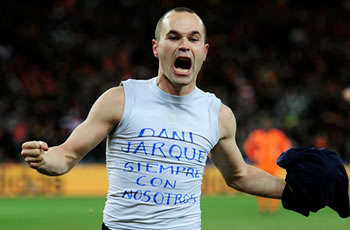
Hero of El Derbi Barcelones !


It’s a glorious coincidence, almost destiny, that Andres Iniesta’s last league game of 2010 will take place at Estadi Cornella-El Prat. There is absolutely no better way to celebrate the end of the historic year in Spanish football history than seeing San Andres treated to the most emotional reception by Espanyol supporters.
Iniesta is applauded at almost every ground in the country since scoring the winner in the World Cup Final against the Netherlands, and yet this one will be special. "Dani Jarque: siempre con nosotros” (always with us), the words on Iniesta’s shirt revealed moments after the ball met the net, are the most beautiful and most significant words ever to grace the biggest sporting event. They are the extract of true sportsmanship, they helped to make the world a better place.
Too many World Cup finals are remembered for wrong and negative reasons: Zinedine Zidane’s assault on Marco Materazzi (or vice versa, depending on which side you take), was the shameful scene in 2006; Ronaldo’s mysterious illness completely overshadowed the 1998 final, and remains a sad reminder that business is more important than sports for many key officials; 1994 was a drab affair between Brazil and Italy, the first ever final to feature no goals, and the first to be decided by the lottery of the shoot-out.
The 1990 final is always be remembered for the dreadful Argentinean side, and the dive by Rudi Voeller that finished them off. And 2010 was only minutes away from joining the list.It was destined to be an anti-climax to a poor tournament, ruined by defensive tactics and, more importantly, by the Jabulani disaster. Then came the moment that changed it all. The most memorable picture from South Africa is a positive one. Iniesta did it almost single-shirtedly. That shirt was presented to Espanyol president Daniel Sanchez Llibre last month.
Some would claim that Iniesta shouldn’t have been on the pitch in extra-time after his stupid retaliation on Mark Van Bommel. They are absolutely right. That was a red-card offence, but even the most passionate Oranje supporters must admit the game of football was lucky Howard Webb chose not to send him off. It could have been a victory for one of the dirtiest players ever. It could have made Van Bommel the new Zidane/Materazzi. Those could be the scenes forever engraved in or memories. Instead, Dani Jarque lifted the World Cup.
It must be mentioned that Iniesta was booked for taking his shift off. That should go down as the biggest travesty in the game. The man who made such a moving tribute to a departed friend was cautioned and given the same punishment Nigel De Jong got for his kung-fu kick on Xabi Alonso. If FIFA were sensible, the automatic yellow card for shirt-lifting would be abolished there and then. If Webb were a bit braver, he would follow his instincts and keep the card in his pocket. But that is just an afterthought. The booking didn’t really matter for San Andres at that moment.

For many, Iniesta became the symbol of honesty and modesty; of team unity and togetherness. When asked about his thoughts after the final whistle, he dedicated the win to Jarque again, and that was probably an even bigger tribute. It really felt like Spain had 24 players in their squad in South Africa. Maybe even 25, as Antonio Puerta was also paid homage by many players.
This is going to be a very special Saturday. Iniesta is about to take to the field Jarque didn’t live to play on. For many Espanyol supporters in the stands, their late captain will be wearing number 8 in Barcelona shirt. They will let him know about it. And then the curtain will fall on 2010, the year that belongs to the two friends, former team-mates in Spain's U-17, U-19, U-20 and U-21 selections.
Gracias, Andres! Gràcies, Andres! Thank you, Andres!

Saturday, December 11, 2010

Goal Exclusive :United Executives in Munich


Manchester United have opened talks over an £18 million move for Bayern Munich star Bastian Schweinsteiger after club officials flew out to Germany, Goal.com UK can reveal.

United executives held talks with Schweinsteiger's representatives in Munich on Thursday and were still in the German city on Friday as they look to beat Chelsea and Real Madrid to his signature next summer.
Schweinsteiger's contract at Bayern Munich expires in June 2012 and speculation has intensified over his future as he has so far rejected the German club's attempts to persuade him to sign a new contract.
United have indicated that they are willing to match Bayern's offer of £140,000-a-week in wages over a five-year contract, and Goal.com UK understands Schweinsteiger has indicated he is keen to take on a new challenge away from the Bundesliga.
A January deal has even been mooted in some quarters but Bayern are determined to do everything they can to convince Schweinsteiger to sign a new contract and will not entertain selling him until the summer. The Bavarian club have offered him a huge increase on his current £100,000-a-week deal and are ready to make him the highest paid player at the club.

Bayern president Uli Hoeness has said it is "incredibly important" for the club to keep the central midfielder but he could now be set for Old Trafford after holding secret talks with United officials at a Munich hotel.
Sir Alex Ferguson was not present at the clandestine meetings but the United manager has made the Germany World Cup star his number one transfer target as he looks to rebuild his squad next summer with a £50m transfer kitty.
The relationship between the two clubs is already frosty from the £17m deal that took Owen Hargreaves to United from the German club in the summer of 2007.
They could be heading for another clash as United look set to poach Schweinsteiger, who has spent his whole career at Bayern and, according to some reports, was close to signing a new deal with the Bavarian giants.
United were beaten to the signing of Mesut Oezil by Real Madrid last summer but are determined to land Schweinsteiger, who would cost a cut-price £18m next summer as Bayern would want to recoup some sort of transfer fee.
Ferguson has identified Schweinsteiger – known for his creative passing and drive – as the natural successor to Paul Scholes, who is 36 and closing in on retirement.
The German midfielder recently revealed that his brother constantly asks him to consider a move to United, and he could now be ready to leave Germany, where Bayern currently lie seventh in the league.
Defender Philipp Lahm, midfielder Franck Ribery and forward Thomas Mueller have all recently signed new deals to keep them at the Allianz Arena, but FC Hollywood now look set to lose Schweinsteiger.

Tuesday, November 30, 2010

Demoted Trio

Jermaine Jones, 13 Sep 08
The aftermath of Saturday's 5-0 loss to Kaiserslautern has gone from bad to worse for a trio of Schalke players. After opting to cut his team's winter break to just four days, coach Felix Magath has now demoted trio Jermaine Jones, Hans Sarpei and Alexander Baumjohann to the reserves.

"For Jones, it is due to his performance in the 5-0 loss, while Sarpei and Baumjohann did not show enough in training," Magath told reporters.
By contrast, Magath will soon have new options to choose from as long-term absentees Christian Pander and Levan Kenia have recovered from injuries and resumed training. Both are still well short of match fitness, but will hope to earn playing time before the mid-season break.
Known for ruling with an iron fist, Magath has struggled to consistently get the best out of a Schalke squad that has been markedly changed since last year. Over the last 10 days, die Koenigsblauen earned successive 4-0 and 3-0 victories over Bremen and Lyon respectively, but found their momentum come to a full stop in their most recent collapse against Kaiserslautern, which left Magath's men 15th in the Bundesliga standings.

@Goal.com
pic : Jermaine Jones

Monday, November 29, 2010

Magath To Cut Short Schalke Holidays


His discipline,manner and character has been highly influential for me.I think reaching sucess acqires certain  basic elements. Here's Goal.com news about recent decision made by Magath:

Schalke coach Felix Magath has previously been called 'Saddam' and 'Quaelix' (a mix of 'Felix' and 'quaelen', the German verb for 'to torture'). But now he might have earned a new nickname, 'The Grinch'. Following his team's 5-0 defeat to Kaiserslautern, the coach vowed to cut short his players' winter break.

"The winter holidays of Schalke players will be short," the club's official website read on Sunday. "They will start their holidays after the German Cup third round on December 21. It will end only four days later, with the first training session set for December 27."
The 2009-10 Bundesliga runners-up have struggled in domestic competition this year, and their worst defeat in 18 years left them in 15th place in the league table.
In the past, it has generally been the custom of Bundesliga teams to grant holidays until early January. However, Magath will look to drill his players into shape long before the January 15 Bundesliga restart.

Thursday, November 25, 2010

Not Alone


Umm,let's say it's ridiculous goodreads is filtered here so i decided to update the latest developments in my bookshelves here ! i added 6 books to my to-read shelf : 4 of them are persian translations of course:
1- The Age of Empire (1875 - 1914 ) : written by Eric Hobsbawm translated by Nahid Foroughan Akhtaran Publication
2-Flush : by Virginia Woolf, Oxford University Press
3- 18 Best Stories by Edgar Allan Poe  edited by Vincent Price and Chandler Brossard, Published by Dell Publishing
4-De la liberte' chez les Modernes:written by Benjamin Constant translated by Abdolvahhab Ahmadi ,Agah Publishing House
5-Hot Water Music by Charles Bukowski,translated by Bahman Kiarostami,Mahriz Publications
6-Budenbrooks written by Thomas Mann ,translated by Ali Asghar Haddad,Maahi Publications

Thursday, November 4, 2010

Leadership and Leitkultur


Since the end of August Germany has been roiled by waves of political turmoil over integration, multiculturalism and the role of the “Leitkultur,” or guiding national culture. This discourse is in turn reinforcing trends toward increasing xenophobia among the broader population.
These trends have been apparent for many years in studies and survey data that show a quiet but growing hostility to immigrants. Yet it is as though they have only now found a voice: the usual stereotypes are being flushed out of the bars and onto the talk shows, and they are echoed by mainstream politicians who want to capture potential voters who are otherwise drifting off toward the right. Two events have given rise to a mixture of emotions that are no longer easy to locate on the scale from left to right — a book by a board member of Germany’s central bank and a recent speech by the German president.
It all began with the advance release of provocative excerpts from “Germany Does Away With Itself,” a book that argues that the future of Germany is threatened by the wrong kind of immigrants, especially from Muslim countries. In the book, Thilo Sarrazin, a politician from the Social Democratic Party who sat on the Bundesbank board, develops proposals for demographic policies aimed at the Muslim population in Germany. He fuels discrimination against this minority with intelligence research from which he draws false biological conclusions that have gained unusually wide publicity.
In sharp contrast to the initial spontaneous objections from major politicians, these theses have gained popular support. One poll found that more than a third of Germans agreed with Mr. Sarrazin’s prognosis that Germany was becoming “naturally more stupid on average” as a result of immigration from Muslim countries.
After half-hearted responses in the press by a handful of psychologists who left the impression that there might be something to these claims after all, there was a certain shift in mood in the news media and among politicians toward Mr. Sarrazin. It took several weeks for Armin Nassehi, a respected sociologist, to take the pseudoscientific interpretation of the relevant statistics apart in a newspaper article. He demonstrated that Mr. Sarrazin adopted the kind of “naturalizing” interpretation of measured differences in intelligence that had already been scientifically discredited in the United States decades ago.
But this de-emotionalizing introduction of objectivity into the discussion came too late. The poison that Mr. Sarrazin had released by reinforcing cultural hostility to immigrants with genetic arguments seemed to have taken root in popular prejudices. When Mr. Nassehi and Mr. Sarrazin appeared at the House of Literature in Munich, a mob atmosphere developed, with an educated middle-class audience refusing even to listen to objections to Mr. Sarrazin’s arguments.
Amid the controversy, Mr. Sarrazin was forced to resign from the Bundesbank board. But his ouster, combined with the campaign against political correctness started by the right, only helped to strip his controversial arguments of their odious character. Criticism against him was perceived as an overreaction. Hadn’t the outraged chancellor, Angela Merkel, denounced the book without having read it? Wasn’t she now doing an about-face, by telling young members of her Christian Democratic Union party that multiculturalism was dead in Germany? And hadn’t the chairman of the Social Democrats, Sigmar Gabriel, the only prominent politician to counter the substance of Mr. Sarrazin’s claims with astute arguments, met with resistance from within his own party when he proposed expelling the unloved comrade?
The second disturbing media event in recent weeks was the reaction to a speech by the newly elected German president, Christian Wulff. As the premier of Lower Saxony, Mr. Wulff had been the first to appoint a German woman of Turkish origin as a member of his cabinet.
In his speech earlier this month on the anniversary of German unification, he took the liberty of reaffirming the commonplace notion, which former presidents had already affirmed, that not only Christianity and Judaism but “Islam also belongs in Germany.”
After the speech the president received a standing ovation in the Bundestag from the assembled political notables. But the next day the conservative press homed in on his assertion about Islam’s place in Germany. The issue has since prompted a split within his own party, the Christian Democratic Union. It is true that, although the social integration of Turkish guest workers and their descendants has generally been a success in Germany, in some economically depressed areas there continue to be problematic immigrant neighborhoods that seal themselves off from mainstream society. But these problems have been acknowledged and addressed by the German government. The real cause for concern is that, as the Sarrazin and Wulff incidents show, cool-headed politicians are discovering that they can divert the social anxieties of their voters into ethnic aggression against still weaker social groups.
The best example is Bavaria’s premier, Horst Seehofer, who has declared “immigrants from other cultures” to be detrimental and has called for a halt to immigration “from Turkey and Arab countries.” Although statistics show a net outflow of people of Turkish origin, Mr. Seehofer invokes the phobic image of unregulated masses of social parasites crowding into our welfare state networks as a way of building support for his own political aims.


Social and political developments in Germany, given its ghastly history, do not necessarily have the same significance as in other countries. So, are there grounds for concern that the “old” mindsets could undergo a revival?
It depends on what we mean by “old.” What we are seeing is not a revival of the mentalities of the 1930s. Instead, it is a rekindling of controversies of the early 1990s, when thousands of refugees arrived from the former Yugoslavia, setting off a debate on asylum seekers. The Christian Democratic Union and its Bavarian sister party, the Christian Social Union, then endorsed the position that Germany was “not a country of immigration.” At that time hostels for refugees went up in flames and even the Social Democrats gave ground, agreeing in Parliament to a shabby compromise on asylum law.
That dispute was already stimulated by the feeling of an endangered national culture, which had to assert itself as the leitkultur that all newcomers must follow. Yet the controversy of the 1990s was also driven by the fact that Germany had recently reunited and had reached the final stage in an arduous path toward a mentality that provides the necessary underpinning of a liberal understanding of the Constitution.
To the present day, the idea of the leitkultur depends on the misconception that the liberal state should demand more of its immigrants than learning the language of the country and accepting the principles of the Constitution. We had, and apparently still have, to overcome the view that immigrants are supposed to assimilate the “values” of the majority culture and to adopt its “customs.”
That we are experiencing a relapse into this ethnic understanding of our liberal constitution is bad enough. It doesn’t make things any better that today leitkultur is defined not by “German culture” but by religion. With an arrogant appropriation of Judaism — and an incredible disregard for the fate the Jews suffered in Germany — the apologists of the leitkultur now appeal to the “Judeo-Christian tradition,” which distinguishes “us” from the foreigners.
Nevertheless I do not have the impression that the appeals to the leitkultur signal anything more than a rearguard action or that the lapse of an author into the snares of the controversy over nature versus nurture has given enduring and widespread impetus to the more noxious mixture of xenophobia, racist feelings of superiority and social Darwinism. The problems of today have set off the reactions of yesterday — but not those of the day before.
I don’t underestimate the scale of the accumulated nationalistic sentiment, a phenomenon not confined to Germany. But in the light of current events, another trend is of greater concern: the growing preference for unpolitical figures on the political scene, which recalls a dubious trait of German political culture, the rejection of political parties and party politics.
During the parliamentary election of the federal president last summer, Joachim Gauck, the politically inexperienced and non-party-affiliated civil rights campaigner, stood as the opposing candidate to Mr. Wulff, the career politician. Against the majority in the electoral college, Mr. Gauck, a Protestant minister with a history of opposition to the old East German regime, won the hearts of the broader population, and almost won the election.
The same yearning for charismatic figures who stand above the political infighting can be seen in the puzzling popularity of the aristocratic defense minister, Karl-Theodor zu Guttenberg, who, with not much more than his family background, polished manners and a judicious wardrobe, has managed to overshadow Ms. Merkel’s reputation.


Of even greater concern is the sort of street protests we are now witnessing in Stuttgart, where tens of thousands of people have come out against the federal railway corporation’s plan to demolish the old central train station. The protests that have been continuing for months are reminiscent of the spontaneity of the extraparliamentary opposition of the 1960s. Unlike then, though, today people from all age groups and sectors of the population are taking to the streets. The immediate aim is a conservative one: preserving a familiar world in which politics intervenes as the executive arm of supposed economic progress.
In the background, however, there is a deeper conflict brewing over our country’s understanding of democracy. The state government of Baden-Württemberg, where Stuttgart is located, sees the protests narrowly, as simply a question of whether government is legally permitted to plan such long-term megaprojects. In the midst of the turmoil the president of the Federal Constitutional Court rushed to the project’s defense by arguing that the public had already voted to approve it 15 years ago, and thus had no more say in its execution.
But it has since emerged that the authorities did not, in fact, provide sufficient information at the time, and thus citizens did not have an opportunity to develop an informed opinion on which they could have based their votes. To insist that they should have no further say in the development is to rely on a formalistic understanding of democracy. The question is this: Does participation in democratic procedures have only the functional meaning of silencing a defeated minority, or does it have the deliberative meaning of including the arguments of citizens in the democratic process of opinion- and will-formation?
The motivations underlying each of the three phenomena — the fear of immigrants, attraction to charismatic nonpoliticians and the grass-roots rebellion in Stuttgart — are different. But they meet in the cumulative effect of a growing uneasiness when faced with a self-enclosed and ever more helpless political system. The more the scope for action by national governments shrinks and the more meekly politics submits to what appear to be inevitable economic imperatives, the more people’s trust in a resigned political class diminishes.
The United States has a president with a clear-headed political vision, even if he is embattled and now meets with mixed feelings. What is needed in Europe is a revitalized political class that overcomes its own defeatism with a bit more perspective, resoluteness and cooperative spirit. Democracy depends on the belief of the people that there is some scope left for collectively shaping a challenging future.


By : Jurgen Habermas
@NYTIMES
Image : Thilo Sarrazin
Thanks to Hossein for sharing the article