Showing posts with label Liverpool. Show all posts

Friday, February 11, 2011

Interview:Heartbeat of Barcelona and Spain

Barcelona's Xavi interviewed ahead of their Champions League match against Arsenal
Many have described Barcelona's 5-0 win over Real Madrid last November as the greatest performance ever. Even Wayne Rooney admits that he stood up in his living room and started applauding.

[Xavi's face lights up]. Yeah? Really? Rooney? That makes me proud. Rooney, wow! Rooney is extraordinary, he could play for Barcelona. And before people imagine headlines like "Xavi says Rooney to join Barcelona" – although, I'd love him to! – what I mean is that he's our kind of player. That game was wonderful, the best I've played. The feeling of superiority was incredible – and against Real Madrid! They didn't touch the ball. Madre mía, what a match! In the dressing room, we gave ourselves a standing ovation.
You mention Barcelona's dominance of possession. It's tempting to conclude that we've never seen a team with an identity – for better or worse – as clear as the current Barcelona and Spain teams. It's all about possession. And that's your identity – one that seems to have become dominant.
It's good that the reference point for world football right now is Barcelona, that it's Spain. Not because it's ours but because of what it is. Because it's an attacking football, it's not speculative, we don't wait. You pressure, you want possession, you want to attack. Some teams can't or don't pass the ball. What are you playing for? What's the point? That's not football. Combine, pass, play. That's football – for me, at least. For coaches, like, I don't know, [Javier] Clemente or [Fabio] Capello, there's another type of football. But it's good that Barcelona's style is now a model, not that.
But some claimed Spain were boring at the World Cup. You kept winning 1-0.
That's upside down. It's not that we were boring, it is the other team that was. What did Holland look for? Penalties. Or [Arjen] Robben on the break. Bam, bam, bam. Of course we were boring – the opposition made it that way. Paraguay? What did they do? Built a spectacularly good defensive system and waited for chances – from dead balls. Up it goes, rebound, loose ball. It's harder than people realise when you've got a guy behind you who's two metres tall and right on top of you.
So, what's the solution?
Think quickly, look for spaces. That's what I do: look for spaces. All day. I'm always looking. All day, all day. [Xavi starts gesturing as if he is looking around, swinging his head]. Here? No. There? No. People who haven't played don't always realise how hard that is. Space, space, space. It's like being on the PlayStation. I think shit, the defender's here, play it there. I see the space and pass. That's what I do.
That's at the heart of the Barcelona model and runs all the way through the club, doesn't it? When you beat Madrid, eight of the starting XI were youth-team products and all three finalists in this year's Ballon d'Or were too – Lionel Messi, Andrés Iniesta and you.
Some youth academies worry about winning, we worry about education. You see a kid who lifts his head up, who plays the pass first time, pum, and you think, 'Yep, he'll do.' Bring him in, coach him. Our model was imposed by [Johan] Cruyff; it's an Ajax model. It's all about rondos [piggy in the middle]. Rondo, rondo, rondo. Every. Single. Day. It's the best exercise there is. You learn responsibility and not to lose the ball. If you lose the ball, you go in the middle. Pum-pum-pum-pum, always one touch. If you go in the middle, it's humiliating, the rest applaud and laugh at you.
Your Barcelona team-mate Dani Alves said that you don't play to the run, you make the run by obliging team-mates to move into certain areas. "Xavi," he said, "plays in the future."
They make it easy. My football is passing but, wow, if I have Dani, Iniesta, Pedro, [David] Villa … there are so many options. Sometimes, I even think to myself: man, so-and-so is going to get annoyed because I've played three passes and haven't given him the ball yet. I'd better give the next one to Dani because he's gone up the wing three times. When Leo [Messi] doesn't get involved, it's like he gets annoyed … and the next pass is for him.
You're talking about style over success but not only can they go together, they have to go together, don't they? Arsenal play great football, Arsène Wenger is a hugely respected coach, but they've not won anything for years. Could that happen at Barcelona?
Almost impossible. If you go two years without winning, everything has to change. But you change names, not identity. The philosophy can't be lost. Our fans wouldn't understand a team that sat back and played on the break. Sadly, people only look at teams through success. Now, success has validated our approach. I'm happy because, from a selfish point of view, six years ago I was extinct; footballers like me were in danger of dying out. It was all: two metres tall, powerful, in the middle, knockdowns, second balls, rebounds … but now I see Arsenal and Villarreal and they play like us.
Do you see yourself as a defender of the faith? An ideologue?
It was that or die. I'm a romantic. I like the fact that talent, technical ability, is valued above physical condition now. I'm glad that's the priority; if it wasn't, there wouldn't be the same spectacle. Football is played to win but our satisfaction is double. Other teams win and they're happy, but it's not the same. The identity is lacking. The result is an impostor in football. You can do things really, really well – last year we were better than Inter Milan – but did not win. There's something greater than the result, more lasting. A legacy. Inter won the Champions League but no one talks about them. People discovered me since Euro 2008, but I've been playing the same way for years. It is true, though, that I have grown in confidence and tranquillity. And that comes with success.
Has English football suffered because it embraces a different footballing culture?
It has changed; the style's a bit more technical. But before it was direct, it was about the second ball, the typical No9 was a Crouch or a Heskey and there was no football. Carragher, boom, up top; Terry, boom, up top. I think it's changing: Barry, Lampard, Gerrard, Carrick … they are players who treat the ball well. You see them now and think, Christ, they are trying to play.
Is Paul Scholes the English Xavi?
[Xavi interrupts, almost bursting with enthusiasm] Paul Scholes! A role model. For me – and I really mean this – he's the best central midfielder I've seen in the last 15, 20 years. I've spoken to Xabi Alonso about him. He's spectacular, he has it all: the last pass, goals, he's strong, he doesn't lose the ball, vision. If he'd been Spanish he might have been rated more highly. Players love him.
England seems to mistrust technical players.
It's a pity. Talent has to be the priority. Technical ability. Always, always. Sure, you can win without it but it's talent that makes the difference. Look at the teams: Juventus, who makes the difference? Krasic. Del Piero. Liverpool? Gerrard, or Torres before. Talento. Talento. When you look at players and ask yourself who's the best: talento. Cesc, Nasri, Ryan Giggs – that guy is a joy, incredible. Looking back, I loved John Barnes and Chris Waddle was buenísimo. [Open-mouthed, eyes gleaming] Le Tissier! Although their style was different I liked Roy Keane and Paul Ince together, too. That United team was great – my English team. If I'd gone anywhere, it would have been there.
In England do we overrate physical players? You mention Carragher, Terry …
Whoa! Wait! Be careful. They're fundamental. We've got Puyol. Technically he might not be the best but it's incredible the way he defends. Carragher and Terry are necessary, brilliant, but they have to adapt to technical football [not the other way round]. For me, that comes naturally – or for Messi, Iniesta or Rooney. Others have to work at it. For them it's harder to lift their head up and play a pass – but they have to.
But when a player is offered to a club, the first question is: "how tall is he?"
Have you seen [the Villarreal winger] Santi Cazorla? You think I'm small, he's up to here on me [Xavi signals his chest]. And yet he's brilliant. Messi is the same and he's the best player in the world. Maybe it's the culture, I don't know, but in England you're warriors. You watch Liverpool and Carragher wins the ball and boots it into the stands and the fans applaud. There's a roar! They'd never applaud that here.
Next week you play Arsenal again in the Champions League last 16. Are they different? A kind of Barcelona-lite?
Arsenal are a great team. When I watch Arsenal, I see Barça. I see Cesc carry the game, Nasri, Arshavin. The difference between them and us is we have more players who think before they play, quicker. Education is the key. Players have had 10 or 12 years here. When you arrive at Barça the first thing they teach you is: think. Think, think, think. Quickly. [Xavi starts doing the actions, looking around himself.] Lift your head up, move, see, think. Look before you get the ball. If you're getting this pass, look to see if that guy is free. Pum. First time. Look at [Sergio] Busquets – the best midfielder there is playing one-touch. He doesn't need more. He controls, looks and passes in one touch. Some need two or three and, given how fast the game is, that's too slow. Alves, one touch. Iniesta, one touch. Messi, one touch. Piqué, one touch. Busi [Busquets], me … seven or eight players with one touch. Fast. In fact, [the youth coach] Charly [Rexach] always used to say: a mig toc. Half a touch.
Arsenal-Barcelona always provokes questions about Cesc Fábregas's future.
If I'd ever gone to another club, I'd have been thinking about Barcelona – the link is strong. The same is happening to him. But now there's a problem: now he's expensive. But I think that a footballer ends up playing where he wants. He has to end up here.
That's not what Arsenal fans want to hear and some have accused Barcelona players, you included, of stirring trouble. Last summer there were so many remarks supposedly coming out of Barcelona …
Really? I hardly spoke then. I imagine they wouldn't have liked that. [Xavi pauses, adding quietly, almost shamefacedly] You know, often footballers don't think. We're selfish, we don't realise. I also say it because I'm thinking of Cesc. He wants to come here. Barcelona has always been his dream. But of course he's Arsenal's captain, the standard bearer, a leader. This situation is a putada [bummer] for him. He's at a club that plays his style with Wenger who has treated him well, taught him, raised him. Cesc respects him. If he'd been at, say, Blackburn it might have been easier to leave. Look, the truth is: I want him to come here. Of course. Barcelona have a very clear style and not many footballers fit. It's not easy. But Cesc fits it perfectly.
Would he replace you, though?
I don't see new players as a threat; I don't say "this is my patch". I'm more: "bring them here, let them play". The more talent in the middle, the better. Four or five years ago [people said] me and Iniesta couldn't play together. We can't play together? Look how that one turned out.
Last year, you beat Arsenal comfortably …
Yes, but this year they're much better. I think it's a disadvantage for us that we played last year. They had [too] much respect for us. It was as if they let us have the ball; we always had it, home and away. The game in London could have been a 4-0 we dominated so much – but it finished 2-2. This year will be different.
What was your reaction to the draw?
I was happy. I like the fact that we'll see a great game. Arsenal aren't the kind of team that come to try to putear you [piss you off, break up the game, destroy the match]. If it was Chelsea, you might think Madre mía, they're going to leave the initiative to you, wait deep, close up, play on the break with Drogba and Malouda. But, no, I think Arsenal will want the ball. There will be more of a game. As a fan I'd definitely pay for a ticket to see this game. Manchester United or Chelsea would play in a more speculative way. They would leave us the ball. Arsenal won't.
Does English football attract you? Spanish players always return from there raving about it.
It's incredible. Una pasada. Now that is football. England really is the birthplace, the heart and soul of football. If Barcelona had Liverpool's fans, or Arsenal's, or United's, we'd have won 20 Champions Leagues, hahaha! OK, so that's an exaggeration but I've never seen anything like it. We won 3-1 at Liverpool once and we were both applauded off the pitch. In England, footballers are respected more, the game is more noble, there's less cheating. Every Spaniard who goes loves it – and comes back a better player. If I had ever left it would have been to England.
The final is at Wembley, which makes it even more special for Barcelona, doesn't it? Last year it was special because it was at the Bernabéu but Wembley is the scene of the Dream Team's one European Cup. And this feels like a year in which you are being constantly compared to them …
In 1992, I was 12 and my brothers went but my parents wouldn't let me. I was in tears but it made no difference. I'd love to play at Wembley. It's special for Barça – and for everyone in football. Last year was more morbosa [about the rivalry with Real Madrid, almost a little dirty, titillating]. This year is more nostalgic, more classic. And I'm more of a nostalgic. Me? I'm a romantic.
@Guardian
Photo : Solarpix.com

Tuesday, January 25, 2011

Berba : Artful Merit


As a keen artist in his spare time, Dimitar Berbatov recognises the power of imagery. So the Bulgarian will fully appreciate how two contrasting scenes illustrate his evolution into one of the stars of United’s 2010/11 campaign.

Two snapshots of Berbatov, taken five months apart, lay bare a United career dramatically rerouted from enigmatic to integral. Following a missed opportunity at Ewood Park last April, he cut a frustrated figure – prostrate, blinded by his own palms, his disappointment all too evident. Then, during September’s victory over Liverpool, having just scored his stunning overhead kick, he was a beaming hub of jubilance swamped by ecstatic colleagues.
Top scorer both for club and division, the striker's form has made him a mainstay of Sir Alex Ferguson’s side. A five-star show against Blackburn was only the third quintuple in United's history, he took his place in club folklore with the Reds' first hat-trick against Liverpool in 64 years and Saturday’s repeat against Birmingham made the striker only the seventh United player to reach three hat-tricks in the same season.
Those three goal-laden displays account for over half the striker’s total, but he has also popped up with vital solitary strikes to keep United’s points total clicking along apace. He’s looking entirely at home with the Reds’ quick-fire style of play, and his performances have had the effect of galvanising the rest of the team.
“Every club has a blueprint, an identity, and United’s is very strong,” says first-team coach Rene Meulensteen. “United stands for attacking, attractive football played at high speed, with one-touch passing combinations, individual skill and unpredictability. That’s all conducted at pace, with intent.”

It’s an approach which takes some getting used to, but Berbatov has found a way to suffuse his own unique talents with United’s well-established approach. Meulensteen is delighted with the huge impact made by the Bulgarian this season.
“Berba sees the art and beauty of bringing a ball down from 30 yards, then flicking it through for a team-mate with a back-heel,” says the Dutchman. “It’s an artistic approach which gives colour to the game and makes him colourful. He’s a vital ingredient to what the team is trying to achieve.
“I said to him once in training to think of himself as the best musician in the world, and as a team that we’re the best orchestra in the world. Everyone is playing the same tune – and Berba is elevating the whole performance. That’s why you are seeing beautiful things.”
The Bulgarian’s first two seasons after his switch from Spurs brought steady dividends (21 goals and 27 assists in 86 appearances) but Sir Alex Ferguson’s penchant for fielding Wayne Rooney as a lone striker ahead of a midfield trio meant he was often relegated to the substitutes’ bench for United’s bigger games – especially in the Champions League, where he started just three of the Reds’ 11 knockout ties in 2008/09 and 2009/10.
Late last term, United’s inability to pick up valuable domestic points in the injury-enforced absence of Rooney fanned the flames of transfer speculation. Given the sheer volume of big name, big money strikers linked, many media outlets suggested that Berbatov would be the unfortunate one to make room in the squad. Sir Alex’s riposte was brisk and blunt. Blue and white tickertape was still blustering around Stamford Bridge when the manager succinctly confirmed: “Dimitar will be staying here. I trust him.”

What the boss saw in his no.9 was incomparable control, vision and finesse – a skill set unlike that of any other player in the Premier League. The striker’s own response to the rumour mill was similarly unambiguous. Over the summer he maintained his fitness with regular running, and upon his return, increased his work with United’s strength and conditioning coaches. Self-belief has also been key to his move up to the next level of performance.
“You need to stay strong, believe in yourself and know what you can do,” the Bulgarian told Inside United in October. “There will be periods when you don’t feel so great, but you have your team-mates and manager who are always behind you. They always pat you on the back and say: ‘Don’t worry.’ It’s the same for every player, not just strikers.”
An impressive pre-season prompted further praise from Sir Alex, who said after the first warm-up game, against Celtic, “We know we have the right player.” After Berbatov’s Community Shield lob against Chelsea, the boss was even more effusive, labelling the striker “a genius”. And similar encouragement was forthcoming from within the dressing room. “We all know how good Dimitar is,” said Nemanja Vidic, while Darren Fletcher echoed: “He’s an important part of the team.”
According to Meulensteen, United’s inherent culture of rallying round one another for the greater good has played a huge part in Berbatov’s upsurge in confidence. “The good thing about this club is that, with the manager and the staff, there’s a massive loyalty to all the players,” says the Dutchman. “We bring them to the club because we know they can perform for us. So if they do have a difficult spell, they can fall back on us. That’s where we need to work harder to get them back to where they should be. That works and players feel that.

“You can rely on the people here, the people you’re training with, the staff, the manager and you all aim for the one thing: the best possible performance and results, and ultimately silverware.”
Berbatov’s treble in a five-star romp over Birmingham, allied to Manchester City’s defeat at Aston Villa, has given United marginally more breathing room in an enthralling Premier League title race - and Meulensteen says all United’s rivals should beware the Bulgarian as the season enters its nitty-gritty stage.
“Berba has been hugely important so far this season, and he’ll be key for the run-in,” says the Reds coach. “He wants to be key for the team, and he understands what he needs to do to be key for the team. And that’s clear in his performances and the goals that he’s scored. I want to see him with a medal around his neck and the biggest grin on his face at the end of the season, so he can look back and know that he’s really contributed so much to such a massive achievement.”
Should he end the current season a champion, Berbatov’s renaissance will be utterly complete – a triumph of heart for art’s sake.
@manutd.com

Saturday, October 16, 2010

John W Henry Seals Liverpool Takeover


New England Sports Ventures’ front man John W. Henry has revealed his delight after completing a £300 million takeover of Liverpool.

The 61-year-old, who also owns the Boston Red Sox baseball team, has reflected on the last week, which was bombarded with legal hurdles after former American owners Tom Hicks and George Gillett attempted to hold on to the Premier League club.

“It has been a dramatic few days, twists and turns, it's been stressful but finally we have it done and that was our goal and our hope," Henry told the club’s official website. "I'm extremely proud of this team that worked on this deal.

“We're incredibly pleased. Talking to all the partners in the States, they're extremely happy.”

The deal finally became official on Friday afternoon, however due to Hicks and Gillett’s legal accusations, Henry conceded he was not completely confident everything would go to plan and he admitted that, during the turmoil, he was worried NESV would be turned away from a sale.

He added: “There were many days where I was wondering whether or not we'd be going home. In fact, even today I wasn't a hundred per cent confident.

“There were days where I was confident but there were a lot of twists and turns here. It was a terrific team [Broughton, Ayre, Purslow] who did a tremendous job of managing this process and I'm just happy it ended successfully.”

The Illinois-born businessman revealed that similarities between the Boston Red Sox and Liverpool are what drew him into taking over the historic club.

“There are a lot of similarities and that was something we've been discussing as we started doing our due diligence. We found more and more similarities between Liverpool 2010 and the Red Sox of 2001.

“For instance the stadium issue was a big issue in Boston in 2001 and we went in there not knowing what we should do, whether we should build a new ball park or refurbish Fenway. We have the same issue here.

“We have to listen, learn, talk to the community, talk to the council, talk with the supporters, but the biggest issue of all is really what makes the most sense for Liverpool long term.”

The position of the club, on and off the field, has been dismal and Henry is under no illusion that it will be easy to bring back winning ways for the Reds.

He continued: “There's a lot of work to be done to get this club to where it needs to be in the grand scheme of things. We really, through all the work we've done over the last two months, saw the challenges and problems which exist and we've got to work to address those.

 “There is a great nucleus here off the field and on the field and we think we can build from that, but it's not going to be easy. We've got real challenges.”

While Liverpool fans have been welcome to the new owners, they have also expressed caution and uncertainty over another tenure of American ownership.

When Hicks and Gillet bought the Anfield outfit in 2007, promises were made by the duo that never came into fruition.

“It's been a tough three years and there were a lot of expectations created, so one thing I'm going to try not to do is to create a lot of expectations,” Henry admitted.

“I'm going to hopefully rather than make promises, deliver. When I say I, I mean New England Sports Ventures.

“We've got a very strong organisation, financially and otherwise, we have some terrific strategic thinkers and we're going to be attacking this head on starting tomorrow.”

“All I can say at this point is we're going to work as hard for you [Liverpool fans] as we possibly can and there's no doubt about it, you deserve it,” Henry continued.

“You have supported this club through the worst of times now and we're going to do everything in our power to make the supporters proud of their club and of us. It's a big challenge but I think we're up for that challenge.”


@GOAL.COM

Sunday, October 10, 2010

Seeking Ruthlessness


United fans got their money’s worth in terms of tension and entertainment in the first few weeks of the season, didn’t they?
Aye, but they shouldn’t have had the drama at Everton or Fulham. At Craven Cottage we missed a penalty kick with three minutes to go, which would have made it 3-1 and put the game out of sight. We threw points away there. And then it was even worse at Everton, where we threw away two goals in injury time. That’s unthinkable.
Losing late goals isn’t something you associate with the Reds. Was it as baffling for you as it was for the supporters?
It’s not like us to concede goals like that. This team doesn’t kill sides off as well as they should – that’s an area where I'd like to see an improvement. At Goodison we had three or four chances at 3-1 to put the game out of sight, but we were wasteful and paid the price. That killer instinct just isn’t there at the moment and it’s something we need to develop. That said, we haven’t had a problem scoring goals – we got three against Liverpool, Everton and West Ham, two at Fulham, three in the Community Shield; we don’t have difficulty finding the net. What we’re not doing, though, is killing teams off.
How do you address that?
The lessons learned are always important and I have no doubt the players have taken these setbacks on board. They suffer just as much – if not more – than the rest of us. They’re the ones throwing the points away and they’re the ones who know fine well that they’re good enough to win this league. So they don’t want to let themselves down. During the match, those on the sidelines – the fans, myself and my staff –perhaps feel the frustration more, but after the game, and for the next day or two, it’s the players who continue to hurt. They don’t like feeling that way, so they’ll take steps to ensure they don’t keep making the same mistakes. All the very best professionals, in any sport in the world, need two things – consistency and concentration. Those attributes are vital to success.


Have we already reached a stage where we can’t afford to drop any more points?
No, no, no. Every team is going to drop points – that’s inevitable. If you look at Chelsea’s start to the season, you’d have expected them to have won all those games, so the position they’re in doesn’t surprise me. Meanwhile, we’ve had tricky trips to Fulham and Everton then played Liverpool at home. Those are difficult matches. Liverpool, Arsenal and ourselves have all played top sides early on – Chelsea’s sterner tests are still to come.
Antonio Valencia suffered a bad injury against Rangers. How do we compensate for his absence from the side?
It’s a loss to lose any player but Antonio was probably the most improved squad member over the last 12 months, so it was a big blow. The development we saw from when he signed for us to the present day has been amazing. We thought it would take a couple of years for him to reach this level, but he took to the challenge like a duck to water. However, we’ve got a strong squad and we’ll cope. It’s up to Nani now to play his part, and he has done superbly this season, so he’ll offer us width. Then there’s also Gabriel Obertan and the boy Bebe, who’s training very well. We’re not too bad – we’ve got options.
Do you learn as much about a player on a cold night in Scunthorpe as you do when they play at Old Trafford against Liverpool?
Absolutely. In the last few years we’ve done really well in the Carling Cup. But it’s not only the fact that we’ve had success. We’ve been to Scunthorpe this season and we went to Barnsley last year, and it’s in those sorts of environments you learn about your squad. We fielded a lot of young players in the Carling Cup last time out, and they acquitted themselves admirably. The competition has served us well; it allows me to keep everybody happy in terms of giving them games and we’ve reached the last two finals, which has its obvious advantages. Playing at Wembley and competing on the big stage is terrific for player development.
You can’t beat the experience of winning trophies, can you?
No, you can’t, but going out in the early rounds – like we did against Coventry and Southend a few years ago – are also good experiences. We always prefer to win, but I remember when Coventry came to Old Trafford and beat us in 2007. Our lads simply forgot it was a cup tie and the penalty for a poor performance was getting knocked out. Coventry were very hungry and you have to say they deserved to win. That was a big lesson and it helps us now.


@insideunited

Wednesday, October 6, 2010

Fielding A Dream

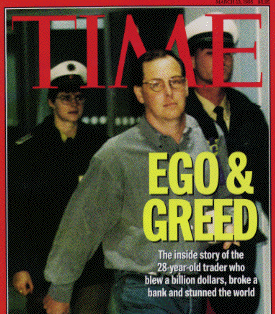
The Boston Red Sox completed one of the most storied seasons in baseball history in 2004 by coming back from a 3-0 deficit to defeat the New YorkYankees and then sweeping the St. Louis Cardinals in the World Series to break a“curse” dating back to 1918. As he has done with his trading, owner John Henry has infused his long-term thinking into the Red Sox system. It goes far beyond bringing in a left-handed pitcher to face a left-handed batter, to include selecting the right players and the right tactics for situations based on probabilities.
Henry is actively involved in both JWH, his money management firm, and the
Red Sox, but gives much of the credit for success in both areas to outstanding staff members such as Mark Rzepczynski, president of JWH, who has been with the firm since 1998, and the front office team of the Red Sox.Here's CME journal's interesting interview with John W. Henry:


CME: First of all, congratulations on your success with the Red Sox. It’s an amazing story. A lot of Clubs fans in Chicago wish they could have some of that magic.
JWH: Yes, it was a gratifying year.
CME: Let’s get right into your trading career.What got you interested in trading futures in the first place?
JWH: My father and mother were farmers in Arkansas. When my father died in thelate 1970s, I decided that I needed to understand agricultural markets. So I spent a few years studying markets, game theory and probability. I was immediately fascinated with market movements. I retain the same fascination today.
CME: You have been described in The New York Times and elsewhere as “a cerebral man with a head for mathematics.” But how did you learn to trade futures – books,trial-and-error . . . ?

JWH: Early on I read Reminiscences of a Stock Operator, the autobiography of Bernard Baruch, and the writing of W.D. Gann. I was particularly taken with Gann’s philosophy. I had been a student of philosophy and quickly began to find a bias toward trading philosophy over and above results. I always distrusted results in the commodity markets and eventually across all markets.Life is too dynamic to place a lot of credence in the past results of any program or any trader. I strongly felt that the key to success in markets over the very long term was in having a valid philosophy of the markets that could not be shaken by results over the short or intermediate term. I equated this with valid philosophies in other areas such as business principles that endure regardless of cycles. With any valid philosophy in any field, there are going to be periods in which doing the right thing every day appears to be counterproductive.
If Keynes said, “In the long run, we are all dead,” I would say, “Remaining true to your principles, if they are valid, will produce great results over the long run.”
CME: What were your early experiences in trading like? Did you start with big losses and then decide to figure out what trading was all about, as some well-known traders have done?
JWH: I started with a diversified portfolio called the “Original Program.” The first week of trading was in June of 1981. I was so confident in my research and philosophy that I left the country and left stops with my broker. After dinner one night in Oslo that first week, I saw a chart on the front page of the Financial Times. It was an amazing chart that showed the price of coffee had skyrocketed. I knew I was short.
I called my broker and he said, “You know, you are on to something. We’re limit up every day in coffee going against us, but we’ve made money every day you’ve been gone.”
CME: What markets did you trade in your early days?
JWH: Soybeans, 30-year U.S. bonds,gold, British pounds, Japanese yen,copper, wheat, sugar, coffee and cocoa at the very beginning.
CME: As you began to evolve as a trader, how did you develop your trend-following trading approach?
JWH: I did not have access to computers.PCs were just coming out. I didn’t have a desire to find the holy grail by testing different methodologies. I came up with a philosophy of very long-term trend-following. I knew the approach would be very profitable, but I also knew the nature of long-term trend-following is to have volatility.
CME: How has your basic approach changed over the years?
JWH: It hasn’t. Portfolios have changed as the markets have expanded. Programs have been added. But the basic philosophy is the same.
CME: How many different trading programs does JWH offer today?
JWH: JWH offers 11 different trading programs to investors. Our diversified portfolios are the Original Investment Program, Global Diversified Portfolio
and the Global Analytics Family of Programs. Our financial portfolios include the Financial and Metals Portfolio, Global Financial and Energy Portfolio and Worldwide Bond Program.
Our foreign exchange programs are the International Foreign Exchange Program, the G-7 Currency Portfolio and the Dollar Program. Additionally,we offer two trading programs that combine the others – the Strategic Allocation Program, which can invest in any of the other programs, and theCurrency Strategic Allocation Program,which limits itself to the foreignexchange-only programs.
CME: How do you “sell” your managed futures programs as an asset class to these clients?
JWH: The primary benefit of managed futures is the low historical correlation to traditional assets. Our programs have done especially well during periods of market stress or dislocation. This is when you have strong market trends. Our market selection and our investment methodology combine to give a return
stream that is unlike a traditional long only portfolio of equities and fixed income instruments.
CME: With the spectrum of instruments available, what is your view about trading futures instead of cash markets – specifically, in FX(Foreign Exchange)?
JWH: Futures offer a uniformity and transparency not found in many cash markets. That having been said, we have not been as active in FX futures markets. This is primarily due to the liquidity available in cash FX markets.Nevertheless, we have seen a significant increase in volume and liquidity at the CME from electronic trading. This is causing us to reevaluate our trading atthe CME, especially for any active trading program.

CME: What are the most significant changes that you have seen in futures trading and in managed futures since the early 1980s?
JWH: Electronic trading has been the most significant change in futures trading. It is so much easier to access the market and transact trades. The influx of competitors to the managed futures field has been significant to our industry. There are more managed futures managers and global macro managers who use futures as a means of diversification and profit opportunity.There also has been a shift of emphasis towards shorter time horizons for trading as a result of the decreasing execution costs. There is less emphasis on long-term trend-following, which is our specialty.
CME: What developments do you see coming in futures/options trading?
JWH: Technology’s emergence into a predominant position in our industry is something that is ongoing in our industry. Another development I see on the horizon is the return of markets that will look very different from the low-volatility situation to which many traders have become accustomed.
CME: What developments would you like to see in futures/options trading?
JWH: We are constantly looking for new markets to trade. With developments in electronics, the cost of entering new futures markets is much lower. We hope to see new products at CME.We also look forward to new market participants in futures trading. This clearly adds to liquidity,which is good for everyone.
CME: In view of your baseball success in addition to your trading success, we have to ask a couple of baseball questions.What was your baseball background as a player or coach?
JWH: I played second base in Little League. I set a strikeout record at the Chicago White Sox Boys Camp in 1960…as a hitter !
CME: What prompted you to get into baseball ownership?
JWH: The investment business can be very insular. Owning a baseball team deeply connects you to important aspects of a community. And if you are a sports fan, there can be no greater dream than to own a team and become a participant. Of course, I don’t make player decisions.I’m not qualified to run a baseball team. So I am fortunate to have a brilliant general manager and a tremendous CEO.
Buying the Red Sox and winning a World Series with great partners was a storybook opportunity and a great accomplishment for an organization that had come so close over many decades. I owned part of the Yankees for a decade, so I knew exactly what we were up against. It’s the greatest rivalry in sports. Being a lifetime baseball fan and having a great love for markets, I’m incredibly lucky to have the Red Sox and JWH.
CME: With such success in two diverse areas, what relationship do you see between successful trading and putting together a successful baseball team?
JWH: There are a number of dissimilarities that people don’t want to hear about. But there are a few principles that guide both the Red Sox and JWH.It’s important to have a plan, remain disciplined in executing that plan and pay attention to what is actually happening rather than what you expect to happen. We try to be as objective as possible in our analyses. I’m a stickler for that. Some may see objectivity as
impossible. But that’s why systematic approaches make sense. It’s not always easy for people who are involved every day to stay with a plan when misfortune occurs for a time.You always encounter the unexpected, and this can push discipline right out of the way in the name of prudence. But prudence almost always dictates staying with the approach that has made you successful. I see that as one of my primary roles. I often encourage everyone during difficult days to be patient.I don’t blame people for the unexpected.
Every time JWH struggles – and that is usually annually – people ask if the markets have changed. I always say,“Yes, the markets have changed. That is the nature of markets, and that is why we have been successful over the long term.The nature of trend-following is to adjust to changing market conditions.”


Sunday, September 19, 2010

Berbalove


september 19 2010
Pic : Manutd.com

Sunday, July 11, 2010

The Only Reason


New Chelsea signing Yossi Benayoun hit out at former Liverpool manager Rafael Benitez, accusing the Spaniard of making his time at Anfield a horrible experience.

Benitez left the Reds to join Inter Milan after a disastrous Premier League season which saw Liverpool failing to qualify for the Champions League next season.

The Israel international reveals that Benitez was the sole reason why he made a £5.5million move to Chelsea earlier this month.

"Everyone asks me why I left Liverpool," Benayoun toldThe News of the World.

"There is only one reason - Rafa Benitez.

"I agreed to join Chelsea before Roy Hodgson was appointed Liverpool's new manager.

"It's a dream for me such a fantastic club have given me this opportunity.

"But I want Liverpool fans to know the truth and for them to know I made up my mind to leave a long time ago because of Benitez.

"He never treated me with the respect I deserved. If I played well, I never felt he gave me credit.

"When I scored, I still expected to be out of the team the next game.

"And when the fans wanted me to play, Benitez told me he couldn't understand why."

The 30-year-old, who scored nine times for the Reds last season, revealed that there were many instances of mistreatment from Benitez.

"There are many examples of him treating me badly.

"On two occasions early last season, against Fulham and Lyon, the fans booed when I was subbed.

"They thought I was playing well but Benitez told me he was surprised the fans booed because I was not good enough.

"Then, when we played Birmingham after I hadn't started a game for a month, he didn't tell me I was starting until two hours before the game.

"He tried to destroy my confidence. You can't treat a player like this and expect him to be happy.

"I don't want to speak on behalf of other players at Liverpool, but people know what happened to Albert Riera and Xabi Alonso.

"It was the same for me. Benitez tried to break me like he broke Riera.”

Benayoun revealed that he was happy to leave once the Premier League champions made an offer for him and he could not take the chance of staying if Benitez ended up staying as well.

"On the day before the final game of last season at Hull, Benitez pulled me to one side after training and said: 'You will not be in the squad for this game. Thank you for your three years of service, now you can call your agent to do a deal with another club.'

"That's when Chelsea made an offer and the deal was done before Benitez left."

"I knew I had to get away from Benitez. A lot of people at Liverpool treated me well and asked me to stay, but I could not turn down such a massive club as Chelsea.

"I could not risk waiting to see if Benitez kept his job.

"The club said they understood why I was unhappy and promised they'd let me leave in the summer if an offer came while Benitez was manager.

The winger believes that Benitez leaving is great for the Reds, and said that playing in front of the Liverpool fans was an honour.


"It is good for Liverpool Benitez has gone, but it was too late for me.

"I know everyone working there will be a lot happier and I believe Roy Hodgson is a good choice.

"It was a privilege for me to play for such a great club in front of great fans. I thought I would be staying for a lot longer."


Anthony Sciarrino @ Goal.com

Tuesday, December 8, 2009

Hat trick


he continues to build hero status at United"