Showing posts with label Obama. Show all posts

Thursday, July 28, 2011

An Iconic Visit


"Had a tour around The White House. Unfortunately never met The President as he was locked in meetings but a great experience all the same."

Michael Owen on twitter
@Manutd.com

Wednesday, May 11, 2011

US Braced For Fights With Pakistanis

President Obama insisted that the assault force hunting down Osama bin Laden last week be large enough to fight its way out of Pakistan if confronted by hostile local police officers and troops, senior administration and military officials said Monday.

In revealing additional details about planning for the mission, senior officials also said that two teams of specialists were on standby: One to bury Bin Laden if he was killed, and a second composed of lawyers, interrogators and translators in case he was captured alive. That team was set to meet aboard a Navy ship, most likely the aircraft carrier Carl Vinson in the North Arabian Sea.
Mr. Obama’s decision to increase the size of the force sent into Pakistan shows that he was willing to risk a military confrontation with a close ally in order to capture or kill the leader of Al Qaeda.
Such a fight would have set off an even larger breach with the Pakistanis than has taken place since officials in Islamabad learned that helicopters filled with members of a Navy Seals team had flown undetected into one of their cities, and burst into a compound where Bin Laden was hiding.
One senior Obama administration official, pressed on the rules of engagement for one of the riskiest clandestine operations attempted by the C.I.A. and the military’s Joint Special Operations Command in many years, said: “Their instructions were to avoid any confrontation if at all possible. But if they had to return fire to get out, they were authorized to do it.”
The planning also illustrates how little the administration trusted the Pakistanis as they set up their operation. They also rejected a proposal to bring the Pakistanis in on the mission.

Under the original plan, two assault helicopters were going to stay on the Afghanistan side of the border waiting for a call if they were needed. But the aircraft would have been about 90 minutes away from the Bin Laden compound.
About 10 days before the raid, Mr. Obama reviewed the plans and pressed his commanders as to whether they were taking along enough forces to fight their way out if the Pakistanis arrived on the scene and tried to interfere with the operation.
That resulted in the decision to send two more helicopters carrying additional troops. These followed the two lead Black Hawk helicopters that carried the actual assault team. While there was no confrontation with the Pakistanis, one of those backup helicopters was ultimately brought in to the scene of the raid when a Black Hawk was damaged while making a hard landing.
“Some people may have assumed we could talk our way out of a jam, but given our difficult relationship with Pakistan right now, the president did not want to leave anything to chance,” said one senior administration official, who like others would not be quoted by name describing details of the secret mission. “He wanted extra forces if they were necessary.”
With tensions between the United States and Pakistan escalating since the raid, American officials on Monday sought to tamp down the divisions and pointed to some encouraging developments.
A United States official said that American investigators would soon be allowed to interview Bin Laden’s three widows, now being held by Pakistani authorities, a demand that Mr. Obama’s national security adviser, Thomas E. Donilon, made on television talk shows on Sunday.
American officials say the widows, as well as a review of the trove of documents and other data the Seals team collected from the raid, could reveal important details, not only about Bin Laden’s life and activities since he fled into Pakistan from Afghanistan in 2001, but also information about Qaeda plots, personnel and planning.
“We believe that it is very important to maintain the cooperative relationship with Pakistan precisely because it’s in our national security interest to do so,” said the White House spokesman, Jay Carney.
In an effort to help mend the latest rupture in relations, the C.I.A. director, Leon E. Panetta, will talk soon with his counterpart, Lt. Gen. Ahmad Shuja Pasha, head of the Inter-Services Intelligence Directorate, or ISI, “to discuss the way forward in the common fight against Al Qaeda,” an American official said.
On Sunday, Adm. Mike Mullen, the chairman of the Joint Chiefs of Staff, called the Pakistani Army chief, Gen. Ashfaq Parvez Kayani. “Mullen just wanted to check in with him,” said an American military official. “The conversation was civil, but sober, given the pressure that the general is under right now.”
In describing the mission, the officials said that American surveillance and reconnaissance aircraft were watching and listening to how Pakistan’s police forces and military responded to the raid. That determined how long the commandos could safely remain on the ground going through the compound collecting computer hard drives, thumb drives and documents.
American forces were under strict orders to avoid engaging with any Pakistani forces that responded to the commotion at the Bin Laden compound, senior administration officials said.
If a confrontation appeared imminent, there were contingency plans for senior American officials, including Admiral Mullen, to call their Pakistani counterparts to avert an armed clash.
But when he reviewed the plans, Mr. Obama voiced concern that this was not enough to protect the troops on the mission, administration officials said.
In planning for the possible capture of Bin Laden, officials decided they would take him aboard a Navy ship to preclude battles over jurisdiction.
The plan, officials said, was to do an initial interrogation for any information that might prevent a pending attack or identify the location of other Qaeda leaders.
“There was a heck of a lot of planning that went into this for almost any and all contingencies, including capture,” one senior administration official said.
In the end, the team organized to handle his death was called into duty. They did a quick forensics study of the body, washed it, and buried it at sea.
But the officials acknowledged that the mission always was weighted toward killing, given the possibility that Bin Laden would be armed or wearing an explosive vest.


By ERIC SCHMITT, THOM SHANKER and DAVID E. SANGER
@ NYTimes

Saturday, April 30, 2011

Appeals Court Overturns Stem Cell Research Ban


Opponents of taxpayer-funded stem cell research lost a key round in a U.S. appeals court Friday.

In a 2-1 decision, a panel of the court of appeals in Washington overturned a judge's order that would have blocked taxpayer funding for stem cell research. The judges ruled that opponents of taxpayer-funded stem cell research are not likely to succeed in their lawsuit to stop it.
The panel reversed an opinion issued last August by U.S. District Judge Royce Lamberth, who said the research likely violates the law against federal funding of embryo destruction.
"We're thrilled with this decision and look forward to allowing federally funded scientists to continue with their work without political constraints," said Sean Tipton, a spokesman for the American Society for Reproductive Medicine.
Researchers hope one day to use stem cells in ways that cure spinal cord injuries, Parkinson's disease and other ailments. Opponents say the research is a form of abortion because human embryos must be destroyed to obtain the stem cells.
The 1996 law prohibits the use of taxpayer dollars in work that harms an embryo, so private money has been used to cull batches of the cells. Those batches can reproduce in lab dishes indefinitely, and the Obama administration issued rules permitting taxpayer dollars to be used in work on them
The lawsuit was filed by two scientists who argued that President Obama's expansion jeopardized their ability to win government funding for research using adult stem cells — ones that have already matured to create specific types of tissues — because it will mean extra competition.

Lamberth, the chief judge of the U.S. District Court in Washington, issued a preliminary injunction in August to block the research while the case continued.
The Obama administration immediately appealed and requested the order be stopped. The appeals court quickly ruled that the research could continue at the National Institutes of Health while the judges took up the case.
The opinion tossing out Lamberth's ruling was written by Judge Douglas Ginsburg, nominated to the court by President Ronald Reagan, and supported by Judge Thomas Griffith, a nominee of President George W. Bush. The dissent came from Judge Karen LeCraft Henderson, a nominee of President George H.W. Bush; she agreed with the lower court judge that the lawsuit was likely to succeed.
As a result of the appellate ruling Friday, the original lawsuit can continue before Judge Lamberth, but the taxpayer-funded research also will go on. Lamberth hasn't thus far either held a trial or issued a final ruling, which he could do based on court filings without taking testimony.
Once the cells are culled, they can reproduce in lab dishes indefinitely. So government policies said using taxpayer dollars to work with the already-created batches of cells is allowed.
The Obama administration has expanded the number of stem cell lines created with private money that federally funded scientists could research, up from the 21 that President George W. Bush had allowed to at least 75 so far. To qualify, parents who donate the original embryo must be told of other options, such as donating to another infertile woman.
Congress twice passed legislation specifically calling for tax-funded stem cell research, which President Bush vetoed.

@AP
Pic : Judge Royce Lamberth

Tuesday, February 8, 2011

Turkey Figure

Prime Minister Recep Tayyip Erdogan of Turkey seems on a path to win his third election in a row, having effectively neutered a once-all-powerful military.
Arriving at a template that effectively integrates Islam, democracy and vibrant economics has been a near-impossible dream for Middle East reformers stretching back decades. To a large extent, Egypt’s inability to accommodate these three themes lies at the root of its current plight.
But no country in the region has come closer to accomplishing this trick, warts and all, than Turkey. As a result, diplomats and analysts have begun to present the still-incomplete Turkish experiment as a possible road map for Egypt.
“Turkey is the envy of the Arab world,” said Hugh Pope, project director for the Turkish office of the International Crisis Group. “It has moved to a robust democracy, has a genuinely elected leader who seems to speak for the popular mood, has products that are popular from Afghanistan to Morocco — including dozens of sitcoms dubbed into Arabic that are on TV sets everywhere — and an economy that is worth about half of the whole Arab world put together.”
The idea is not new. President Obama’s first trip as president to a Muslim country was to Turkey in April 2009, and he hailed its progress as a Middle East model. (His visit there preceded his better-remembered speech in Cairo by two months.)
Since then, the already wide distance separating these countries has grown. Turkey’s economy and its internationally competitive companies are expanding at a relentless pace. Meanwhile, its mildly Islamist prime minister, Recep Tayyip Erdogan, seems on a path to win his third election in a row, having effectively neutered a once-all-powerful military apparatus long seen as the guardian of secularism in the country.
It has not always been this way.
Indeed, when Hosni Mubarak came to power in Egypt in October 1981, after the assassination of President Anwar el-Sadat, Turkey was still being governed by its army, which one year earlier intervened to impose a sense of order on the country’s fractious political scene.
But while Mr. Mubarak, a military man himself, banked upon authoritarian rule, paying only lip service to democratic institutions and running rigged elections, the general behind the Turkish coup, Kenan Evren, moved to withdraw from politics. The constitution he imposed left the military considerable scope to meddle in political affairs, but it allowed civilian institutions to bloom.
On the economic front Egypt maintained state control, with many restrictions on foreign trade and domestic competition. By contrast, Turkey, which hopes to join the European Union, has opened up its economy and unleashed a dynamic private sector.
Today, with similarly sized populations of about 80 million, Turkey has an economy that is nearly four times the size of Egypt’s.
Its recent growth spurt has been driven by Mr. Erdogan, who came to power in 2003 and focused first on reducing deficits and bringing down inflation. Only after he demonstrated success in raising living standards did he feel confident enough to overcome opposition from the determinedly secular army and the cosmopolitan elite in Istanbul by introducing elements of Islam into Turkish public life.
He has been rewarded with broad popular support at home — demonstrated in September when Mr. Erdogan easily won a referendum that further diluted the military’s powers — and growing influence abroad.
In responding to the Egypt crisis, President Obama telephoned Prime Minister Erdogan twice in six days to discuss the unfolding events, and administration officials say they have been keeping in close contact with their Turkish counterparts at all levels.
“There’s no question that Turkey can play a role,” one administration official said. The official, speaking on grounds of anonymity, noted that Mr. Erdogan and Turkish leaders had publicly called for Mr. Mubarak to listen to what the protesters on the streets of Cairo had been saying — words that might have heartened democracy advocates in the Muslim world.
Turkey’s ability to thrive as a predominantly Muslim country that maintains diplomatic relations — though chilly — with Israel is one that American officials would like to see other Muslim nations develop.
But it is also true that actions taken by the Erdogan government against the Turkish news media have been a cause for some concern, a point made recently by the new American ambassador to Turkey, Francis J. Ricciardone Jr., who was ambassador to Egypt from 2005 to 2008.
With the Egyptian military likely to play the role of political guarantor in any transition from Mr. Mubarak’s rule, analysts suggest that Turkey might serve as a model for introducing new political parties, writing a constitution from scratch and ultimately stepping aside and letting the democratic process play out (as uncomfortable as that might be) — all of which the Turkish military has done since the 1980 coup.
“The military did not overplay its hand in Turkey,” said Soner Cagaptay, an analyst at the Washington Institute for Near East Policy. Mr. Cagaptay also said that even though Mr. Erdogan had made gains in pushing his Islamist agenda, the military served as an effective restraint.
“The relative moderation of Islamic parties in Turkey is due to the military,” he said.
There are still substantial differences between the countries. For the Turkish military, its organizing philosophy has always been preserving the secularist traditions that Turkey’s post-World War I founder, Kemal Ataturk, set in place. In Egypt, while the Muslim Brotherhood has been officially banned, the army has been seen more as the defender of the authoritarian status quo rather than secularism itself.
How the military in Egypt deals with the Muslim Brotherhood — by far the most powerful civic force in the country — will be crucial in determining the country’s political future.
Can it, as was the case in Turkey, encourage the formation of competing political parties? And can it encourage the moderate elements of the Muslim Brotherhood to come to the fore rather than its more militant factions?
Turkey may have a more direct role to play on that front. Mr. Erdogan’s party has already established ties to the Muslim Brotherhood — a result of Mr. Erdogan’s long and successful campaign to present himself as a dominant and increasingly anti-Israeli voice in the Middle East.
According to research by Dore Gold at the Jerusalem Center for Public Affairs, three members of the Muslim Brotherhood — two of whom serve in the Egyptian Parliament — were on the Turkish-sponsored ship that was attacked by Israeli forces on its way to deliver aid to the Gaza Strip in May.
“There is a great deal of ideological compatibility between the A.K.P. and the Muslim Brotherhood,” said Mr. Gold, a former top adviser to Prime Minister Benjamin Netanyahu of Israel, referring to Mr. Erdogan’s Justice and Development Party. “This is something to watch carefully.”
Perhaps, but in the end that could be a plus rather than a minus.
For all his Islamist sympathies, Mr. Erdogan is at root a pragmatist. As a young firebrand he was jailed for his antisecular rhetoric but now, after working within Turkey’s democratic framework rather than outside it, he is recognized as perhaps the Middle East’s most influential figure.

by : Landon Thomas Jr.

Monday, January 17, 2011

Condition Upgraded To Serious


In yet another sign of significant recovery during a remarkable week, the condition of gravely wounded Rep. Gabrielle Giffords was upgraded from critical to serious Sunday after a procedure to remove her from a ventilator was successful.
Giffords has responded from the moment she arrived at the emergency room Jan. 8, at first just squeezing a doctor’s hand. Then she raised two fingers. She opened her unbandaged eye shortly after President Obama’s bedside visit Wednesday. Then, more milestones – which doctors said were all indicative of higher cognitive function – were achieved, all with her husband, astronaut Mark Kelly, at her side.
Kelly asked her to give him a thumbs-up if she could hear him. She did more than that. She slowly raised her left arm. By the end of the week, she had moved her legs and arms.
At the hospital, more than 100 people were gathered amid a sea of get-well balloons and cards when the University of Arizona put out a statement upgrading her condition.
“Oh, that’s great news,” said Jean Emrick, a 50-year resident of Tucson, as a violinist played in the background. “Tucson is such a special place, and she represents what’s the best of southern Arizona.”
Doctors decided to upgrade her condition because a tracheotomy done a day earlier was uneventful, hospital spokeswoman Katie Riley said. A feeding tube was also put in Saturday.
Giffords and 18 others were shot when a gunman opened fire at an event she was hosting outside a supermarket in her hometown. Six people died.
A week after the shootings, more details emerged about a victim who police said became distraught and was arrested during a town hall meeting Saturday evening.
James Eric Fuller, a self-described liberal and military veteran, started ranting at the end of the program. He took a picture of a local Tea Party leader and yelled, “You’re dead,” before calling others in the church “whores,” police said.
Deputies called a doctor and decided he should be taken to a hospital for a mental evaluation, Pima County sheriff’s spokesman Jason Ogan said.
The man Fuller is accused of threatening, Tucson Tea Party co-founder Trent Humphries, said he was worried about the threat and the dozens of other angry e-mails he has received.
Source :AP

Saturday, December 18, 2010

WikiLeaks: Pope wanted Muslim Turkey kept out of EU (?)

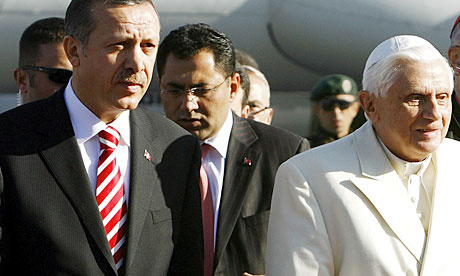
A WikiLeaks cable reports that Pope Benedict XVI, seen here being received by Turkish prime minister Recep Tayyip Erdogan in Ankara in 2006, 'might prefer to see Turkey develop a special relationship short of EU membership'.


The pope is responsible for the Vatican’s growing hostility towards Turkey joining the EU, previously secret cables sent from the US embassy to the Holy See in Rome claim.

In 2004 Cardinal Ratzinger, the future pope, spoke out against letting a Muslim state join, although at the time the Vatican was formally neutral on the question.
The Vatican’s acting foreign minister, Monsignor Pietro Parolin, responded by telling US diplomats that Ratzinger’s comments were his own rather than the official Vatican position.

The cable released by WikiLeaks shows that Ratzinger was the leading voice behind the Holy See’s unsuccessful drive to secure a reference to Europe’s “Christian roots” in the EU constitution. The US diplomat noted that Ratzinger “clearly understands that allowing a Muslim country into the EU would further weaken his case for Europe’s Christian foundations”.
But by 2006 Parolin was working for Ratzinger, now Pope Benedict XVI, and his tone had distinctly chilled. “Neither the pope nor the Vatican have endorsed Turkey’s EU membership per se,” he told the American charge d’affaires, “rather, the Holy See has been consistently open to accession, emphasising only that Turkey needs to fulfil the EU’s Copenhagen criteria to take its place in Europe.”
But he did not expect the demands on religious freedom to be fulfilled: “One great fear is that Turkey could enter the EU without having made the necessary advances in religious freedom. [Parolin] insisted that EU members – and the US – continue to press the [Turkish government] on these issues … He said that short of ‘open persecution’, it couldn’t get much worse for the Christian community in Turkey.”
The cables reveal the American government lobbying within Rome and Ankara for Turkish EU membership. “We hope a senior department official can visit the Holy See and encourage them to do more to push a positive message on Turkey and integration,” concluded the 2006 cable.
But by 2009, the American ambassador was briefing in advance of President Barack Obama’s visit, that “the Holy See’s position now is that as a non-EU member the Vatican has no role in promoting or vetoing Turkey’s membership. The Vatican might prefer to see Turkey develop a special relationship short of membership with the EU.”
Roman Catholicism is the only religion in the world with the status of a sovereign state, allowing the pope’s most senior clerics to sit at the top table with world leaders. The cables reveal the Vatican routinely wielding influence through diplomatic channels while sometimes denying it is doing so. The Vatican has diplomatic relations with 177 countries and has used its diplomatic status to lobby the US, United Nations and European Union in a concerted bid to impose its moral agenda through national and international parliaments.
The US charge d’affaires D Brent Hardt told Parolin, his diplomatic counterpart in Rome, of “the Holy See’s potential to influence Catholic countries to support a ban on human cloning” to which Parolin emphasised his agreement with the US position and promised to support fully UN efforts for such a ban.
On other global issues such as climate change, the Vatican sought to use its moral authority as leverage, while refusing itself to sign formal treaties, such as the Copenhagen accord, that require reporting commitments.
At a meeting in January this year Dr Paolo Conversi, the pope’s representative on climate change at the Vatican’s secretariat of state, told an American diplomat that the Vatican would “encourage other countries discreetly to associate themselves with the accord as opportunities arise”.
The Americans noted that Conversi’s offer to support the US, even if discreetly, was significant because the Vatican was often reluctant to appear to compromise its independence and moral authority by associating itself with particular lobbying efforts.
“Even more important than the Vatican’s lobbying assistance, however, is the influence the pope’s guidance can have on public opinion in countries with large Catholic majorities and beyond.”
The cables also reveal that the Vatican planned to use Poland as a trojan horse to spread Catholic family values through the structures of the European Union in Brussels.
The then US ambassador to the Holy See, Francis Rooney, briefed Washington in 2006, shortly after the election of Pope Benedict XVI, that “the Holy See hopes that Poland will hold the line at the EU on ‘life and family’ issues that arise” and would serve as a counterweight to western European secularism once the country had integrated into the EU.
The cable notes that Pope Benedict is preoccupied with Europe’s increasing psychological distance from its Christian roots.
“He has continued to focus on Poland’s potential in combating this trend. This was one of the themes of the visit of several groups of Polish bishops to the Vatican at the end of last year [2005]. ‘It’s a topic that always comes up,’ explained Monsignor Michael Banach, the Holy See minister of foreign affairs country director for Poland. He told us that the two sides recognised that the Polish bishops needed to exert leadership in the face of western European secularism.”
Across the Atlantic, the Vatican has told the Americans it wants to undermine the Venezuelan president, Hugo Chávez, in Latin America because of worries about the deterioration of Catholic power there. It fears Chávez is seriously damaging relations between the Catholic church and the state by identifying the church hierarchy as part of the privileged class.
Monsignor Angelo Accattino, in charge of Caribbean and Andean matters for the Vatican, said Obama should reach out to Cuba “in order to reduce the influence of Chávez and break up his cabal in Latin America”.In December last year, America’s adviser for western Europe at the UN, Robert Smolik, said the Vatican observer was “as always active and influential behind the scenes” and “lobbied actively and influentially in the corridors and in informal consultations, particularly on social issues”.
In 2001 another American diplomat to the Vatican stated: “The Holy See will continue to seek to play a role in the Middle East peace process while denying this intention.”


Source : Guardian

Thursday, December 9, 2010

Hacker Threatens More Attacks On WikiLeaks Foes

On Thursday, a man identifying himself as one of the activists from a group called Anonymous, who used the pseudonym Coldblood in an interview with BBC radio, said: “This campaign is not over from what I’ve seen. It’s still going strong.” The speaker had an English accent and said he was a 22-year-old software engineer with no specific political loyalty.
Within 12 hours of a British judge’s decision on Tuesday to deny Mr. Assange bail in a Swedish extradition case, attacks on the Web sites of WikiLeaks’s “enemies,” as defined by the organization’s impassioned supporters around the world, caused several corporate Web sites to become inaccessible or slow down markedly.
Targets of the attacks, in which activists overwhelmed the sites with traffic, included the Web site of MasterCard, which had stopped processing donations for WikiLeaks; Amazon.com, which revoked the use of its computer servers; and PayPal, which stopped accepting donations for Mr. Assange’s group. Visa.com was also affected by the attacks, as were the Web sites of the Swedish prosecutor’s office and the lawyer representing the two women whose allegations of sexual misconduct are the basis of Sweden’s extradition bid.
The Internet assaults underlined the growing reach of self-described “cyberanarchists,” antigovernment and anticorporate activists who have made an icon of Mr. Assange, a 39-year-old Australian.
Though Reuters said that no major Web sites appeared to be under attack early Thursday, a Swedish newspaper, Aftonbladet, reported that the Swedish government’s Web site had gone down briefly during the night.
The speed and range of the attacks appeared to show the resilience of the backing among computer activists for Mr. Assange, who has appeared increasingly isolated in recent months amid the furor stoked by WikiLeaks’s posting of hundreds of thousands of secret Pentagon documents on the wars in Afghanistan and Iraq.
Mr. Assange has come under renewed attack in the past two weeks for posting the first tranche of a trove of 250,000 secret State Department cables that have exposed American diplomats’ frank assessments of relations with many countries, forcing Secretary of State Hillary Rodham Clinton to express regret to world leaders and raising fears that they and other sources would become more reticent.
The New York Times and four other news organizations last week began publishing articles based on the archive of cables made available to them.
In recent months, some of Mr. Assange’s closest associates in WikiLeaks abandoned him, calling him autocratic and capricious and accusing him of reneging on WikiLeaks’s original pledge of impartiality to launch a concerted attack on the United States. He has been simultaneously fighting a remote battle with the Swedish prosecutors, who have sought his extradition for questioning on accusations of “rape, sexual molestation and forceful coercion” made by the Swedish women. Mr. Assange has denied any wrongdoing in the cases.
American officials have repeatedly said that they are reviewing possible criminal charges against Mr. Assange, a step that could lead to a bid to extradite him to the United States and confront him with having to fight for his freedom on two fronts.
The cyberattacks in Mr. Assange’s defense appear to have been coordinated by Anonymous, a loosely affiliated group of activist computer hackers who have singled out other groups before, including theChurch of Scientology. Last weekend, members of Anonymous vowed in two online manifestos to take revenge on any organization that lined up against WikiLeaks.
Anonymous claimed responsibility for the MasterCard attack in Web messages and, according to one activist associated with the group, conducted waves of attacks on other companies during the day. The group said the actions were part of an effort called Operation Payback, which began as a way of punishing companies that tried to stop Internet file-sharing and movie downloads.
The activist, Gregg Housh, who disavows a personal role in any illegal online activity, said that 1,500 supporters had been in online forums and chat rooms organizing the mass “denial of service” attacks. His account was confirmed by Jose Nazario, a senior security researcher at Arbor Networks, a Chelmsford, Mass., firm that tracks malicious activity on computer networks.
Most of the corporations whose sites were targeted did not explain why they severed ties with WikiLeaks. But PayPal issued statements saying its decision was based on “a violation” of its policy on promoting illegal activities.
Almost all the corporate Web sites that were attacked appeared to be operating normally later on Wednesday, suggesting that any economic impact was limited. But the sense of an Internet war was reinforced when Netcraft, a British Internet monitoring firm, reported that the Web site being used by the hackers to distribute denial-of-service software had been suspended by a Dutch hosting firm, Leaseweb.
A sense of the belligerent mood among activists was given when one contributor to a forum the group uses, WhyWeProtest.net, wrote of the attacks: “The war is on. And everyone ought to spend some time thinking about it, discussing it with others, preparing yourselves so you know how to act if something compels you to make a decision. Be very careful not to err on the side of inaction.”
Mr. Housh acknowledged that there had been online talk among the hackers of a possible Internet campaign against the two women who have been Mr. Assange’s accusers in the Swedish case, but he said that “a lot of people don’t want to be involved.”
A Web search showed new blog posts in recent days in which the two women, identified by the Swedish prosecutors only as Ms. A. and Ms. W., were named, but it was not clear whether there was any link to Anonymous. The women have said that consensual sexual encounters with Mr. Assange became nonconsensual when he stopped using condoms.
The cyberattacks on corporations Wednesday were seen by many supporters as a counterstrike against the United States. Mr. Assange’s online supporters have widely condemned the Obama administration as the unseen hand coordinating efforts to choke off WikiLeaks by denying it financing and suppressing its network of computer servers.
Mr. Housh described Mr. Assange in an interview as “a political prisoner,” a common view among WikiLeaks supporters who have joined Mr. Assange in condemning the sexual abuse accusations as part of an American-inspired “smear campaign.”
Another activist used the analogy of the civil rights struggle for the cyberattacks.
“Are they disrupting business?” a contributor using the name Moryath wrote in a comment on the slashdot.org technology Web site. “Perhaps, but no worse than the lunch counter sit-ins did.”


John Markoff and Ashlee Vance contributed reporting from San Francisco, and Alan Cowell from Paris.
NYTIMES

Monday, December 6, 2010

Cables Disclosed

Some of the cables, made available to The New York Times and several other news organizations, were written as recently as late February, revealing the Obama administration’s exchanges over crises and conflicts. The material was originally obtained by WikiLeaks, an organization devoted to revealing secret documents. WikiLeaks posted 220 cables, some redacted to protect diplomatic sources, in the first installment of the archive on its Web site on Sunday.
The disclosure of the cables is sending shudders through the diplomatic establishment, and could strain relations with some countries, influencing international affairs in ways that are impossible to predict.
Secretary of State Hillary Rodham Clinton and American ambassadors around the world have been contacting foreign officials in recent days to alert them to the expected disclosures. A statement from the White House on Sunday said: “We condemn in the strongest terms the unauthorized disclosure of classified documents and sensitive national security information.”
The White House said the release of what it called “stolen cables” to several publications was a “reckless and dangerous action” and warned that some cables, if released in full, could disrupt American operations abroad and put the work and even lives of confidential sources of American diplomats at risk. The statement noted that reports often include “candid and often incomplete information” whose disclosure could “deeply impact not only U.S. foreign policy interests, but those of our allies and friends around the world.”
The cables, a huge sampling of the daily traffic between the State Department and some 270 embassies and consulates, amount to a secret chronicle of the United States’ relations with the world in an age of war and terrorism. Among their revelations, to be detailed in The Times in coming days:


A dangerous standoff with Pakistan over nuclear fuel: Since 2007, the United States has mounted a highly secret effort, so far unsuccessful, to remove from a Pakistani research reactor highly enriched uranium that American officials fear could be diverted for use in an illicit nuclear device. In May 2009, Ambassador Anne W. Patterson reported that Pakistan was refusing to schedule a visit by American technical experts because, as a Pakistani official said, “if the local media got word of the fuel removal, ‘they certainly would portray it as the United States taking Pakistan’s nuclear weapons,’ he argued.”


Thinking about an eventual collapse of North Korea: American and South Korean officials have discussed the prospects for a unified Korea, should the North’s economic troubles and political transition lead the state to implode. The South Koreans even considered commercial inducements to China, according to the American ambassador to Seoul. She told Washington in February that South Korean officials believe that the right business deals would “help salve” China’s “concerns about living with a reunified Korea” that is in a “benign alliance” with the United States.


Bargaining to empty the Guantánamo Bay prison: When American diplomats pressed other countries to resettle detainees, they became reluctant players in a State Department version of “Let’s Make a Deal.” Slovenia was told to take a prisoner if it wanted to meet with President Obama, while the island nation of Kiribati was offered incentives worth millions of dollars to take in Chinese Muslim detainees, cables from diplomats recounted. The Americans, meanwhile, suggested that accepting more prisoners would be “a low-cost way for Belgium to attain prominence in Europe.”


Suspicions of corruption in the Afghan government: When Afghanistan’s vice president visited the United Arab Emirates last year, local authorities working with the Drug Enforcement Administration discovered that he was carrying $52 million in cash. With wry understatement, a cable from the American Embassy in Kabul called the money “a significant amount” that the official, Ahmed Zia Massoud, “was ultimately allowed to keep without revealing the money’s origin or destination.” (Mr. Massoud denies taking any money out of Afghanistan.)


A global computer hacking effort: China’s Politburo directed the intrusion into Google’s computer systems in that country, a Chinese contact told the American Embassy in Beijing in January, one cable reported. The Google hacking was part of a coordinated campaign of computer sabotage carried out by government operatives, private security experts and Internet outlaws recruited by the Chinese government. They have broken into American government computers and those of Western allies, the Dalai Lama and American businesses since 2002, cables said.


Mixed records against terrorism: Saudi donors remain the chief financiers of Sunni militant groups like Al Qaeda, and the tiny Persian Gulf state of Qatar, a generous host to the American military for years, was the “worst in the region” in counterterrorism efforts, according to a State Department cable last December. Qatar’s security service was “hesitant to act against known terrorists out of concern for appearing to be aligned with the U.S. and provoking reprisals,” the cable said.


 intriguing alliance: American diplomats in Rome reported in 2009 on what their Italian contacts described as an extraordinarily close relationship between Vladimir V. Putin, the Russian prime minister, and Silvio Berlusconi, the Italian prime minister and business magnate, including “lavish gifts,” lucrative energy contracts and a “shadowy” Russian-speaking Italian go-between. They wrote that Mr. Berlusconi “appears increasingly to be the mouthpiece of Putin” in Europe. The diplomats also noted that while Mr. Putin enjoyed supremacy over all other public figures in Russia, he was undermined by an unmanageable bureaucracy that often ignored his edicts.


Arms deliveries to militants: Cables describe the United States’ failing struggle to prevent Syria from supplying arms to Hezbollah in Lebanon, which has amassed a huge stockpile since its 2006 war with Israel. One week after President Bashar al-Assad promised a top State Department official that he would not send “new” arms to Hezbollah, the United States complained that it had information that Syria was providing increasingly sophisticated weapons to the group.


Clashes with Europe over human rights: American officials sharply warned Germany in 2007 not to enforce arrest warrants for Central Intelligence Agency officers involved in a bungled operation in which an innocent German citizen with the same name as a suspected militant was mistakenly kidnapped and held for months in Afghanistan. A senior American diplomat told a German official “that our intention was not to threaten Germany, but rather to urge that the German government weigh carefully at every step of the way the implications for relations with the U.S.”
The 251,287 cables, first acquired by WikiLeaks, were provided to The Times by an intermediary on the condition of anonymity. Many are unclassified, and none are marked “top secret,” the government’s most secure communications status. But some 11,000 are classified “secret,” 9,000 are labeled “noforn,” shorthand for material considered too delicate to be shared with any foreign government, and 4,000 are designated both secret and noforn.
Many more cables name diplomats’ confidential sources, from foreign legislators and military officers to human rights activists and journalists, often with a warning to Washington: “Please protect” or “Strictly protect.”
The Times, after consultations with the State Department, has withheld from articles and removed from documents it is posting online the names of some people who spoke privately to diplomats and might be at risk if they were publicly identified. The Times is also withholding some passages or entire cables whose disclosure could compromise American intelligence efforts. While the White House said it anticipated WikiLeaks would make public “several hundred thousand” cables Sunday night, the organization posted only 220 released and redacted by The Times and several European publications.
The cables show that nearly a decade after the attacks of Sept. 11, 2001, the dark shadow of terrorism still dominates the United States’ relations with the world. They depict the Obama administration struggling to sort out which Pakistanis are trustworthy partners against Al Qaeda, adding Australians who have disappeared in the Middle East to terrorist watch lists, and assessing whether a lurking rickshaw driver in Lahore, Pakistan, was awaiting fares or conducting surveillance of the road to the American Consulate.
They show officials managing relations with a China on the rise and a Russia retreating from democracy. They document years of effort to prevent Iran from building a nuclear weapon — and of worry about a possible Israeli strike on Iran with the same goal.
Even when they recount events that are already known, the cables offer remarkable details.
For instance, it has been previously reported that the Yemeni government has sought to cover up the American role in missile strikes against the local branch of Al Qaeda. But a cable’s fly-on-the-wall account of a January meeting between the Yemeni president, Ali Abdullah Saleh, and Gen. David H. Petraeus, then the American commander in the Middle East, is breathtaking.
“We’ll continue saying the bombs are ours, not yours,” Mr. Saleh said, according to the cable sent by the American ambassador, prompting Yemen’s deputy prime minister to “joke that he had just ‘lied’ by telling Parliament” that Yemen had carried out the strikes.
Mr. Saleh, who at other times resisted American counterterrorism requests, was in a lighthearted mood. The authoritarian ruler of a conservative Muslim country, Mr. Saleh complains of smuggling from nearby Djibouti, but tells General Petraeus that his concerns are drugs and weapons, not whiskey, “provided it’s good whiskey.”
Likewise, press reports detailed the unhappiness of the Libyan leader, Col. Muammar el-Qaddafi, when he was not permitted to set up his tent in Manhattan or to visit ground zero during a United Nations session last year.
The cables also disclose frank comments behind closed doors. Dispatches from early this year, for instance, quote the aging monarch of Saudi Arabia, King Abdullah, as speaking scathingly about the leaders of Iraq and Pakistan.
Speaking to another Iraqi official about Nuri Kamal al-Maliki, the Iraqi prime minister, King Abdullah said, “You and Iraq are in my heart, but that man is not.” The king called President Asif Ali Zardari of Pakistan the greatest obstacle to that country’s progress. “When the head is rotten,” he said, “it affects the whole body.”
The American ambassador to Eritrea reported last year that “Eritrean officials are ignorant or lying” in denying that they were supporting the Shabab, a militant Islamist group in Somalia. The cable then mused about which seemed more likely.
As he left Zimbabwe in 2007 after three years as ambassador, Christopher W. Dell wrote a sardonic account of Robert Mugabe, that country’s aging and erratic leader. The cable called him “a brilliant tactician” but mocked “his deep ignorance on economic issues (coupled with the belief that his 18 doctorates give him the authority to suspend the laws of economics).”
The possibility that a large number of diplomatic cables might become public has been discussed in government and media circles since May. That was when, in an online chat, an Army intelligence analyst, Pfc. Bradley Manning, described having downloaded from a military computer system many classified documents, including “260,000 State Department cables from embassies and consulates all over the world.” In an online discussion with Adrian Lamo, a computer hacker, Private Manning said he had delivered the cables and other documents to WikiLeaks.
Mr. Lamo reported Private Manning’s disclosures to federal authorities, and Private Manning was arrested. He has been charged with illegally leaking classified information and faces a possible court-martial and, if convicted, a lengthy prison term.
In July and October, The Times, the British newspaper The Guardian and the German magazine Der Spiegel published articles based on documents about Afghanistan and Iraq. Those collections were placed online by WikiLeaks, with selective redactions of the Afghan documents and much heavier redactions of the Iraq reports.


Fodder for Historians


Traditionally, most diplomatic cables remain secret for decades, providing fodder for historians only when the participants are long retired or dead. The State Department’s unclassified history series, titled “Foreign Relations of the United States,” has reached only 1972.
While an overwhelming majority of the quarter-million cables provided to The Times are from the post-9/11 era, several hundred date from 1966 to the 1990s. Some show diplomats struggling to make sense of major events whose future course they could not guess.
In 1989, an American diplomat in Panama City mulled over the options open to Gen. Manuel Noriega, the Panamanian leader, who was facing narcotics charges in the United States and intense domestic and international political pressure to step down. The cable called General Noriega “a master of survival”; its author appeared to have no inkling that one week later, the United States would invade Panama to unseat General Noriega and arrest him.
In 1990, an American diplomat sent an excited dispatch from Cape Town: he had just learned from a lawyer for Nelson Mandela that Mr. Mandela’s 27-year imprisonment was to end. The cable conveys the momentous changes about to begin for South Africa, even as it discusses preparations for an impending visit from the Rev. Jesse L. Jackson.
The voluminous traffic of more recent years — well over half of the quarter-million cables date from 2007 or later — show American officials struggling with events whose outcomes are far from sure. To read through them is to become a global voyeur, immersed in the jawboning, inducements and penalties the United States wields in trying to have its way with a recalcitrant world.
The cables have their own lexicon: “codel,” for a Congressional delegation; “visas viper,” for a report on a person considered dangerous; “démarche,” an official message to a foreign government, often a protest or warning.
But the drama in the cables often comes from diplomats’ narratives of meetings with foreign figures, games of diplomatic poker in which each side is sizing up the other and neither is showing all its cards.
Among the most fascinating examples recount American officials’ meetings in September 2009 and February 2010 with Ahmed Wali Karzai, the half brother of the Afghan president and a power broker in the Taliban’s home turf of Kandahar.
They describe Mr. Karzai, “dressed in a crisp white shalwar kameez,” the traditional dress of loose tunic and trousers, appearing “nervous, though eager to express his views on the international presence in Kandahar,” and trying to win over the Americans with nostalgic tales about his years running a Chicago restaurant near Wrigley Field.
But in midnarrative there is a stark alert for anyone reading the cable in Washington: “Note: While we must deal with AWK as the head of the Provincial Council, he is widely understood to be corrupt and a narcotics trafficker.” (Mr. Karzai has denied such charges.) And the cables note statements by Mr. Karzai that the Americans, informed by a steady flow of eavesdropping and agents’ reports, believe to be false.
A cable written after the February meeting coolly took note of the deceit on both sides.
Mr. Karzai “demonstrated that he will dissemble when it suits his needs,” the cable said. “He appears not to understand the level of our knowledge of his activities. We will need to monitor his activity closely, and deliver a recurring, transparent message to him” about the limits of American tolerance.


Not All Business


Even in places far from war zones and international crises, where the stakes for the United States are not as high, curious diplomats can turn out to be accomplished reporters, sending vivid dispatches to deepen the government’s understanding of exotic places.
In a 2006 account, a wide-eyed American diplomat describes the lavish wedding of a well-connected couple in Dagestan, in Russia’s Caucasus, where one guest is the strongman who runs the war-ravaged Russian republic of Chechnya, Ramzan Kadyrov.
The diplomat tells of drunken guests throwing $100 bills at child dancers, and nighttime water-scooter jaunts on the Caspian Sea.
“The dancers probably picked upwards of USD 5000 off the cobblestones,” the diplomat wrote. The host later tells him that Ramzan Kadyrov “had brought the happy couple ‘a five-kilo lump of gold’ as his wedding present.”
“After the dancing and a quick tour of the premises, Ramzan and his army drove off back to Chechnya,” the diplomat reported to Washington. “We asked why Ramzan did not spend the night in Makhachkala, and were told, ‘Ramzan never spends the night anywhere.’ ”

Saturday, October 30, 2010

The Challenge Hypothesis


When Barack Obama won the American presidency in 2008 his supporters cheered, cried, hugged—and in many cases logged onto their computers to look at pornography( :))  ). And, lest Republicans crow about the decadence of their opponents, precisely the obverse happened when their man won in 2004.
That, at least, is the conclusion of a study by Patrick Markey of Villanova University, in Pennsylvania, and his wife Charlotte, who works at Rutgers, in New Jersey. The Markeys were looking for confirmation of a phenomenon called the challenge hypothesis. This suggests that males involved in a competition will experience a rise in testosterone levels if they win, and a fall if they lose.

The challenge hypothesis was first advanced to explain the mating behaviour of monogamous birds. In these species, males’ testosterone levels increase in the spring, to promote aggression against potential rivals. When the time comes for the males to settle down and help tend their young, their testosterone falls, along with their aggressive tendencies.
Something similar has since been found to apply to fish, lizards, ring-tailed lemurs, rhesus monkeys, chimpanzees—and humans. In many of these animals, though, there is a twist. It is not just that testosterone ramps up for breeding and ramps down for nurturing. Rather, its production is sensitive to a male’s success in the breeding competition itself. In men, then, levels of the hormone rise in preparation for a challenge and go up even more if that challenge is successfully completed. Failure, by contrast, causes the level to fall


Previous research has found these hormonal ups and downs in male wrestlers, martial artists, tennis players, chess players and even people playing a coin-flip game. In evolutionary terms, it makes sense. If a losing male continues to be aggressive, the chances are he will be seriously injured (it is unlikely natural selection could have foreseen competitive coin-tossing). Turning down his testosterone level helps ward off that risk. Conversely, the winner can afford to get really dominant, as the threat of retaliation has receded.
For most species, determining that this actually happens requires a lot of boring fieldwork. But the Markeys realised that in the case of people they could cut the tedium by asking what was going on in those parts of the web that provide a lot more traffic than their users will ever admit to, on the assumption that men fired up by testosterone have a greater appetite for pornography than those who are not.
To do this they first used a web service called WordTracker to identify the top ten search terms employed by people seeking pornography (“xvideos” was the politest among them). Then they asked a second service, Google Trends, to analyse how often those words were used in the week before and the week after an American election, broken down by state.
Their results, just published in Evolution and Human Behavior, were the same for all three of the elections they looked at—the 2004 and 2008 presidential contests, and the 2006 mid-terms (in which the Democrats made big gains in both houses of Congress). No matter which side won, searches for porn increased in states that had voted for the winners and decreased in those that had voted for the losers. The difference was not huge; it was a matter of one or two per cent. But it was consistent and statistically significant.
If the polls are right, then, next Tuesday’s mid-term elections will see red faces in the red states for those furtive surfers who are caught in the act. In the blue states, meanwhile, a fit of the blues will mean the screens stay switched off.

Tuesday, October 26, 2010

About Tea Party


It was an interesting article published yesterday clarifying the identity of under the spotlight Tea Party,how it spawned and who particularly it is canvassing for.Slight amendments were made in the original article.
Pedram


In an unruly, unpredictable and chaotic election year, no group has asserted its presence and demanded to be heard more forcefully than the tea party. The grass-roots movement that was spawned with a rant has gone on to upend the existing political order, reshaping the debate in Washington, defeating a number of prominent lawmakers and elevating a fresh cast of conservative stars.

But a new Washington Post canvass of hundreds of local tea party groups reveals a different sort of organization, one that is not so much a movement as a disparate band of vaguely connected gatherings that do surprisingly little to engage in the political process.
.
Seventy percent of the grass-roots groups said they have not participated in any political campaigning this year. As a whole, they have no official candidate slates, have not rallied behind any particular national leader, have little money on hand, and remain ambivalent about their goals and the political process in general.
"We're not wanting to be a third party," said Matt Ney, 55, the owner of a Pilates studio and a founder of the Pearland Tea Party Patriots in Pearland, Tex. "We're not wanting to endorse individual candidates ever. What we're trying to do is be activists by pushing a conservative idea."
The group, with 25 active members, meets to discuss policies and listen to speakers, Ney said. "We provide opportunities for like-minded people to get together," he said.
The local groups stand in contrast to - and, in their minds, apart from - a handful of large national groups that claim the tea party label. Most of those outfits, including FreedomWorks and Tea Party Express, are headed by longtime political players who have used their resources and know-how to help elect a number of candidates.
The findings suggest that the breadth of the tea party may be inflated. The Atlanta-based Tea Party Patriots, for example, says it has a listing of more than 2,300 local groups, but The Post was unable to identify anywhere near that many, despite help from the organization and independent research In all, The Post identified more than 1,400 possible groups and was able to verify and reach 647 of them. Each answered a lengthy questionnaire about their beliefs, members and goals. The Post tried calling the others as many as six times. It is unclear whether they are just hard to reach or don't exist.
Mark Meckler, a founding member of the Tea Party Patriots, said: "When a group lists themselves on our Web site, that's a group. That group could be one person, it could be 10 people, it could come in and out of existence - we don't know. We have groups that I know are 15,000 people, and I have groups that I know are five people."
'We can't always agree'
There is little agreement among the leaders of various groups about what issue the tea party should be most concerned about. In fact, few saw themselves as part of a coordinated effort.
The most common responses were concerns about spending and limiting the size of government, but together those were named by less than half the groups. Social issues, such as same-sex marriage and abortion rights, did not register as concerns.
If anything tied the groups together, it was what motivated their members to participate. Virtually all said that
economic concerns were a factor, and nearly as many cited a general mistrust of government. Opposition to President Obama and Democratic policies was a big factor, but only slightly more so than dissatisfaction with mainstream Republican leaders.Eleven percent said that Obama's race, religion or ethnic background was either a "very important" or "somewhat important" factor in the support their group has received.
While the tea party groups may lack a unifying direction or vision at the moment, the results show that they are ripe for action. A remarkable 86 percent of local leaders said most of their members are new to political activity, suggesting that they could be turned into a potent grass-roots force heading into the 2012 elections.
Of course, their general lack of interest in politics also suggests that they could just as easily recede, particularly if the economy improves.
The tea party's biggest successes this year have come only after one of a handful of well-funded national groups swooped in to mobilize local support. In upset victories in Alaska and Delaware, for instance, the Sacramento-based Tea Party Express spent hundreds of thousands of dollars on advertising for Republican Senate candidates Joe Miller and Christine O'Donnell, respectively.
Other national groups, such as FreedomWorks and Americans for Prosperity, have also built organizations and spent millions of dollars on advertising, high-profile bus tours or other direct campaign tactics.
Some of the local group leaders may find such tactics distasteful. Fifty-seven percent said they want to operate as a network of independent entities. And many organizers said the lack of coordination and the independence of the groups are what drew them to the movement, even if it is a liability when it comes to turning their beliefs into action.
"It's both an advantage and a disadvantage," said Joe Lisante, 43, a family doctor and a founder of Miami County Liberty, a group near Dayton, Ohio.
"If you're an opponent of the tea party, we're not an easy target," he said. "Some of the groups want to take on prayer in school. Some of them want to take on voter education. Some want to be endorsing candidates. But there is no particular person, at least in the state of Ohio, who is the president of the tea party; it just doesn't exist. That's a disadvantage for us because we can't move quickly on things. We can't always agree."

Many of the groups that were interviewed claim hundreds of members and some boast thousands, but most said they have fewer than 50. A number of them appear to be limited to family or friends - the Northern Connecticut Patriots, for instance, counts seven members; the Southeast Wyoming Tea Party Patriots has one.
Jeff Lafferty, a landscaper in Cheyenne, Wyo., said he formed the Southeast Wyoming Tea Party Patriots in April after growing increasingly concerned about such federal actions as the bank bailouts and the stimulus bill. But Lafferty attracted just one person to his only meeting, in part because a 9/12 Project tea party group in Cheyenne was already active, he said. Moreover, he said he has since grown disillusioned with the movement and the signs that some of its members are motivated by racism against Obama. Not only is his group no longer functioning, he said, but it "never was."
Donna Riner, 52, a medical practice manager, founded the five-member San Carlos Tea Party, in San Diego, which has met just once. "I just invited friends and family members," Riner said. "I wanted them to know what the tea party represents. It's about smaller government and less taxes. I wanted them to go on the national lists and join and give money to some of the big groups that support the people I believe in."
The tea party has been accused of racism by its political opponents after comments from some prominent members and signs at several major rallies this year that attacked Obama for either his race or the false belief that he is a Muslim. At rallies, for instances, organizers have kicked out questionable members and have sought to project a more tolerant image.
But the interviews found that Obama's race is, in fact, important in more than one in 10 tea party groups.
Andy Stevens, 68, a video producer and a founder of the Tea Party Patriots in Anacortes, Wash., said he described Obama's race and and religion as "somewhat important" to members of his group because they remain troubled by what they see as the president's un-American and un-Christian behaviors.
In Stevens's view, those include Obama's "socialist" policies and intentional failure to mention "the creator" when talking about inalienable rights.
"There are questions that don't get answered, like citizenship and his birth certificate," Stevens said. "I don't know why questions keep popping up all the time. If something is irrefutable, the questions wouldn't keep popping up."
The groups clearly do not identify with any particular national leaders, an indication that there is no tea party front-runner to take on Obama in 2012. When asked to name a national leader who best represents their views, more than a third of the groups said "no one."
Former Alaska governor Sarah Palin (R) received the most mentions, with 14 percent, followed by talk-show host Glenn Beck with 7 percent and South Carolina Sen. Jim DeMint (R) with 6 percent.
One question remains: If most tea party groups don't engage in political campaigning, what exactly do they do?
Lisante, from Miami County, Ohio, said his meetings generally start with the Pledge of Allegiance, followed by a prayer, and then a speaker and a skit - the most recent was about the bank bailout. (Lisante said it was very funny.) The point, he said, is not to organize political action but to educate members and encourage them to become active on their own.
"Basically, we say: 'Listen, guys: You can no longer be the one who doesn't vote,' " Lisante said. " 'If you want to have an impact, you've got to show up.' "


@WashingtonPost