Title: How Proust Can Change Your Life
Author: Alain de Botton
I read "How Proust Can Change Your Life": Another great book by swiss Alain de Botton way back in February. It's an exceptional talent that makes the most difficult issues understandable for the reader. The book introduces several dimensions of Proust's works and life; a blend of literary biography and psychology manual Focusing on some simple facts in his life. I understand the author has opted superficiality at times to underline some particular themes, it might affect some die hard fans of Proust but i presume this direction is wisely chosen by de Botton. Actually the book can be the optimum choice as an intro to Proust's world.
Showing posts with label Culture. Show all posts
Showing posts with label Culture. Show all posts
Friday, May 11, 2012


Saturday, May 5, 2012
The Life of David Gale
I watched Alan Parker’s “The Life of David Gale” on my
vacation. It was an intriguing movie considering the plot and the convincing
job by Kevin Spacey and Kate Winslet. Unfortunately I must mention
some weak points which appeared as fumbles to me. In such a real and tense
context (including issues like rape, murder and suicide), some over-dramatic and scenes coupled with ultra-moralist blah blah damaged the picture.
The movie is not coy about the anti-death penalty message. Unfortunately this
overdid hampered the outstanding dynamic of the movie. The main characters are
well executed and presented, however the peripheral ones are poorly dramatized. One exception
is Constance Harraway (Laura Linney),
Gale’s colleague and close friend, which is well portrayed. Gale/Harraway relationship evolves
in a comprehensible manner and dramatically contribute to the whole story.
Laura Linney handled the complex role of Constance excellently. The final third
of the movie was shocking to me. It appears that all false inquests were part
of a bigger plan; a series of self-intended acts such as euthanasia or serving as an innocent
convicted to execution, etc. All and all serve Gale and Harraway social/political plan to hit
out at pro-death penalty officials. The result is a heart-wrenching drama.
pedram, April 2012
Sunday, June 19, 2011
هرجایی
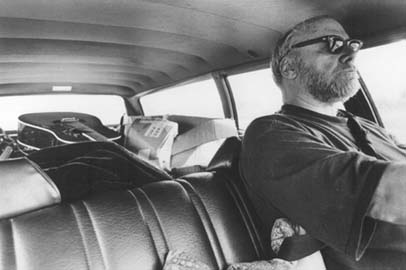
تقاطع گیشا - آل احمد ، ساعت 7 صبح ، سوارماشین هستم در مسیر
بیمارستان... به ناگهان یک ماشین از لاین خودش منحرف می شه می آید در مسیر من ، من مجبور می شوم ناگهان ترمز بگیرم . ماشین پشت سر من هم به همین ترتیب....در این بین ماشین پشت سری به شدت پیگیر این موضوع میشود وبا مهارت خاص ایرانی از من سبقت می گیرد...دختر و پسر جوانی در ماشین هستند.پسرکه پشت رل است به سمت من بر می گردد و بلند داد و فریاد می کند. البته نمی فهمم چه می گوید بعید میدانم اگر شیشه ی ماشین پایین بود و صدای گیتار جان فیهی هم اجازه می داد و همه ی توجهم را هم می دادم ، باز هم چیزی درک می کردم . نفهمیدم چی گفت : راستش این روز ها از کمتر حرفی که می شنوم سر در می آورم .دختر هم خیره شده است به جلو گویا فیلمی را تماشا می کند. زیر پل پارک می کنم .به طور اتفاقی می بینم که همان ماشین بیرون پارکینگ ،زیر پل نگه داشته است و دختر و پسر لحظات ملکوتی جدایی را می گذرانند. واقعا خوشحالم اگر امروز باعث شدم یک دختر به دوست پسرش افتخار کند یا به هرشکلی به شکل گیری هر اتفاقی در هر جایی کمک کردم
photo: John Fahey by Bettina Herzner
Monday, May 9, 2011
Beyond Revenge

it's an interesting article ,psychological analysis of ecstatic joy after Bin Laden's death/Pedram
Some Americans celebrated the killing of Osama bin Laden loudly, with chanting and frat-party revelry in the streets. Others were appalled — not by the killing, but by the celebrations.“It was appropriate to go after Bin Laden, just to try to cut the head off that serpent, but I don’t think it’s decent to celebrate a killing like that,” said George Horwitz, a retired meat cutter and Army veteran in Bynum, N.C.
Others were much more critical. “The worst kind of jingoistic hubris,” a University of Virginia student wrote in the college newspaper, The Cavalier Daily. In blogs and online forums, some people asked: Doesn’t taking revenge and glorying in it make us look just like the terrorists?
The answer is no, social scientists say: it makes us look like human beings. In an array of research, both inside laboratories and out in the world, psychologists have shown that the appetite for revenge is a sensitive measure of how a society perceives both the seriousness of a crime and any larger threat that its perpetrator may pose.
Revenge is most satisfying when there are strong reasons for exacting it, both practical and emotional.
“Revenge evolved as a deterrent, to impose a cost on people who threaten a community and to reach into the heads of others who may be contemplating similar behavior,” said Michael McCullough, a psychologist at the University of Miami and author of “Beyond Revenge: The Evolution of the Forgiveness Instinct” (Jossey-Bass, 2008). “In that sense it is a very natural response.”
Many of the sources of the joyous outburst were obvious: A clear victory after so many drawn-out conflicts. A demonstration of American competence, and of consequences delivered. The public relations value of delivering a public blow to a worldwide terror network. And, it needs to be said, the timing: The news hit just as many bars were starting to clear out for the night.
But this was much more than a simple excuse to party.
“Pure existential release,” said Tom Pyszczynski, a social psychologist at the University of Colorado at Colorado Springs, who has studied reactions to 9/11. “Whether or not the killing makes any difference in the effectiveness of Al Qaeda hardly matters; defeating an enemy who threatens your worldview, the very values you believe are most protective, is the quickest way to calm existential anxiety.”
After almost 10 years, the end was nothing if not final. “The emotions were so strong, I think, because the event was compacted: Bin Laden was found and killed, and it was done — done and over, just like that,” said Kevin Carlsmith, a social psychologist at Colgate University and the Center for Advanced Study in the Behavioral Sciences at Stanford. “We’re so used to people being brought in, held at Guantánamo, the trials, the appeals; it feels like justice is never done.”
As a rule, people are far more forgiving than they might guess, studies find. After most betrayals, like being dumped by a love interest or insulted, the urge for revenge erodes around the same rate that certain memories do: sharply in the first few weeks, and much more slowly afterward. The same kind of pattern can follow even physical assaults, depending on the circumstances and the personality of the victim.
“The intensity of the emotion falls off precipitously, simply because the body can’t carry such a giant load of outrage and function very well,” Dr. McCullough said.
But the urge for payback — especially for a crime like the Sept. 11, 2001, attacks, which killed almost 3,000 civilians — never goes to zero. “There is a stubborn part of the memory that hangs on to the urge, to a little piece of it,” and the pain is refreshed every time the memory is recalled, Dr. McCullough said.
It is easy to forget how much fear was in the air after the 9/11 attacks: the anthrax mailings, the airport lines, the color-coded terror alerts. Many of those celebrating late on Sunday and early Monday were teenagers during those years, young people who have lived much of their lives under the threat of terrorism — and this terrorist in particular — and who had the time and energy to hit the streets and share the moment.
“For them this was a chance to be a part of history,” Dr. Pyszczynski said.
In a long series of studies, psychologists have shown that when people are reminded that they will one day die, they fixate on attributes they consider central to their self worth. Those who are religious become more so; those who value strength or physical attractiveness intensify their focus on these qualities; and people generally become more patriotic, more supportive of aggressive military action.
“Even subtle reminders of 9/11 have the same effect,” Dr. Pyszczynski said.
The sight of Bin Laden’s face on television or a smartphone news feed might have been enough to move people from the sidelines into the streets, to cheer for the home team.
Finally, people everywhere have a strong belief in “just desserts” punishment. In a 2002 study, psychologists at Princeton University had more than 1,000 participants evaluate specific crimes and give sentencing recommendations for each. The subjects carefully tailored each recommended sentence to the details of the infraction, its brutality and the record of the perpetrator.
The drive to enforce those sentences varies widely from person to person. But in a crowd of like-minded people, the most intense drives for justice become the norm: People who may have felt a mix of emotions in response to the news can be swept up in the general revelry.
Thus the natural urge for revenge — satisfied so suddenly, releasing a decade of background anxiety, stoked by peers — feeds on itself. Delight turns to chanting turns to climbing on lamp posts.
by : Benedict Carey
Saturday, April 30, 2011
The Royals Need To Earn Their Keep

Amid the flag-waving and the street parties to celebrate the marriage of Prince William and Kate Middleton today, bigger questions about the relevance of the monarchy to modern Britain lurk like uninvited guests. Extravagant living in a time of austerity abrades public sensibilities; unearned privilege is resented, while snobbery and elitism are seen as dangerously outmoded. The usual arguments in support of the monarchy — continuity, tradition and dignity — are no longer enough. The royals need to earn their keep.
While only a small minority here favor a republican government, many Britons hope the wedding might signal the dawning of a more populist monarchy. This is the marriage of a senior royal prince and a commoner — the first in 350 years — that spans the class divide and is, it seems, a marriage for love. These two met in college, have lived in a shared house with friends, and plan to spend at least the first few years of their married life in northern Wales, with William continuing his service as a search-and-rescue pilot for the Royal Air Force. They have caught the public’s imagination not because of outdated deference to royalty but because of their appearance of normality and togetherness even amid the strictures of royal protocol and the frenzy of press coverage.
Comparisons have of course been drawn to the wedding of William’s parents, Prince Charles and Lady Diana Spencer. Diana was young, aristocratic, naïve and intimidated, whereas Kate is older, middle-class, educated, respected by her groom and undoubtedly wiser to the pressures that will surround her. But the circumstances are similar: in 1981, as now, Britain was mired in economic difficulty and the public was expected to welcome the opulence of the ceremony as a respite from hardship.
To understand how a wedding could accomplish that, it is instructive to look much further back than 1981 — to a time before royal weddings meant much at all to ordinary Britons.
Consider Mary Tudor’s 1554 marriage to Philip of Spain. Officials feared that the public might object to the queen, herself half-Spanish, marrying a Spanish prince. And so the nuptials were performed some 50 miles from London, at Winchester Cathedral. It was an alliance born of the mutual strategic interest forged by the marriage of Mary’s parents, Henry VIII and Katherine of Aragon.
Royal marriages had long been arranged for diplomatic and political reasons. In 1420, Henry V married Catherine of Valois in an attempt at peace with France during the Hundred Years’ War; in 1589, James I married Anne of Denmark to establish a strong Protestant alliance in Europe; in 1625, Charles I married Henrietta Maria of France during a brief period when England’s pro-Spanish policy was replaced by a pro-French one.
Under the Stuarts, royal brides were mainly Catholic, which jarred a Protestant nation. The monarchs of the German House of Hanover, which acceded in 1714, invariably wed Germans of similar rank.
What finally changed all this was a remaking — indeed a rebranding — of the monarchy in 1917. England and Germany were at war, so another marriage to a German was out of the question. Instead, what was then the House of Saxe-Coburg-Gotha was renamed the House of Windsor, and George V decreed that his children could now “marry English men and English women.” In that moment the all-British monarchy was born. And royal weddings became big events to be celebrated publicly and patriotically.
When the future George VI married Lady Elizabeth Bowes-Lyon in 1923, wedding fever engulfed the country. Newspapers and magazines scrutinized every detail: the dress, the guests, the venue. A million people lined the route from Buckingham Palace to Westminster Abbey. There were fireworks and parties in the streets.
The wedding of Charles and Diana followed this tradition. The ceremony was moved from the abbey to the larger St. Paul’s Cathedral, and much of the country watched on television. Celebratory merchandise, from mugs and plates to plastic trays and tea towels, were sold worldwide. The royal family had become the ultimate British brand.
As the wedding unfolds today, many people here will be keenly aware that this is a spectacle to which they, the taxpayers, have contributed. Britons want to see their royals demonstrating “value for money,” to be seen to be in touch, to have a greater ethos of service and to be more than vacuous figureheads propped up by pomp and pageantry. In a democratic age of mass media, maintaining public favor has never been more critical.
Queen Elizabeth II’s longevity — next year will be her 60th on the throne — has in many ways suspended public discussion of the reform and modernization of the monarchy.
This might prove to be the biggest threat to the royal future: more than half of Britons now believe William should succeed the queen. With Charles first in line, there is a real prospect that William and Kate will not become king and queen until they are middle-aged. By then, the honeymoon will be over, their public appeal will surely have waned and the new “classless” monarchy that their marriage symbolized may well have arrived too late.
@NYTIMES
Sunday, March 20, 2011
Big Fan

Big Fan depicts the pathologic projection of weak and downtrodden souls into the well-known public figures.It is an accurate criticism of the unwise idolization.The so-called role models or celebrities' unjustified stand and outstanding position, is hugely under fire by Robert D. Siegel.the undeserved alluring social prominence by some unworthy individuals doomed to play the super-star persona of modern days.
In my opinion the movie manages a neutral yet critical attitude toward both sides of the strife:the bubble formation of frail super-stars nearly worshiped across the world ,and on the other side,the exhausted and unwilling low players,surrendered by dreamy image of their heros.Feeling connected and being projected into a superior being is nothing new but what adds to the flavor is that the modern projection stays unaffected after unmasking the corruption and felonies.It's the darkly portrayed story of the personality freely choosed mediocrity in order to pursue an imaginary commitment and self-satisfying devotion to a team(here the teams name is allegoriccally New York Giants;in a rough contrast with the protagonist's tiny physics ) Big Fan picks ups bruises by his idol but does not intend to proceed any lawsuit, fearing it might cost his super-hero some indissoluble discplinary actions.
The movie is a dark but realistic shot of a social type who has voluntarily choosen to play low roles and left the key roles to their self-made super-stars; a relieving solution to escape distress and pain as essential elements of progression.
Big Fan
year : 2009
Writer/Director : Robert D. Siegel
Starring : Patton Oswalt , Kevin Corrigan , Marcia Jean Kurtz
Thursday, December 30, 2010
Annie Hall Highlights

I could finally watch Annie Hall (1977).It was splended .The movie is a sharply critical comedy/drama with some extreme opinions. It takes up a fortified position on some social,political or moral issues.In my opinion it's a highly intellectual picture of a liberal culture in jeopardy.The screenplay is brilliant (written by Woody Allen and Marshall Brickman).Annie Hall won 4 oscars,deservedly including Diane Keaton as best actress in a leading role...Pedram
Alvy Singer:[narrating] After that it got pretty late, and we both had to go, but it was great seeing Annie again. I... I realized what a terrific person she was, and... and how much fun it was just knowing her; and I... I, I thought of that old joke, y'know, the, this... this guy goes to a psychiatrist and says, "Doc, uh, my brother's crazy; he thinks he's a chicken." And, uh, the doctor says, "Well, why don't you turn him in?" The guy says, "I would, but I need the eggs." Well, I guess that's pretty much now how I feel about relationships; y'know, they're totally irrational, and crazy, and absurd, and... but, uh, I guess we keep goin' through it because, uh, most of us... need the eggs.
Monday, December 20, 2010
Ennui Led To Industriousness

" I grew up in New Mexico, and there wasn't a whole lot as far as youth culture is concerned. Especially when I started to get interested in straight edge and wasn't doing drugs anymore, there was really nothing for me to do. So that was like a big reason for me, I suppose, to become really productive. Also, I've never been a really social person. So there's not a lot of time taken up by my social life. And music has always been a very very big part of my life. I guess just a combination of those factors is why everything got started so early. "Aaron Turner
Source : Wikipedia
Monday, November 15, 2010
Essential Lessons

Whatever else gets cut in this time of nicks and scrapes, incisions and mutilations, the cord of our national memory had better not be among the casualties. For even during the toughest trials it's our history that binds us together as a distinctive community in an otherwise generically globalised culture. Mother Teresa and Lady Gaga are multinationals; Oliver Cromwell and Margaret Thatcher are peculiarly ours. In a headphone world where we get to privatise our brains, it's history that logs us on to Our Space.
This is not to say history is a placebo for our many arguments and ills; a stroll down memory lane to escape the headaches of the present. It's exactly because history is, by definition, a bone of contention (the Greek word historia meant, and was used from the very beginning by Herodotusas, "inquiry") that the arguments it generates resist national self-congratulation. So that inquiry is not the uncritical genealogy of the Wonderfulness of Us, but it is, indispensably, an understanding of the identity of us. The endurance of British history's rich and rowdy discord is, in fact, the antidote to civic complacency, the condition of the irreverent freedom that's our special boast. (Try the American version and you will know what I mean about our brand of salutary disrespect.) The founding masterpiece of European history, Thucydides's Peloponnesian Wars, was written by a veteran for whom the discipline was sceptical or not worth the writing: an attack on Athenian hubris precisely to demonstrate what was, and what was not, worth fighting for in defence of the democratic polis.
So it is exactly at a time when we are being asked to make painful, even invidious, distinctions between the inessential and the indispensable in our public institutions: that we need history's long look at our national makeup. This is not an insular proposal. The way Britain has conducted itself in the world beyond the shores of Albion, for good as well as ill, is integral to the self-examining story. How European are we; how Americanised in our habits and strategies? Why does Hong Kong pretty much run the world? There is no hope of answers to those kinds of questions without history's help.
Who is it that needs history the most? Our children, of course: the generations who will either pass on the memory of our disputatious liberty or be not much bovvered about the doings of obscure ancestors, and go back to Facebook for an hour or four. Unless they can be won to history, their imagination will be held hostage in the cage of eternal Now: the flickering instant that's gone as soon as it has arrived. They will thus remain, as Cicero warned, permanent children, for ever innocent of whence they have come and correspondingly unconcerned or, worse, fatalistic about where they might end up.
The seeding of amnesia is the undoing of citizenship. To the vulgar utilitarian demand, "Yes, all very nice, I'm sure, but what use is it?", this much (and more) can be said: inter alia, the scrutiny of evidence and the capacity to decide which version of an event seems most credible; analytical knowledge of the nature of power; an understanding of the way in which some societies acquire wealth while others lose it and others again never attain it; a familiarity with the follies and pity of war; the distinctions between just and unjust conflicts; a clear-eyed vision of the trappings and the aura of charisma, the weird magic that turns sovereignty into majesty; the still more peculiar surrender to authority grounded in revelation, be that a sacred book or a constitution invoked as if it too were supernaturally ordained and hence unavailable to contested interpretation.
Tell a classroom of 12-year-olds the story of the British (for they took place across our nations) civil wars of the 17th century and all those matters will catch fire in their minds. Explain how it came to be that in the 18th century Britain, a newly but bloodily united kingdom, came somehow to lose most of America but acquire an Indian empire, to engross a fortune on the backs of slaves but then lead the world in the abolition of the trade in humans; explain all that, and a classroom of pupils whose grandparents may have been born in Mumbai or Kingston will grasp what it means to be British today, just as easily as a girl whose grandparents hail from Exeter or Aberdeen.
But the history of how we came to execute our king, or dominate south Asia, is exactly the history that, in practice, gets short shrift from the present national curriculum. The same is true of vast tracts of British history – most of the medieval centuries, in which the relationship between church and state, a topic of compelling contemporary significance – seldom get class time. A comprehensive school teacher I talked to at one of the Prince of Wales's Summer Institutes told me that he was eager to teach his pupils medieval history and the curriculum offered him space to do just that. He made plans to have his class look at pipe rolls in the county archive with their laconically eloquent accountings of villages decimated by the black death; visit churches and cathedrals to understand what a truly Christian England felt like and take all those experiences back into the classroom. But once he realised – or was made to realise – how much more work it would take both for his pupils and himself to satisfy the time-lords of assessment, "I collapsed back on Hitler and the Henries."
My own anecdotal evidence suggests that right across the secondary school system our children are being short-changed of the patrimony of their story, which is to say the lineaments of the whole story, for there can be no true history that refuses to span the arc, no coherence without chronology. A pedagogy that denies that completeness to children fatally misunderstands the psychology of their receptiveness, patronises their capacity for wanting the epic of long time; the hunger for plenitude. Everything we know about their reading habits – from Harry Potter to The Amber Spyglass and Lord of the Rings suggests exactly the opposite. But they are fiction, you howl? Well, make history – so often more astounding than fiction – just as gripping; reinvent the art and science of storytelling in the classroom and you will hook your students just as tightly. It is, after all, the glory of our historical tradition – again, a legacy from antiquity – that storytelling is not the alternative to debate but its necessary condition.
I don't underestimate the difficulty, especially with a looming rise in classroom numbers as the mini baby-boom of the 2000s comes to school, of reinstating a more complete history; especially one that will not neglect Europe and the non-western world. And it can't be a good idea to treat school age as if it ran on parallel tracks to chronology, so that the eight-year-olds automatically get Boudicca. Better, perhaps, to start the reconnections between then and now in primary school with the history closest to the children: families, the local town and country, while not stinting their natural fascination with those who live their lives on the world stage. All of which makes added time for history in the curriculum the precondition of its rescue from disconnection.
Academies – where history is discouraged, or even ruled out, in favour of more exam-friendly utilitarian options – must be persuaded to teach it, and for more than a trivial hour a week. Drive-by history is no history at all. Ideally, no pupils should be able to abandon the subject at 14.
To the retort that teachers have enough on their hands in the state system getting their students to be literate and numerate, I would respond that in a pluralist Britain of many cultures, vocational skills are the necessary but insufficient conditions of modern civility. Kids need to know they belong to a history that's bigger, broader, more inclusive than the subject they imagine to be the saga of remote grandees alien to their traditions and irrelevant to their present. A truly capacious British history will not be the feeder of identity politics but its dissolvent. In the last resort, all serious history is about entering the lives of others, separated by place and time. It is the greatest, least sentimental, least politically correct tutor of tolerance.
None of this is to underestimate the heroic job being done by history teachers in primary and secondary schools throughout the country, with brutally constrained resources of time and materials. Nor is it to turn a deaf ear to their own concerns. As two successive Historical Association surveys in 2009 and this year make dramatically clear (they are available online at history.org.uk along with an excellent podcast debate about history in schools chaired by Sir David Cannadine), my concerns are but an echo of theirs. "My subject is disappearing," writes one anguished teacher in the 2009 report, in a spirit of lament rather than recrimination. What emerges most startlingly from testimonies of hundreds of teachers is that at a moment fraught with the possibility of social and cultural division, we are, in effect, creating two nations of young Britons: those, on the one hand, who grow up with a sense of our shared memory as a living, urgently present body of knowledge, something that informs their own lives and shapes their sense of community; and those on the other hand who have been encouraged to treat it as little more than ornamental polishing for the elite.
Independent and grammar schools by and large teach the subject for 90 minutes or more a week (albeit often in those chopped-up modules); and their teachers have usually had specialist historical training. But one in three comprehensives and academies teach the subject, if at all, with teachers who have no history themselves beyond GCSE; and with harshly truncated hours. There is absolutely no more guaranteed recipe for boredom than discontinuous subject matter taught as an exercise in "learning" by someone who is passionless about the past. How would you rather spend an hour: "learning about learning", trapped in some sort of indeterminate swamp of histo-geographic-social studies, or listening to and talking about, the murder of Thomas Becket?
If we care about this as a country; if we believe, as I do, that one of its cultural glories is that our future absorbs our past not as dead weight but inspiration, then there is much to consider, debate and do. And nothing worthwhile can be done without listening to and learning from those charged with the mission, working on its frontlines up and down the country in all kinds of schools. But in the end, the history community is – or ought to be – bigger than just its school lessons: it should involve and engage academics who might want to think as deeply about how the subject is taught to 13-year-olds as to undergraduates and PhD students; writers outside the academy who might want to produce new books – not just textbooks – but for the digital age, integrating the kinds of sources that can be put without straining too many resources, on every student's laptop, or even smartphone; the many devoted curators and custodians of historic sites and museums. And, not least, the reform and rejuvenation of history as a living breathing subject ought to involve parents, who, after all, are themselves, one hopes, the first storytellers their children listened to.
Of course, the first obligation parents will feel towards their children, beyond their safety, is that they be equipped with the skills and knowledge needed to earn their living in a world in which that task gets harder by the day. But caring parents, whatever their means, and wherever they live, surely have another concern too, beyond the exigencies of pounds and pence: that their children come to understand that the value of the house they live in is not measured by square footage, the size of the car or the number of electronic machines whirring and flashing in room after room, but the wealth of its memories, the abundance of its shared stories; for it is from that history that we recognise our membership of a common family. Like all other families, it will row and rage and seldom sing from the same page. But somehow that common memory will make it pause before it tears itself apart and shreds the future to ribbons.
What every child should learn
Murder in the cathedral :The whole showdown between religious and royal/secular ideas of law and sovereignty embodied in the persons of Thomas Becket and Henry II. This could hardly be more relevant in our contemporary world, where secular law and authority are asked to submit to religious law. And a thrilling story, given that Becket goes from being the king's right-hand man to his indefatigable opponent. What kind of conversion was that? The story of Henry's penitence and the establishment of a martyr legend is just as riveting.
The black death and the peasants revolt: How did society deal with the arrival of a terrifying pandemic in the reign of Richard II? (Are we any more prepared?) How did the plague change society among rich and poor. Was there any connection between the trauma and a rebellion that took over the capital?
The execution of King Charles I: How did Britain get from a country that revered its monarch to one that cut off his head? How could a total British war – fought in Ireland, Scotland and Wales, as well as England – happen over religion?! What happened when whole families divided in civil war? What was it like for Britain to be governed by a non-royal who turned quasi-dictator? Why did the official campaign to abolish Christmas fail? The really big question is why this most thrilling, terrifying epic moment in British history, seldom gets classroom time.
The Indian moment: How was it that a country throwing its weight around the world's oceans got kicked out of most of America but in two generations came to rule an immense part of the subcontinent? Any class would want to know about the cunning-crazed Robert Clive; to look again at Siraj ud Daula and the tragic ruin that Warren Hastings became, not to mention stories of Brits who defied the race and culture barrier by wearing Indian dress, speaking Indian languages; illicitly marrying Indian princesses.
The Irish wars: William Gladstone, Charles Parnell and the Irish wars – the subject that never goes away! Two heroic and, in their own ways, tragic figures. Could it ever have worked out peacefully?
The opium wars and China: Victorian Britain using the royal navy to protect hard drug trafficking? True
Simon Schama @GUARDIAN
Pic : One of Schama’s six epic moments in British history: the execution of King Charles I in 1649. Source: The Gallery Collection/Corbis
Saturday, November 13, 2010
New York : Cantankerous To Old Metropolitan Criteria

This is a fantastic article about New York by NYU professor Tony Judth
I came to New York University in 1987 on a whim. The Thatcherite assault on British higher education was just beginning and even in Oxford the prospects were grim. N.Y.U. appealed to me: by no means a recent foundation — it was established in 1831 — it is nevertheless the junior of New York City’s great universities. Less of a “city on a hill,” it is more open to new directions: in contrast to the cloistered collegiate worlds of Oxbridge, it brazenly advertises itself as a “global” university at the heart of a world city.
But just what is a “world city”? Mexico City, at 18 million people, or São Paulo at near that, are unmanageable urban sprawls; they are not “world cities.” Conversely, Paris — whose central districts have never exceeded three million inhabitants — was the capital of the 19th century.
Is it a function of the number of visitors? In that case, Orlando, Fla., would be a great metropolis. Being the capital of a country guarantees nothing: think of Madrid or Washington (the Brasília of its time). It may not even be a matter of wealth: within the foreseeable future Shanghai (14 million people) will surely be among the richest places on earth; Singapore already is. Will they be “world cities”?
I have lived in four such cities. London was the commercial and financial center of the world from the defeat of Napoleon until the rise of Hitler; Paris, its perennial competitor, was an international cultural magnet from the building of Versailles through the death of Albert Camus. Vienna’s apogee was perhaps the shortest: its rise and fall coincided with the last years of the Hapsburg Empire, though in intensity it outshone them all. And then came New York.
It has been my mixed fortune to experience these cities at twilight. In their prime they were arrogant and self-assured. In decline, their minor virtues come into focus: people spend less time telling you how fortunate you are to be there. Even at the height of “Swinging London” there was something brittle about the city’s self-promotion, as though it knew this was but an Indian summer.
Today, the British capital is doubtless geographically central, its awful bling-bloated airport one of the world’s busiest. And the city can boast the best theater and a multicolored cosmopolitanism sadly lacking in years past. But it all rests precariously on an unsustainable heap of other peoples’ money: the capital of capital.
By the time I got to Paris, most people in the world had stopped speaking French (something the French have been slow to acknowledge). Who now would deliberately reconstruct their city — as the Romanians did in Bucharest in the late 19th century — to become “the Paris of the East,” complete with grand boulevards like the Calea Victoria? The French have a word for the disposition to look insecurely inward, to be preoccupied with self-interrogation: nombrilisme — “navel-gazing.” They have been doing it for over a century.
I arrived in New York just in time to experience the bittersweet taste of loss. In the arts the city led the world from 1945 through the 1970s. If you wanted to experience modern painting, music or dance, you came to the New York of Clement Greenberg, Leonard Bernstein and George Balanchine. Culture was more than an object of consumption: people thronged to New York to produce it too. Manhattan in those decades was the crossroads where original minds lingered — drawing others in their wake. Nothing else came close.
Jewish New York too is past its peak. Who now cares what Dissent or Commentary says to the world or each other? In 1979, Woody Allen could count on a wide audience for a joke about the two magazines merging and forming “Dissentary” (see “Annie Hall”). Today? A disproportionate amount of the energy invested in these and certain other small journals goes to the Israel question: perhaps the closest that Americans get to nombrilisme.
The intellectual gangs of New York have folded their knives and gone home to the suburbs — or else they fight it out in academic departments to the utter indifference of the rest of humanity. The same, of course, is true of the self-referential squabbles of the cultural elites of Russia or Argentina. But that is one reason neither Moscow nor Buenos Aires matters on the world stage. New York intellectuals once did, but most of them have gone the way of Viennese cafe society: they have become a parody of themselves, their institutions and controversies of predominantly local concern.
And yet, New York remains a world city. It is not the great American city — that will always be Chicago. New York sits at the edge: like Istanbul or Mumbai, it has a distinctive appeal that lies precisely in its cantankerous relationship to the metropolitan territory beyond. It looks outward, and is thus attractive to people who would not feel comfortable further inland. It has never been American in the way that Paris is French: New York has always been about something else as well.
Today I drop my cleaning off with Joseph the tailor and we exchange Yiddishisms and reminiscences (his) of Jewish Russia. Two blocks south I lunch at a place whose Florentine owner disdains credit cards and prepares the best Tuscan food in New York. In a hurry, I can opt instead for a falafel from the Israelis on the next block; I might do even better with the sizzling lamb from the Arab at the corner.
Fifty yards away are my barbers: Giuseppe, Franco and Salvatore, all from Sicily — their “English” echoing Chico Marx. They have been in Greenwich Village forever but never really settled: how should they? They shout at one another all day in Sicilian dialect, drowning out their main source of entertainment and information: a 24-hour Italian-language radio station. On my way home, I enjoy a mille-feuille from a surly Breton pâtissier who has put his daughter through the London School of Economics, one exquisite éclair at a time.
All this within two square blocks of my apartment — and I am neglecting the Sikh newsstand, the Hungarian bakery and the Greek diner (actually Albanian but we pretend otherwise). Three streets east and I have Little Hapsburgia: Ukrainian restaurant, Uniate church, Polish grocery and, of course, the long-established Jewish deli serving Eastern European staples under kosher labels. All that is missing is a Viennese cafe — for this, symptomatically, you must go uptown to the wealthy quarters of the city.
Such variety is doubtless available in London. But the cultures of contemporary London are balkanized by district and income — Canary Wharf, the financial hub, keeps its distance from the ethnic enclaves at the center. Contrast Wall Street, within easy walking distance of my neighborhood. As for Paris, it has its sequestered quarters where the grandchildren of Algerian guest workers rub shoulders with Senegalese street vendors, while Amsterdam has its Surinamese and Indonesian districts: but these are the backwash of empire, what Europeans now refer to as the “immigrant question.”
One must not romanticize. I am sure that most of my neighborhood traders and artisans have never met and would have little to say to one another: at night they return home to Queens or New Jersey. If I told Joseph and Sal they had the good fortune to live in a “world city,” they would probably snort. But they do — just as the barrow boys of early 20th-century Hoxton were citizens of the same cosmopolitan London that Keynes memorialized in “The Economic Consequences of the Peace,” even though they would have had no idea what he was talking about.
We are experiencing the decline of the American age. But how does national or imperial decay influence the lifecycle of a world city? Modern-day Berlin is a cultural metropolis on the make, despite being the capital of a medium-sized and rather self-absorbed nation. Meanwhile, Paris retained its allure for nearly two centuries after the onset of French national decline.
New York — a city more at home in the world than in its home country — may do better still. As a European, I feel more myself in New York than in the European Union’s semi-detached British satellite, and I have Brazilian and Arab friends here who share the sentiment.
To be sure, we all have our complaints. And while there is no other city where I could imagine living, there are many places that, for different purposes, I would rather be. But this too is a very New York sentiment. Chance made me an American, but I chose to be a New Yorker. I probably always was.
Tony Judth
Subscribe to:
Posts (Atom)