Showing posts with label World Cup. Show all posts

Tuesday, December 21, 2010

Great Clubs Developed By Great Men


Two men pass each other on the hallway of history.
They are men of substance, shaped by sacrifice and ­solidarity.
Their reputations are ­landmarks in a post-apocalyptic landscape.
Their world, football, has spun off its axis.
Their standards are being challenged by corporate cockroaches, chicken ­farmers, and assorted­ opportunists.
Today is the 8810th that Sir Alex Ferguson has devoted to Manchester United.
That is a day longer than Sir Matt Busby was in charge at Old Trafford.
Together they bridged the gap between minimum wage and ransom demand. They witnessed the lurch from idealism to ­cynicism. Busby’s father was killed by a German sniper on the Somme.
Ferguson’s father fought for social justice in the shipyards on the Clyde.
Busby found strength in his faith, succour from the ­extended family of a ­Lanarkshire mining ­community.
Ferguson absorbed life ­lessons on the wharf, the ­importance of diligence, ­dignity, and discipline.
Great football clubs – and they can be more than mere cash cows – are developed by great men.
Not by those whose wallets are stuffed, but whose souls are empty.
Neither Busby nor Ferguson could claim to be perfect human beings.
Sir Matt had the avuncular air of a parish priest, a knack of making the little man feel 10 feet tall.
He espoused honesty and humility, but was sufficiently streetwise to hide a slush fund, to attract the best and the brightest.
When his authority was challenged, even by icons like Denis Law, he had a tyrant’s wrath.
Sir Alex is ­attentive to those toiling at his trade, and respectful to those pushed to the margins by principle.
He is a good friend, a bad enemy. His intransigence ­occasionally spills over into vindictiveness.
When his authority was challenged by Wayne Rooney, he responded with a mixture of sensitivity and savagery that would be beyond a ­younger man.
The nouveau riche can’t wait for him to detach himself from his life force, the game on which he imposes his will.
They see him as just another dinosaur fossil, more suited to the Natural History Museum than the Theatre of Dreams.
Can any sentient being ­really dispute ­Ferguson’s ­insistence that the game has gone mad? It’s most powerful figure, Sepp Blatter, sets the most putrid example.
Just when Blatter’s reputation couldn’t get any worse, his ­ramblings about gay football fans “refraining from sexual activity” at the 2022 World Cup assaulted the senses.
The crass, casual bigotry was breathtaking, and beyond apology.
Qatar’s winter World Cup will be the tipping point, at which clubs go their own way.
The old men of FIFA will go to their graves not caring about the consequences.
Absolute power corrupts, absolutely.
And ignorance breeds ­arrogance.
Anuradha J Desai, first ­female president of the World Poultry Science Association, may well be one of India’s ­richest women.
But if she believes that Blackburn Rovers – her new executive toy – can qualify for the Champions League, she is several McNuggets short of a Happy Meal.
If football follows her model, which neuters the manager – and sub-contracts control to agents – clubs will become ­factory farms.
Meanwhile, Manchester City are busy staging a ­remake of Pulp Fiction for the pantomime season.
There’s blood all over the walls, and no one knows who to believe.
Not quite the PR scam the Sheikh’s advisers envisaged.
Where is the dignity in multi-millionaire footballers being traded like counterfeit perfume?
Busby, of course, saw the realities of life, and sudden, violent death.
He lived through the ­Second World War, and the Munich tragedy.
He never forgot that the club he built was lubricated by the blood of boys who died too young.
Ferguson won’t. Neither should we.


                                                              Written by Michael Calvin Decemver 18th
                                                                                   @mirrorfootball


Saturday, December 18, 2010

Hero of El Derbi Barcelones !


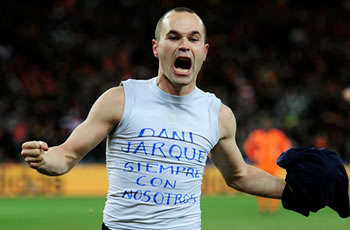
It’s a glorious coincidence, almost destiny, that Andres Iniesta’s last league game of 2010 will take place at Estadi Cornella-El Prat. There is absolutely no better way to celebrate the end of the historic year in Spanish football history than seeing San Andres treated to the most emotional reception by Espanyol supporters.
Iniesta is applauded at almost every ground in the country since scoring the winner in the World Cup Final against the Netherlands, and yet this one will be special. "Dani Jarque: siempre con nosotros” (always with us), the words on Iniesta’s shirt revealed moments after the ball met the net, are the most beautiful and most significant words ever to grace the biggest sporting event. They are the extract of true sportsmanship, they helped to make the world a better place.
Too many World Cup finals are remembered for wrong and negative reasons: Zinedine Zidane’s assault on Marco Materazzi (or vice versa, depending on which side you take), was the shameful scene in 2006; Ronaldo’s mysterious illness completely overshadowed the 1998 final, and remains a sad reminder that business is more important than sports for many key officials; 1994 was a drab affair between Brazil and Italy, the first ever final to feature no goals, and the first to be decided by the lottery of the shoot-out.
The 1990 final is always be remembered for the dreadful Argentinean side, and the dive by Rudi Voeller that finished them off. And 2010 was only minutes away from joining the list.It was destined to be an anti-climax to a poor tournament, ruined by defensive tactics and, more importantly, by the Jabulani disaster. Then came the moment that changed it all. The most memorable picture from South Africa is a positive one. Iniesta did it almost single-shirtedly. That shirt was presented to Espanyol president Daniel Sanchez Llibre last month.
Some would claim that Iniesta shouldn’t have been on the pitch in extra-time after his stupid retaliation on Mark Van Bommel. They are absolutely right. That was a red-card offence, but even the most passionate Oranje supporters must admit the game of football was lucky Howard Webb chose not to send him off. It could have been a victory for one of the dirtiest players ever. It could have made Van Bommel the new Zidane/Materazzi. Those could be the scenes forever engraved in or memories. Instead, Dani Jarque lifted the World Cup.
It must be mentioned that Iniesta was booked for taking his shift off. That should go down as the biggest travesty in the game. The man who made such a moving tribute to a departed friend was cautioned and given the same punishment Nigel De Jong got for his kung-fu kick on Xabi Alonso. If FIFA were sensible, the automatic yellow card for shirt-lifting would be abolished there and then. If Webb were a bit braver, he would follow his instincts and keep the card in his pocket. But that is just an afterthought. The booking didn’t really matter for San Andres at that moment.

For many, Iniesta became the symbol of honesty and modesty; of team unity and togetherness. When asked about his thoughts after the final whistle, he dedicated the win to Jarque again, and that was probably an even bigger tribute. It really felt like Spain had 24 players in their squad in South Africa. Maybe even 25, as Antonio Puerta was also paid homage by many players.
This is going to be a very special Saturday. Iniesta is about to take to the field Jarque didn’t live to play on. For many Espanyol supporters in the stands, their late captain will be wearing number 8 in Barcelona shirt. They will let him know about it. And then the curtain will fall on 2010, the year that belongs to the two friends, former team-mates in Spain's U-17, U-19, U-20 and U-21 selections.
Gracias, Andres! Gràcies, Andres! Thank you, Andres!

Tuesday, November 9, 2010

Football : An Empty Pleasure


An article written by Mario Vargas Llosa in Nou Camp 1982;dissecting the entertaining might of Football ,as it meets the characteristics of a innocuous ,ephemeral and non-transcendent entertainment.
Pedram 


A couple of years ago, I heard the Brazilian anthropologist Roberto da Matta give a brilliant lecture in which he explained that the popularity of football expresses an innate desire for legality, equality and freedom.
His argument was clever and amusing. According to him, the public sees football as a sort of model society-one governed by clear and simple laws which everyone understands and observes and which, if violated, bring immediate punishment to the guilty party. A football field is an egalitarian space which excludes all favouritism and privilege. Here, on this grass marked out by white lines, a person is valued for what he is: for his skill, dedication, inventiveness and effectiveness. Names, money and influence count for nothing when it comes to scoring goals and earning the applause or whistles from the stands. The football player exercises the only form of freedom that society can allow its members if it is not to come apart: to do whatever they please as long as it is not prohibited by rules that everyone accepts.
This is what, in the end, stirs the passions of the crowds that, the world over, pour into the grounds, follow games on television with rapt attention and fight over their football idols: the secret envy, the unconscious nostalgia for a world that -unlike the one they live in, which is full of injustice, corruption, lawlessness and violence-offers harmony, law and equality.
Could this beautiful theory be true? Would that it were, for nothing could be more positive for the future of humanity than to have these civilised feelings nestling in the instinctive depths of the crowds. But, as usual, reality overtakes theory-showing it up as incomplete. Theories are always rational, logical, intellectual (even those theories that propose irrationality and madness); but in society, in human behaviour, the unconscious, unreason and pure spontaneity will always play a part. This is both inevitable and immeasurable.
I’m scribbling these lines in a seat in the Nou Camp, a few minutes before the Argentina-Belgium game that is kicking off this World Cup (Spain 1982). The signs are favourable: a radiant sun; an impressive multi-coloured crowd full of waving Spanish, Catalan, Argentine and a few Belgian flags; noisy fireworks; a festive atmosphere and applause for the dancing and gymnastic displays which are a warm-up to the game.
This is a much more appealing world than the one left outside, behind the Nou Camp stands and the people applauding the dances and patterns made by dozens of young people on the pitch. This is a world without wars, such as those in the South Atlantic and Lebanon, which the World Cup has relegated to second place in the minds of millions of fans throughout the world; they, like those of us here in the stands, will be thinking of nothing else in the next two hours except the passes and the shots of the 22 Argentine and Belgian players who are opening the tournament.
Perhaps the explanation for this extraordinary contemporary phenomenon, the passion for football-a sport raised to the status of a lay religion, with the greatest following of all-is in fact a lot less complicated than sociologists and psychologists would have us suppose; football might simply offer people something they can scarcely ever have: an opportunity to have fun, to enjoy themselves, to get excited, to feel certain intense emotions that daily routine rarely offers them.
To want to have fun, to enjoy ourselves, to have a good time, is a most legitimate aspiration-a right as valid as the desire to eat and work. For many, doubtless complex reasons, football in the world today has taken on this role with more success than any other sport.
Those of us who get pleasure from football are not in any way surprised at its great popularity as a collective entertainment. But there are many who do not understand it and even criticise it. They see it as deplorable because, they say, football alienates and impoverishes the masses-distracting them from important issues. Those who think like this forget that it is important to have fun. They also forget that what characterises entertainment, however intense and absorbing (and a good game of football is enormously intense and absorbing), is that it is ephemeral, non-transcendent, innocuous. An experience where the effect disappears at the same time as the cause. Sport, for those who enjoy it, is the love of form, a spectacle that does not transcend the physical, the sensory, the instant emotion; a spectacle that, unlike a book or a play, scarcely leaves a trace in the memory and does not enrich or impoverish knowledge. This is its appeal: it is exciting and empty. For that reason, intelligent and unintelligent, cultured and uncultured people can equally enjoy football. But that’s enough for now. The King has arrived. The teams have come out. The World Cup has been officially opened. The game is beginning. That’s enough writing. Let’s enjoy ourselves a bit.


@Prospect Magazine

Wednesday, September 22, 2010

Byron Moreno Arrested !


Controversial former referee Byron Moreno, who was at the centre of the 2002 World Cup refereeing scandal, has been arrested at John F. Kennedy airport, New York, for allegedly being in possession of six kilograms of heroin.

Moreno had the drug concealed in his underwear as he passed through security, according to 
Cre.com.ec andRainews.

The Ecuadorian is best remembered for refereeing the infamous second round game at the 2002 World Cup between co-hosts South Korea and Italy.

The 2002 competition has gone down in infamy due to the huge number of refereeing mistakes that helped eliminate a string of top nations, and also ensured that Korea made it all the way to the semi-finals.

During their final two group games against Croatia and Mexico, Italy had four perfectly good goals disallowed, but somehow managed to scrape through to the second round where they met South Korea. Against Guus Hiddink’s men, Moreno chalked off another valid Italy goal, a golden goal from Damiano Tommasi which would have taken them to the next round. Francesco Totti was sent off for diving when replays suggested he had lost his footing, while the Koreans - who repeatedly went unpunished for apparent foul play - were awarded a controversial penalty for a Christian Panucci tugging offence. Italy eventually lost after Ahn Jung-Hwan’s golden winner, but the match and Moreno represent a black mark in Italian sport.

Moreno would later that year receive a 20 match ban after he played an extra 13 minutes of stoppage time during an Ecuadorian league match between Deportiva Universita de Quito and Barcelona Sporting Club. During this time Deportiva scored twice to turn a 3-2 deficit into a 4-3 victory. After retuning from his suspension, Moreno was suspended again after controversially sending off three players in one match. He retired from officiating shortly after.

Today's events will undoubtedly hit the headlines all over Italy.


by : Rick D'Andrea @ Goal.com

Wednesday, June 30, 2010

On Their Early Exit


TEHRAN - The elimination of England, France and the United States in the early stages of the World Cup was a just reward for their ill-treatment of Iran, its foreign minister said on Tuesday.
Iran did not qualify for the tournament in South Africa but fans have been glued to their televisions nonetheless in a country where football is the number one sport.
While the United States - often referred to by Iran's leaders as "the great Satan" - were never a favourite at the tournament, the elimination of England and France before the quarter-finals was a crushing blow to their fans back home.
England and the U.S. both lost in second round matches while France and world champions Italy fell in the opening group stage.
Foreign Minister Manouchehr Mottaki said they had all got what they deserved after they backed a new round of sanctions against Iran over its nuclear programme which the West fears may be aimed at making a bomb, something Tehran denies.
"Whatever we witness today in the international political arena has been identically manifested in the 19th tournament of the World Cup," Mottaki was quoted as saying by Iran's official news agency IRNA.
"Those countries which played a key role in imposing new sanctions against Iran - like England, America and France - were all eliminated in the preliminary phases," he said.
Brazil, which voted against the sanctions, is one of the favourites to win having impressively reached the last eight with a crushing 3-0 victory over Chile on Monday.
Iran played at the last World Cup finals in Germany four years ago but finished bottom of their qualifying group.
In 1998, they famously beat the United States 2-1 although neither side went through to the next round.

@Reuters

Thursday, June 17, 2010