Showing posts with label South America. Show all posts

Monday, July 4, 2011

Assault on Democracy


Hugo Chávez has long considered Noam Chomsky one of his best friends in the west. He has basked in the renowned scholar's praise for Venezuela's socialist revolution and echoed his denunciations of US imperialism.

Venezuela's president, who hasrevealed that he has had surgery in Cuba to remove a cancerous tumour, turned one of Chomsky's books into an overnight bestseller after brandishing it during a UN speech. He hosted Chomsky in Caracas with smiles and pomp. Earlier this year Chávez even suggested Washington make Chomsky the US ambassador to Venezuela.
The president may be about to have second thoughts about that, because his favourite intellectual has now turned his guns on Chávez.
Speaking to the Observer last week, Chomsky has accused the socialist leader of amassing too much power and of making an "assault" on Venezuela's democracy.
"Concentration of executive power, unless it's very temporary and for specific circumstances, such as fighting world war two, is an assault on democracy. You can debate whether [Venezuela's] circumstances require it: internal circumstances and the external threat of attack, that's a legitimate debate. But my own judgment in that debate is that it does not."
Chomsky, a linguistics professor at Massachusetts Institute of Technology, spoke on the eve of publishing an open letter  that accuses Venezuela's authorities of "cruelty" in the case of a jailed judge.
The self-described libertarian socialist says the plight of María Lourdes Afiuni is a "glaring exception" in a time of worldwide cries for freedom. He urges Chávez to release her in "a gesture of clemency" for the sake of justice and human rights.
Chomsky reveals he has lobbied Venezuela's government behind the scenes since late last year after being approached by the Carr centre for human rights policy at Harvard University. Afiuni earned Chávez's ire in December 2009 by freeing Eligio Cedeño, a prominent banker facing corruption charges. Cedeño promptly fled the country.
In a televised broadcast the president, who had taken a close interest in the case, called the judge a criminal and demanded she be jailed for 30 years. "That judge has to pay for what she has done."
Afiuni, 47, a single mother with cancer, spent just over a year in jail, where she was assaulted by other prisoners. In January, authorities softened her confinement to house arrest pending trial for corruption, which she denies.
"Judge Afiuni has suffered enough," states Chomsky's letter. "She has been subject to acts of violence and humiliations to undermine her human dignity. I am convinced that she must be set free."
Amnesty International and the European parliament, among others, have condemned the judge's treatment but the intervention of a scholar considered a friend of the Bolivarian revolution, which is named after the hero of Venezuelan independence, Simón Bolívar, is likely to sting even more.
Speaking from his home in Boston, Chomsky said Chávez, who has been in power for 12 years, appeared to have intimidated the judicial system. "I'm sceptical that [Afiuni] could receive a fair trial. It's striking that, as far as I understand, other judges have not come out in support of her … that suggests an atmosphere of intimidation."
He also faulted Chávez for adopting enabling powers to circumvent the national assembly. "Anywhere in Latin America there is a potential threat of the pathology of caudillismo [authoritarianism] and it has to be guarded against. Whether it's over too far in that direction in Venezuela I'm not sure, but I think perhaps it is. A trend has developed towards the centralisation of power in the executive which I don't think is a healthy development."
Chomsky expressed concern over Chávez's cancer and wished the president a full and prompt recovery.
Chomsky's book Hegemony or Survival: America's Quest for Global Dominance became a publishing sensation after Chávez waved a copy during a UN address in 2006 famous for his denunciation of President George W Bush as a devil.
Its author remains fiercely critical of the US, which he said had tortured Bradley Manning, alleged source of the diplomatic cables exposed by WikiLeaks, and continued to wage a "vicious, unremitting" campaign against Venezuela.
The Chávez government deserved credit for sharply reducing poverty and for its policies of promoting self-governing communities and Latin American unity, Chomsky said. "It's hard to judge how successful they are, but if they are successful they would be seeds of a better world."
Leonardo Vivas, co-ordinator of Latin American initiatives at the Carr Centre, said that Afiuni's case was the most prominent example of the erosion of justice in several Latin American countries. The centre hoped that Caracas would now heed Chomsky.
"He is one of the most important public intellectuals in the US and is respected by the Venezuelan government."
The decision to lobby publicly was taken because quiet diplomacy had limits, said Vivas.
Chávez, who is convalescing in Cuba, has a reputation for lashing back at criticism, raising the risk that the Afiuni initative could backfire.
"That could happen," said Vivas. "But that would mean recognition of the problem."


Chomsky's letter


Judge María Lourdes Afiuni has suffered enough
With this public letter I want to express my open support of the liberty of judge María Lourdes Afiuni, detained in Venezuela since December 2009. In November of last year I was informed of her situation by the Latin American initiative of the Carr Centre for human rights policy at Harvard University. Ever since, I have been directly involved in mediation efforts with the Venezuelan government, with the purpose of releasing her from prison through a gesture of clemency by President Chávez.
Judge Afiuni had my sympathy and solidarity from the very beginning. The way she was detained, the inadequate conditions of her imprisonment, the degrading treatment she suffered in the Instituto Nacional de Orientación Femenina, the dramatic erosion of her health and the cruelty displayed against her, all duly documented, left me greatly worried about her physical and psychological wellbeing, as well as about her personal safety.
Those reasons motivated me in December 2010 to address, jointly with the Carr Centre, a petition for an official pardon from the president in the context of the yearly presidential amnesties.
In January I received with relief the news that Venezuela's attorney general had suggested house arrest for judge Afiuni given her fragile health condition, which ended up with emergency surgery. Being in her house with her family and with adequate medical attention has been without doubt a significant improvement of her situation.
However, judge Afiuni has suffered enough. She has been subject to acts of violence and humiliations to undermine her human dignity. I am convinced that she must be set free, not only due to her physical and psychological health conditions, but in conformance with the human dignity the Bolivarian revolution presents as a goal. In times of worldwide cries for freedom, the detention of María Lourdes Afiuni stands out as a glaring exception that should be remedied quickly, for the sake of justice and human rights generally and for affirming an honourable role for Venezuela in these struggles.
For the above reasons I want Venezuelans to be aware of my total solidarity with judge Afiuni, while I affirm my unwavering commitment with the efforts advanced by the Carr Centre in Harvard University to release her from imprisonment. At the same time, I shall keep high hopes that President Chávez will consider a humanitarian act that will end the judge's detention.
@Guardian
Pic : Maria Lourdes Afiuni

Saturday, December 18, 2010

WikiLeaks: Pope wanted Muslim Turkey kept out of EU (?)

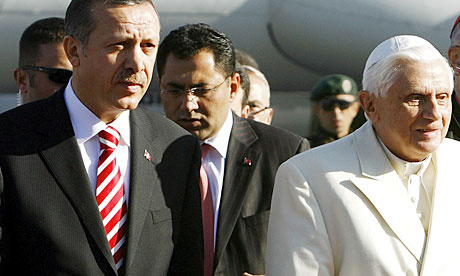
A WikiLeaks cable reports that Pope Benedict XVI, seen here being received by Turkish prime minister Recep Tayyip Erdogan in Ankara in 2006, 'might prefer to see Turkey develop a special relationship short of EU membership'.


The pope is responsible for the Vatican’s growing hostility towards Turkey joining the EU, previously secret cables sent from the US embassy to the Holy See in Rome claim.

In 2004 Cardinal Ratzinger, the future pope, spoke out against letting a Muslim state join, although at the time the Vatican was formally neutral on the question.
The Vatican’s acting foreign minister, Monsignor Pietro Parolin, responded by telling US diplomats that Ratzinger’s comments were his own rather than the official Vatican position.

The cable released by WikiLeaks shows that Ratzinger was the leading voice behind the Holy See’s unsuccessful drive to secure a reference to Europe’s “Christian roots” in the EU constitution. The US diplomat noted that Ratzinger “clearly understands that allowing a Muslim country into the EU would further weaken his case for Europe’s Christian foundations”.
But by 2006 Parolin was working for Ratzinger, now Pope Benedict XVI, and his tone had distinctly chilled. “Neither the pope nor the Vatican have endorsed Turkey’s EU membership per se,” he told the American charge d’affaires, “rather, the Holy See has been consistently open to accession, emphasising only that Turkey needs to fulfil the EU’s Copenhagen criteria to take its place in Europe.”
But he did not expect the demands on religious freedom to be fulfilled: “One great fear is that Turkey could enter the EU without having made the necessary advances in religious freedom. [Parolin] insisted that EU members – and the US – continue to press the [Turkish government] on these issues … He said that short of ‘open persecution’, it couldn’t get much worse for the Christian community in Turkey.”
The cables reveal the American government lobbying within Rome and Ankara for Turkish EU membership. “We hope a senior department official can visit the Holy See and encourage them to do more to push a positive message on Turkey and integration,” concluded the 2006 cable.
But by 2009, the American ambassador was briefing in advance of President Barack Obama’s visit, that “the Holy See’s position now is that as a non-EU member the Vatican has no role in promoting or vetoing Turkey’s membership. The Vatican might prefer to see Turkey develop a special relationship short of membership with the EU.”
Roman Catholicism is the only religion in the world with the status of a sovereign state, allowing the pope’s most senior clerics to sit at the top table with world leaders. The cables reveal the Vatican routinely wielding influence through diplomatic channels while sometimes denying it is doing so. The Vatican has diplomatic relations with 177 countries and has used its diplomatic status to lobby the US, United Nations and European Union in a concerted bid to impose its moral agenda through national and international parliaments.
The US charge d’affaires D Brent Hardt told Parolin, his diplomatic counterpart in Rome, of “the Holy See’s potential to influence Catholic countries to support a ban on human cloning” to which Parolin emphasised his agreement with the US position and promised to support fully UN efforts for such a ban.
On other global issues such as climate change, the Vatican sought to use its moral authority as leverage, while refusing itself to sign formal treaties, such as the Copenhagen accord, that require reporting commitments.
At a meeting in January this year Dr Paolo Conversi, the pope’s representative on climate change at the Vatican’s secretariat of state, told an American diplomat that the Vatican would “encourage other countries discreetly to associate themselves with the accord as opportunities arise”.
The Americans noted that Conversi’s offer to support the US, even if discreetly, was significant because the Vatican was often reluctant to appear to compromise its independence and moral authority by associating itself with particular lobbying efforts.
“Even more important than the Vatican’s lobbying assistance, however, is the influence the pope’s guidance can have on public opinion in countries with large Catholic majorities and beyond.”
The cables also reveal that the Vatican planned to use Poland as a trojan horse to spread Catholic family values through the structures of the European Union in Brussels.
The then US ambassador to the Holy See, Francis Rooney, briefed Washington in 2006, shortly after the election of Pope Benedict XVI, that “the Holy See hopes that Poland will hold the line at the EU on ‘life and family’ issues that arise” and would serve as a counterweight to western European secularism once the country had integrated into the EU.
The cable notes that Pope Benedict is preoccupied with Europe’s increasing psychological distance from its Christian roots.
“He has continued to focus on Poland’s potential in combating this trend. This was one of the themes of the visit of several groups of Polish bishops to the Vatican at the end of last year [2005]. ‘It’s a topic that always comes up,’ explained Monsignor Michael Banach, the Holy See minister of foreign affairs country director for Poland. He told us that the two sides recognised that the Polish bishops needed to exert leadership in the face of western European secularism.”
Across the Atlantic, the Vatican has told the Americans it wants to undermine the Venezuelan president, Hugo Chávez, in Latin America because of worries about the deterioration of Catholic power there. It fears Chávez is seriously damaging relations between the Catholic church and the state by identifying the church hierarchy as part of the privileged class.
Monsignor Angelo Accattino, in charge of Caribbean and Andean matters for the Vatican, said Obama should reach out to Cuba “in order to reduce the influence of Chávez and break up his cabal in Latin America”.In December last year, America’s adviser for western Europe at the UN, Robert Smolik, said the Vatican observer was “as always active and influential behind the scenes” and “lobbied actively and influentially in the corridors and in informal consultations, particularly on social issues”.
In 2001 another American diplomat to the Vatican stated: “The Holy See will continue to seek to play a role in the Middle East peace process while denying this intention.”


Source : Guardian

Monday, September 27, 2010

Venezuela election loosens Chávez's grip on power


Opponents of Hugo Chavez today made major gains in legislative elections that could weaken the president's dominant power in Venezuela.
The opposition overturned Chávez's two-thirds majority in the national assembly, and claimed to have won most of the popular vote. If confirmed, the result would mark a milestone.
The Democratic Unity coalition won at least 60 of 165 seats in the assembly – well short of a majority but enough to end Chávez's ability to appoint judges and other officials and to push through major laws.
The opposition said it had won 52% of the popular vote, but that controversial changes in electoral rules favouring rural areas, where Chávez is popular, meant that support failed to translate into proportional seats.
Both sides claimed victory and momentum for the 2012 president election, in which Chávez will seek a third consecutive term. Turnout was 66%, high for a legislative election.
Chávez's allies took at least 94 seats. The president said via Twitter today that his PSUV party was the victor. "Well, my dear compatriots," he wrote, "it has been a great election day and we have obtained a solid victory: enough to continue deepening Bolivarian and democratic socialism. We need to continue strengthening the revolution!"
He did not address supporters from the balcony of Miraflores palace, a tradition from previous elections.
During the campaign, the former soldier said it was crucial to "demolish" the opposition and win at least 110 seats for the two-thirds majority required to continue to rubber-stamp his decisions.
Television pictures from the rival camps told their own story: PSUV supporters in red T-shirts looking uncertain, and opponents in yellow and blue T-shirts appearing upbeat.
Ramón Guillermo Aveledo, leader of the opposition coalition, said it had been a "marvellous" day but lambasted the national electoral council for an eight-hour delay before announcing the first, incomplete results at 2am local time to a tense country.
The council, which mostly comprises government loyalists, listed assembly winners but failed to immediately supply a breakdown of the nationwide popular vote. This is a crucial benchmark for Chávez, who declared the election a referendum on his rule.
"It will be a pyschological handicap for Chavistas if they get less than 50% of the vote," said Steve Ellner, a political analyst and author at the University of the East. "The opposition could then say: 'We are the majority.'"
Since sweeping to power in 1998, Chávez has cast his revolution as that of the poor majority against wealthy oligarchs. Two years ago, however, Caracas and other cities voted for opposition mayors and governors. Recession, inflation and crime played into the opposition's hands again this time.
The president's once-stellar approval ratings have tumbled but he remains the country's most popular politician, and he has a firm grip on all state institutions.
The assembly has acted as a rubber stamp since the opposition boycotted the last legislative election in 2005, giving Chávez free rein to push through radical legislation and appoint judges and members of the electoral council.
By securing more than 58 seats, the opposition can in theory exert influence over appointments and major new laws; if it clinches takes 67 – which seems possible – it could block the president's requests for temporary decree powers.
Aveledo, the opposition leader, warned the outgoing "moribund" pro-Chávez legislature against rushing out radical laws before the new assembly starts, in January 2011.

@Guardian
pic : Ramon Guilermo Aveledo