Showing posts with label Relationship. Show all posts

Saturday, June 23, 2012

"Are You Committed?"


"Commitment is a big part of what I am and what I believe. How committed are you to winning? How committed are you to being a good friend? To being trustworthy? To being successful? How committed are you to being a good father, a good teammate, a good role model? There's that moment every morning when you look in the mirror: Are you committed, or are you not?"

Wednesday, May 23, 2012

Haneke Presents: "Amour"

 By Sunday morning the 65th Cannes Film Festival had its first masterwork and an overwhelming critical favorite in Michael Haneke’s “Amour.” A tender, wrenching, impeccably directed story of love and death, the French-language film stars Emmanuelle Riva and Jean-Louis Trintignant as a Parisian couple in their 80s — named Georges and Anne, as are most of Mr. Haneke’s middle-class couples — struggling with an increasingly debilitating illness and the specter of what comes next. One day over breakfast she suffers a frightening episode that leaves her briefly locked in a mute, seemingly unaware blankness. She’s there, but not, and then just as suddenly she returns.
A hospital stay follows along with an operation, a grim prognosis, a slide into helplessness, the expected accumulation of humiliations, natural and not, and swells of emotion. Half-frozen by a stroke, Anne’s body has begun to betray her, but Georges holds her so very close: he brushes her hair, bathes and dresses her. Somewhat stooped, with a shaky, hitchy walk, he trembles when he lifts her from the bed or a chair, but he keeps holding on. The first time he has to help her move from her wheelchair, she tells him how to grasp her properly, as if in a hug, a gesture that’s poignant in its literalness — they press into each other — and reverberant of an erotic life shared and still remembered.
Mr. Haneke has often turned his cool gaze toward power and violence, and in some respects he has done so again in “Amour,” one difference being that he’s also made room here for tenderness. Part of the film’s emotional force is due to the actors, both superb, and to the poignancy of watching these two familiar, now frail bodies of cinema, as it were, performing in a pantomime of sickness and death. This very real fragility makes a sharp contrast with the bodies cinema immortalizes — eternally young — and it seems telling that Mr. Haneke, who likes to pick at screen illusion, cast actors who starred in two of the most famous French films of all time: Mr. Trintignant was the titular man from “A Man and a Woman” and Ms. Riva played the nameless woman in “Hiroshima Mon Amour.”
“Amour” sent a charge through the packed, rapt 2,300-seat theater, and immediately suggested that there was more to the official lineup than the first few days had suggested. The competition had gotten off toa terrific start with Wes Anderson’s “Moonrise Kingdom,” even if not everyone was equally convinced. A similar critical ambivalence greeted another strong competition entry, “Beyond the Hills,” from the Romanian director Cristian Mungiu, who won the Palme in 2007 for “4 Months, 3 Weeks and 2 Days.” His new film centers on two young women who, after a reunion, are slowly and forcibly separated by different faiths: Alina (Cristina Flutur) believes in their friendship while Voichita (Cosmina Stratan) has turned to God and become a nun in a tiny Christian Orthodox sect.
Set largely in Voichita’s monastery, a windswept outcropping of buildings in the deep countryside, the story unfolds in atmospheric bits and narrative pieces. Alina and Voichita are lifelong friends, having grown up in the same orphanage. Alina, the stronger, more stubbornly independent of the two, has returned home after a stint working in Germany and thinking that she and Voichita will go off together. Mr. Mungiu, who prefers that viewers come to their own conclusions, never makes it clear if the women are lovers — “You will think whatever you will think,” he said during the party for his film Saturday — though a scene in which Voichita massages Alina’s back, then looks away when Alina turns over, baring her breasts, suggests private worlds of complication.
Shot on film and running two-and-a-half engrossing hours, “Beyond the Hills” explores the push and pull between the collective and the individual, between faith and free will. Voichita insists that she wants to stay at the monastery, where she and some dozen other nuns — along with chickens, boxes of bees and a kind of Greek chorus of incessantly barking dogs — live without electricity under the strict religious supervision of a priest. With mounting desperation and increasingly violent outbursts, Alina tries to change Voichita’s mind. Believing in a world of absolute good and evil, and confused by Alina’s passion, the nuns and priest respond by trying to ritualistically drive out the Devil, an ordeal that effectively pits one woman against a millennium of religious orthodoxy.
At his party, a typical Cannes beach affair with pounding beats and revelers swarming the open bar, Mr. Mungiu talked about his film, the difficulties of shooting in winter and working with a young, untested cast. He based the screenplay (originally 245 pages!) on a pair of fact-based books by Tatiana Niculescu Bran about a real nun who died after being gagged and tied to a cross for days in a Romanian monastery during an exorcism. (Ms. Bran turned her first book into a play, “Deadly Confession,” which was staged at La MaMa in 2008.) It’s a shocker of a story, yet while Mr. Mungiu’s sympathies are transparently with Alina he neither sentimentalizes her — he keeps her at both an emotional and visual distance — nor does he demonize the priest or, especially, the nuns.
“The film should be watched and judged from each character’s perspective,” he explained, giving the larger, suggestively political view. “This is how you will discover that it is difficult to say who is guilty, because the people who are really guilty are not in the film. They are the people who created this kind of society, the people who created education that completely lacks the very important moral values that people should have.”


@NYTIMES

Friday, May 18, 2012

My Album of The Month (February-March 2012)

Artist: My Dying Bride
Album: 34.788...% Complete
Year: 1998
In 1998, the band switched to a more experimental/gothic sound. 34.788...% distances from traditional My Dying Bride. Initially I didn't enjoy the album. Little by little some tracks grew in me.  The "The Whore, The Cook and The Mother " is the standout. I can consider this as a concept album, dealing with known MDB issues like love, sex, drugs and innocence. with solid composure and a genuine sound exploration.

Tuesday, August 2, 2011

Best Regards


That's a sign of a progress;they say
So;
You !
Superstar !
Still determined to erect your red flags all across the globe ?
Parasite ! Enjoying your free ride?
Your friendship ; This fabulous postiche ;
Won't be missed !

Sunday, June 19, 2011

هرجایی


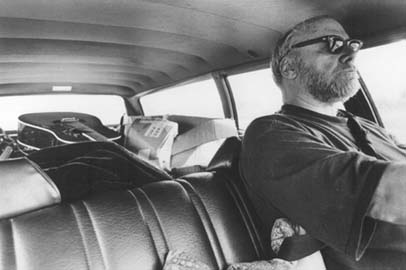
     تقاطع گیشا  - آل احمد ، ساعت 7 صبح ، سوارماشین هستم در مسیر
بیمارستان...   به ناگهان یک ماشین از لاین خودش منحرف می شه می آید در مسیر من ، من مجبور می شوم ناگهان ترمز بگیرم . ماشین پشت سر من هم به همین ترتیب....در این بین ماشین پشت سری به شدت پیگیر این موضوع میشود وبا مهارت خاص ایرانی از من سبقت می گیرد...دختر و پسر جوانی در ماشین هستند.پسرکه پشت رل است به سمت من بر می گردد و بلند داد و فریاد می کند. البته نمی فهمم چه می گوید بعید میدانم اگر شیشه ی ماشین پایین بود و صدای گیتار جان فیهی هم اجازه می داد  و همه ی توجهم را هم می دادم ، باز هم چیزی درک می کردم . نفهمیدم چی گفت : راستش این روز ها از کمتر حرفی که می شنوم سر در می آورم .دختر هم خیره شده است به جلو گویا فیلمی را تماشا می کند. زیر پل پارک می کنم .به طور اتفاقی می بینم که همان ماشین بیرون پارکینگ ،زیر پل نگه داشته است و دختر و پسر لحظات ملکوتی جدایی را می گذرانند. واقعا خوشحالم اگر امروز  باعث شدم یک دختر به دوست پسرش افتخار کند یا به هرشکلی به شکل گیری هر اتفاقی در هر جایی کمک  کردم
photo: John Fahey by Bettina Herzner

Friday, February 4, 2011

Lesson For Those Facing Serious Illnesses


by : Danielle Leach, MPA

“A true friend walks in when everyone else walks out.”
I read that on a magnet on my friend’s refrigerator recently and the simple power of that saying brought me to tears. I have learned that lesson of true friends since my son’s diagnosis of cancer in 2007.
Anyone who has faced a serious illness as a patient or a caregiver knows that you quickly learn who your friends are. They are the ones who are there, who listen instead of trying to fix things, who are present for you in any way you need them. Some people you love will disappoint and not rise to the occasion, and some people you never expected will be your biggest supporters.
It is hard not to resent people who are there in the crisis, and then leave once the immediate crisis is over. There are people who are not there for the long haul, for the good and the bad that a disease may bring. The initial drama draws everyone in, but sends them running afterward.
I have learned, especially when you are living a nightmare, that it takes a special person to stay with you throughout the crisis. A person who keeps checking in and knows the journey is not necessarily over once you are in remission, or when your loved one has passed away. When my son Mason had brain cancer, our family found our true friends. We were surprised by many who walked out, but also by how many true friends walked into our lives because of Mason’s illness. We have learned even after Mason’s death, even three years later, we continue to go through this process of discovering our true friends.
Some people are not capable of handling personal difficulties. We, as patients and caregivers, need to understand not everyone has the capacity or tools to handle a crisis of another. This knowledge does not make it any easier for us as we wade through process of dealing with disease. As a director at Inspire, a company that creates and manages online patient support communities, I see regularly the comments of patients and caregivers who talk about friendships won and lost since diagnosis. Some are surprised and profoundly saddened by the lack of support from those expected to help the most. However, many happily note those friends, family, and even strangers who surprise them with support in a time of great need.
I recall reading about a Florida woman, whose teenage son was undergoing chemo, wrote that her friends avoided her upon learning about her son’s cancer diagnosis. “It’s almost like they were afraid they could catch it,” she said.
Another, a bladder cancer survivor from New Jersey, observed, “A lot of people walk out. . . a good 50% of my ‘pre-cancer’ friends I have never heard from again.” He went on to say, “In my case, I am lucky. I have all strong ones, having cut weak relations a long time ago. I keep only the cream of the crop.”
Sometimes finding others who are dealing with the same issues can be the most helpful strategy. You can often talk online more frankly and honestly with them than with some loved ones or friends. Dealing with an illness can be a lonely and scary process. Participating in support communities often help alleviate some of that loneliness. I have seen repeatedly how these connections are a powerful tool and establish strong personal friendships among members.
If you’re a patient or caregiver, look for the people who are true friends and hold those people close. Craft a strong support network–both in person and online. If you have a chance to do so, be the kind of true friend people are often searching for in their lives when they need it the most.

Danielle Leach is Director of Partnerships at Inspire and is founder of the Mason Leach Superstar Fund, in memory of her son, Mason, who died of pediatric medulloblastoma in 2007.

Sunday, January 30, 2011

Montgomery Clift Remebered


"We loved each other in the most complete sense of the word."
Elizabeth Taylor

Tuesday, January 25, 2011

Compassion And Decency Overwhelmed By Fear

This piece written by Eileen M.K. Bobek,clinging on a heartfelt issue;the matter of our everyday communication clouded by ignorance ,vanity or idifference .It's an old story of coldness hang in the air between us.

The year after I finished my emergency medicine residency, I had all four of my wisdom teeth pulled.

Afterwards, I looked as if I had taken several punches to my face. My jaw was swollen, my skin a cornucopia of muddied blues, purples, greens, yellows and reds. If people didn’t know better, I told my husband with a laugh, they might think that I’d been beaten.
It took weeks for the swelling and discoloration to resolve. I went about my life, aware of both my face and people’s responses to it. Their pitying, uncomfortable, sometimes disgusted expressions told me what they were thinking: I was being abused. But nobody ever asked me how I was, how it had happened or even if it hurt.
“I can’t believe it!” I’d rail to my husband. “Not one person has asked. Not one!”
It wasn’t long before my disbelief gave way to resentment. I started testing people. When our eyes met, I’d refuse to look away, silently daring them to ignore my face. Sometimes I’d relent and reveal that I’d had some teeth pulled. An expression of relief, tinged with lingering suspicion, would wash over their faces. But their nervous laughter and the tension that evaporated from their shoulders told me that their relief was not for me: It was for them. I’d absolved them of the responsibility of asking.
Most of the time, I said nothing, letting the weight of their silence hang in the air between us. Their guilt made me feel certain that I would never be silent.


***

I still don’t know her name.
I saw her only at my six-year-old son’s weekly T-ball games, five years ago. She and her two young sons had the benign, nondescript look of the families advertised in picture frames–all feathery light-brown hair and creamy skin. Her husband dressed in oxford shirts and business slacks, a beeper clinging to his belt. He was a grim-faced Ken doll–clean-shaven, with immobile sandy brown hair and a mouth locked in a thin line.
Once, she and I chatted on the sidelines as our three-year-old boys played together alongside the baseball field. At some point, her son picked up the Styrofoam cup next to her and took a drink from the straw. I saw her husband’s face darken, his body stiffen. He strode from the first base line where he’d been coaching and snatched the cup from his son’s hands, slamming it into the garbage before returning to first base.
The boy retreated to his mother’s lap, leaning his body into hers. As she dipped her head over his, she said, “You know you shouldn’t take Daddy’s drink.”
I thought I saw her glance at me through the curtain of her hair. We never spoke again.
I don’t remember seeing her again until the end of the season. She was sitting on the ground, handing out drinks and snacks to the players. As they swarmed around her like bees, I walked over with my sons. She looked up.
The wind whipped back her hair to reveal a black eye.
She’d made no attempt to hide it; she wasn’t wearing makeup or sunglasses. Her defiant expression mirrored my own of so many years before; she was testing me.
I imagined us in the ER–she sheltered within the walls of a patient room, me sheltered within my white doctor’s coat, freed from my fear and embarrassment and empowered to ask her the question on my lips. If she denied being beaten and got indignant or angry, I could retreat into my role: It’s my responsibility to ask. If she admitted it, I could offer her help–social work, counseling, a safe house, something. But without my coat, there on our sons’ playing field, I felt stripped of my power and authority–a not-so-super hero, crippled without her costume.
I said nothing. There are too many children around, I told myself. This is not the time.
We held each other’s gaze for a few seconds; then she turned away.
Instantly, I knew that I’d made a mistake–but the moment was lost. I reassured myself that I would have another chance; I’d see her after the game, at the nearby ice cream store where they handed out the trophies.
When I didn’t see her there, I approached another mother.
“Do you know the woman at the game who was handing out snacks? She had a black eye. I was wondering if she’s all right.”
She started, darting her eyes away as she stammered, “I…uh…no…I don’t know…I see my son.” She hurried past me, trailing a string of unintelligible words.
It was then that I turned and saw her husband and two sons sitting in a booth ten feet away, eating their ice cream cones in silence. As my son received his trophy, I scanned the entrance for her, willing her to show up and come through the glass doors; she never appeared.
I still think of her sometimes. I don’t know whether her black eye happened by accident or intention. Remembering her husband’s angry response to his young son, I think I know–but still I want to deny.
I recall my own bruised and swollen face and my disbelief that so many people so easily let me go without a word of concern or curiosity. I imagine how alone I would have felt if the unspoken suspicion on their faces had been justified. And I remember her face–defiant, bare of makeup, as if she were testing us, hoping someone might ask. If I had asked, maybe she would have said it was nothing. Maybe she would have lied but also taken comfort in knowing that someone had dared enough, cared enough to ask.
That moment–the wind blowing back her hair, her eyes meeting mine–replays in my mind like an endless loop. I think of all the things I could have said. Are you okay? How did it happen? Does it hurt?
I want to believe that I would never make the same mistake again–that my fear would never again overwhelm my compassion and decency.
I can’t help but think that’s why she didn’t show up later. She had taken a chance on us, and we’d all failed her. I had failed her. I’d had my one chance–and let it slip away.

Eileen M.K. Bobek is a former emergency room physician.