Showing posts with label Religion. Show all posts

Saturday, January 25, 2025


"Refugees aren’t generalities or stereotypes. They are suffering children with desperate parents struggling to find a better life. And for those who survive the dangerous struggle and enter the U.S., their children are taken away and tortured. . . .


Families are being torn apart forever. Intentionally. This is one of the most stark, clear choices a Christian can make: Defend torture of children, or support Christ. You can’t do both. You cannot be a Christian and support what the government is doing to families and children."
Jim Meisner Jr, The US Immigration Crisis is a Test for Christians, Patheos, June 30, 2019 


One wonders how America’s right-wing evangelicals live with their choice to support such inhumane treatment of anyone, much less children, some of whom are babes in arms. It is a most monumental failure of Christian imagination not to realize that their Lord and Savior could never countenance such atrocities. Any Christian leaders who do not actively oppose this onslaught on humanity as a grievous sin against the demands of their faith commit an outrage of unfathomable proportions against the Gospel of Jesus Christ and every canon of decency that we know.

Hendricks, Obery M M. Christians Against Christianity: How Right-Wing Evangelicals Are Destroying Our Nation and Our Faith (pp. 101-102). Beacon Press. Kindle Edition. 

Sunday, November 4, 2012

Being in Uncertainty

I read the following post @ Talking Philosophy blog. It looks at Felix Baumgartner's epic effort from an interesting perspective. 
pedram

Like millions of people I watched Felix Baumgartner’s space jump last Sunday. He leapt from a tiny capsule pulled 24 miles into the sky by a helium balloon. He fell to the ground from the edge of space, breaking the sound barrier, and several records, in the process.

I found his achievement moving and compelling. And this surprised me because quite often I find extreme feats of this sort rather sterile, and perhaps a little bullet-headed.  When someone walks across the Antarctic, or climbs Everest without oxygen, it seems to involve a chest-beating determination to assert oneself against nature. The self-assertion makes it seem a small inward-looking response to the largeness and awesomeness of the world. It reminds me of the character in William Golding’s novel Pincher Martin who takes huge pride in surviving against the odds on a tiny rock in the middle of the ocean,  staving his hunger with vile rock-dwelling creatures and sheltering himself by squeezing into a tiny jagged hole. The astonishing twist in that story shows  his pride in that narrow victory to be the very same thing as his failure to see and appreciate something much larger and more beautiful than his deluded and debased survival.


Golding’s novel has a belief in God at its centre. So as an atheist, I read it at arm’s length. I can’t share its central vision.  Some or all of Baumgartner’s jump team are atheists too. That’s the message I took from mission control’s reassurance to Baumgartner that “his guardian angel” was with him. The notion of a guardian angel is so kitsch, so primitive and so not a part of most religious people’s  experience of faith that it seemed to me that these colleagues of Baumgartner were stating their atheism at the same time as they indulged an (entirely understandable) need to supplicate (someone, something) for their friend’s survival.

That these scientists felt drawn to this playful but clumsy invocation of a supernatural entity in which they probably disbelieved gives me a clue about why I found Baumgartner’s jump so moving.
An atheist invoking God in response to peril can easily be seen as a momentary weakness, a panicked irrationality, so it is not terribly interesting. More interesting is the way an atheist might feel when contemplating the strange empty  infinity and complexity of the universe and the sheer oddness of being a conscious presence within it. We might not be at all tempted to say that the idea of God needs to be invoked to explain the universe. But the idea that God exists and that we humans are in a state of separation from that God can seem like a very vivid way of experiencing our awe in the face of a not-yet-fully-explained universe and also of capturing  some central philosophical problems. The idea of a God from whom we are separated and whom we strive to rejoin (the idea of a fall followed by redemption) has in the past lent philosophy some of its fundamental structure. Hegel’s self-positing spirit, for example, is a version of God coming to self-knowledge through a process which involves first the generation and then the overcoming of separateness.  And even if we eschew Hegelian ways of thinking,  the idea of a God that we must strive to rejoin feels like a rich metaphor for the traditional philosophical project of characterising reality in a manner which makes it both independent of us and yet within our knowledge. The truth (if it is a truth) of the atheist’s claim that there is no God sometimes seems like poor compensation for the loss of the religious worldview –  because that worldview is a very beautiful and metaphorically fertile orientation to the strange condition of being conscious in the world.
There is an atheist’s plight, I think. Not for all atheists, but for some atheists most of the time, and perhaps even for most atheists some of the time. The plight is this: there is no God, but sometimes invoking the concept of God seems a very compelling way indeed of doing justice to the strangeness, the beauty and the peril of our lives.
So, just as Baumgartner’s colleagues summoned the idea of a guardian angel to fill the space left by their disbelief in God,  I too look around for metaphors to fill the space left by my own disbelief in God. And Baumgartner’s endeavour at the physical margins of our world, the point where it joins the universe, seemed to fit the bill. Where Pincher Martin, in Golding’s novel, squeezes himself into a small hole on a small rock and feels big, Baumgartner took himself to the edge of the largest possible space to (in his own words) “see how small he was.” It was (corny expressions seem unavoidable here) an encounter with the infinite. The symbolism of falling also has poignancy. It speaks of a chosen passivity, a surrender, very different from the assertive striving  of a Pincher Martin, and very resonant with Christian mythology. Finally the sheer pointlessness of jumping from space seems a rather heroic defiance of the meaninglessness that threatens to engulf us when we look at a vast universe empty of mind: it embraces meaninglessness joyfully and colonises it with purpose.
I don’t want to spend too long teasing out the symbolism of the jump. Instead I want to ask a question. It seems from the above that we (or many of us) have a need for what might be called aids to reflection, aids to the contemplation of certain fundamental features of our presence in the world. If a belief in God is not available to us as a supplier of such aids, we look for it elsewhere. What I want to ask is this: Can a religious person endorse this status of religion as being, not the provider of truth but simply a provider of resources for reflection? If we reject every distinctively religious claim (that there is a god, that there is a soul, or an afterlife, or reincarnation …), if we say that religion offers us no truths of its own but onlyresources for the contemplation of the truths of science and philosophy, and if we say that religion is not even the only supplier of such resources because art and literature and jumping men are also resources, might it still be possible to be religious? Note that I’m not asking  a question about the value of religion, considered from outside the religious perspective. I’m asking whether the religious perspective itself can survive a certain view of its status. In a review of Alain de Botton’s Religion for Atheists John Gray quotes  Keats to suggest that “the heart of religion isn’t belief, but something more like what Keats described as negative capability: ‘being in uncertainties, mysteries, doubts, without any irritable reaching after fact and reason’.” But can a religious person really and wholeheartedly subscribe to such a view?
I think that this question translates into (at least) three more specific questions (only very roughly formulated here):
(1) Is it really true that a religious practitioner can give an entirely “non-creedal” account of religion, one that does not claim there to be any distinctively religious truths  and states that religion is simply not about belief? Quakerism, for example,  advises us to “remember that Christianity is not a notion but a way.” But is it, in fact, possible for a religious person consistently to sustain this religious non-cognitivism?
(2) If religion turns its back on the notion of religious beliefs, can it still maintain a distinctive territory for itself, or does it simply become a part of art and literature? If we contemplate God without asserting his existence, and derive very important lessons from the contemplation, what – if anything – makes this different from contemplating, say, Achilles, or Hamlet, or Dorothea Brooke?
(3) A version of religion which denied the existence of God, and of every single other supernatural phenomenon, would be a very profoundly revisionist one. It might be one that almost every single religious practitioner rejected. Is such extreme religious innovation coherent? Or does religion have to be defined in terms of (certain very general) widely shared features of people’s actual religious practice?
Perhaps these questions seem unmotivated: if one rejects religious belief, why struggle to find common ground with religion? That might very well be a good question. But the extremity of the current antipathy between atheism and faith seems to call for an exploration of different, happier and more mutually enriching forms of interaction between them.  So I’d be grateful for any comments that considered the three questions above. If John Gray and Keats are right, and religion is, not about belief but about “being in uncertainty,” are those questions the right ones for the project of making sense of religion so-conceived? How could they be better formulated? What further questions are there for that project? What direction might the answers take?

Wednesday, May 23, 2012

Haneke Presents: "Amour"

 By Sunday morning the 65th Cannes Film Festival had its first masterwork and an overwhelming critical favorite in Michael Haneke’s “Amour.” A tender, wrenching, impeccably directed story of love and death, the French-language film stars Emmanuelle Riva and Jean-Louis Trintignant as a Parisian couple in their 80s — named Georges and Anne, as are most of Mr. Haneke’s middle-class couples — struggling with an increasingly debilitating illness and the specter of what comes next. One day over breakfast she suffers a frightening episode that leaves her briefly locked in a mute, seemingly unaware blankness. She’s there, but not, and then just as suddenly she returns.
A hospital stay follows along with an operation, a grim prognosis, a slide into helplessness, the expected accumulation of humiliations, natural and not, and swells of emotion. Half-frozen by a stroke, Anne’s body has begun to betray her, but Georges holds her so very close: he brushes her hair, bathes and dresses her. Somewhat stooped, with a shaky, hitchy walk, he trembles when he lifts her from the bed or a chair, but he keeps holding on. The first time he has to help her move from her wheelchair, she tells him how to grasp her properly, as if in a hug, a gesture that’s poignant in its literalness — they press into each other — and reverberant of an erotic life shared and still remembered.
Mr. Haneke has often turned his cool gaze toward power and violence, and in some respects he has done so again in “Amour,” one difference being that he’s also made room here for tenderness. Part of the film’s emotional force is due to the actors, both superb, and to the poignancy of watching these two familiar, now frail bodies of cinema, as it were, performing in a pantomime of sickness and death. This very real fragility makes a sharp contrast with the bodies cinema immortalizes — eternally young — and it seems telling that Mr. Haneke, who likes to pick at screen illusion, cast actors who starred in two of the most famous French films of all time: Mr. Trintignant was the titular man from “A Man and a Woman” and Ms. Riva played the nameless woman in “Hiroshima Mon Amour.”
“Amour” sent a charge through the packed, rapt 2,300-seat theater, and immediately suggested that there was more to the official lineup than the first few days had suggested. The competition had gotten off toa terrific start with Wes Anderson’s “Moonrise Kingdom,” even if not everyone was equally convinced. A similar critical ambivalence greeted another strong competition entry, “Beyond the Hills,” from the Romanian director Cristian Mungiu, who won the Palme in 2007 for “4 Months, 3 Weeks and 2 Days.” His new film centers on two young women who, after a reunion, are slowly and forcibly separated by different faiths: Alina (Cristina Flutur) believes in their friendship while Voichita (Cosmina Stratan) has turned to God and become a nun in a tiny Christian Orthodox sect.
Set largely in Voichita’s monastery, a windswept outcropping of buildings in the deep countryside, the story unfolds in atmospheric bits and narrative pieces. Alina and Voichita are lifelong friends, having grown up in the same orphanage. Alina, the stronger, more stubbornly independent of the two, has returned home after a stint working in Germany and thinking that she and Voichita will go off together. Mr. Mungiu, who prefers that viewers come to their own conclusions, never makes it clear if the women are lovers — “You will think whatever you will think,” he said during the party for his film Saturday — though a scene in which Voichita massages Alina’s back, then looks away when Alina turns over, baring her breasts, suggests private worlds of complication.
Shot on film and running two-and-a-half engrossing hours, “Beyond the Hills” explores the push and pull between the collective and the individual, between faith and free will. Voichita insists that she wants to stay at the monastery, where she and some dozen other nuns — along with chickens, boxes of bees and a kind of Greek chorus of incessantly barking dogs — live without electricity under the strict religious supervision of a priest. With mounting desperation and increasingly violent outbursts, Alina tries to change Voichita’s mind. Believing in a world of absolute good and evil, and confused by Alina’s passion, the nuns and priest respond by trying to ritualistically drive out the Devil, an ordeal that effectively pits one woman against a millennium of religious orthodoxy.
At his party, a typical Cannes beach affair with pounding beats and revelers swarming the open bar, Mr. Mungiu talked about his film, the difficulties of shooting in winter and working with a young, untested cast. He based the screenplay (originally 245 pages!) on a pair of fact-based books by Tatiana Niculescu Bran about a real nun who died after being gagged and tied to a cross for days in a Romanian monastery during an exorcism. (Ms. Bran turned her first book into a play, “Deadly Confession,” which was staged at La MaMa in 2008.) It’s a shocker of a story, yet while Mr. Mungiu’s sympathies are transparently with Alina he neither sentimentalizes her — he keeps her at both an emotional and visual distance — nor does he demonize the priest or, especially, the nuns.
“The film should be watched and judged from each character’s perspective,” he explained, giving the larger, suggestively political view. “This is how you will discover that it is difficult to say who is guilty, because the people who are really guilty are not in the film. They are the people who created this kind of society, the people who created education that completely lacks the very important moral values that people should have.”


@NYTIMES

Thursday, December 22, 2011

Les anges du peche (1943)


The Secular and the religious, the extremism and the wisdom, innocence and sin, these have been thematic concerns of Robert Bresson and are present as this movie as well. Bressonian stylistic signature is visible in images and narration. 
The story takes place in a convent which aim is to rehabilitate former convicts. The story orbit around the character of Anne-Mariea: a rich and idealistic girl who joined the convent  as a dedicated novice. In a visit from a jail she becomes preoccupied with a prisoner, an opportunistic person (Therese). After her release from prison, Therese kills an ex-friend because of which she has been imprisoned. Thereafter Therese joins the convent as an escape from the public and police. Anne-Marie's expects the event and embrace her with absolute fascination. Therese is reluctant to tell her the dark secret and protests against her innocence and kindness.  pedram


aka: Angels of the streets or Angels of sin
 Director/Writer: Robert Bresson
Starring: Renee Faure, Jany Holt, Mila Parely
Produced: 1943
Release Date (USA): 1950

Sunday, April 3, 2011

Highway To Sheol


...for she has wounded many and thrown them down; indeed, she has slain a great multitude. Her house is a highway to Sheol, leading down to the chambers of death.

Proverbs 7:26-27 

Friday, April 1, 2011

Beyond,Beyond


Caught in thy net of shadows,
What dreams hast thou to show?
Who treads the silent meadows,
To worship thee with love?
 
pic : Bykovo neo-gothic church

Thursday, February 10, 2011

سه آستانه نشین


دو شب قبل به کتابفروشی سر زدم و کتاب "سه آستانه نشین " را خریدم. این کتاب را دایا جینیس الن در سال 1983  نوشته  وترجمه ی آن را مترجم خوب کشورمان  رضا رضایی انجام داده است.این کتاب مروری است بر آرای بلز پاسکال، سورن کیرکگور و سیمون وی.این کتاب در 164 صفحه و توسط نشر نی منتشر شده است.../پدرام

Saturday, February 5, 2011

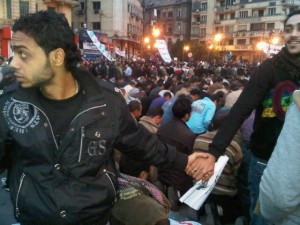
Christians Protect Muslims while they perform prayer in Egypt!


What will you call this? Humanity or Faith relationship? In my view i call this an helpful hand given by brother of one faith towards a brother of another faith.

Yep, Christians shielded Muslims while they perform the prayer in Egypt.
Sounds chilling.
I reckon its the favor returned back.
Favor how?
Lets date back to Christmas on Dec 2010. Churches in Egypt were attacked by unknown groups and the atmosphere was very nervous among the local Christians. But they got assistance from local Muslims who protected them during the Christmas and now they got the favor back.
There’s a quote in Muslim terminology,
“When God decides to protect you, help will come to you from everywhere”.

Anyway i have uploaded the image of the Christians shielding Muslims.

by Shane @ ThFire.com

Tuesday, December 21, 2010

Hope Breeds


“Hope has two beautiful daughters. Their names are anger and courage; anger at the way things are, and courage to see that they do not remain the way they are.”

Saturday, December 18, 2010

WikiLeaks: Pope wanted Muslim Turkey kept out of EU (?)

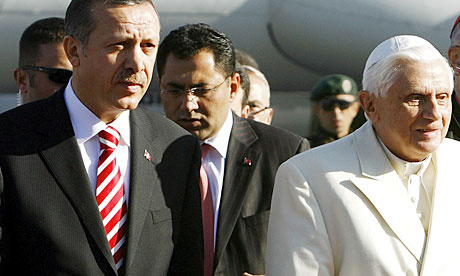
A WikiLeaks cable reports that Pope Benedict XVI, seen here being received by Turkish prime minister Recep Tayyip Erdogan in Ankara in 2006, 'might prefer to see Turkey develop a special relationship short of EU membership'.


The pope is responsible for the Vatican’s growing hostility towards Turkey joining the EU, previously secret cables sent from the US embassy to the Holy See in Rome claim.

In 2004 Cardinal Ratzinger, the future pope, spoke out against letting a Muslim state join, although at the time the Vatican was formally neutral on the question.
The Vatican’s acting foreign minister, Monsignor Pietro Parolin, responded by telling US diplomats that Ratzinger’s comments were his own rather than the official Vatican position.

The cable released by WikiLeaks shows that Ratzinger was the leading voice behind the Holy See’s unsuccessful drive to secure a reference to Europe’s “Christian roots” in the EU constitution. The US diplomat noted that Ratzinger “clearly understands that allowing a Muslim country into the EU would further weaken his case for Europe’s Christian foundations”.
But by 2006 Parolin was working for Ratzinger, now Pope Benedict XVI, and his tone had distinctly chilled. “Neither the pope nor the Vatican have endorsed Turkey’s EU membership per se,” he told the American charge d’affaires, “rather, the Holy See has been consistently open to accession, emphasising only that Turkey needs to fulfil the EU’s Copenhagen criteria to take its place in Europe.”
But he did not expect the demands on religious freedom to be fulfilled: “One great fear is that Turkey could enter the EU without having made the necessary advances in religious freedom. [Parolin] insisted that EU members – and the US – continue to press the [Turkish government] on these issues … He said that short of ‘open persecution’, it couldn’t get much worse for the Christian community in Turkey.”
The cables reveal the American government lobbying within Rome and Ankara for Turkish EU membership. “We hope a senior department official can visit the Holy See and encourage them to do more to push a positive message on Turkey and integration,” concluded the 2006 cable.
But by 2009, the American ambassador was briefing in advance of President Barack Obama’s visit, that “the Holy See’s position now is that as a non-EU member the Vatican has no role in promoting or vetoing Turkey’s membership. The Vatican might prefer to see Turkey develop a special relationship short of membership with the EU.”
Roman Catholicism is the only religion in the world with the status of a sovereign state, allowing the pope’s most senior clerics to sit at the top table with world leaders. The cables reveal the Vatican routinely wielding influence through diplomatic channels while sometimes denying it is doing so. The Vatican has diplomatic relations with 177 countries and has used its diplomatic status to lobby the US, United Nations and European Union in a concerted bid to impose its moral agenda through national and international parliaments.
The US charge d’affaires D Brent Hardt told Parolin, his diplomatic counterpart in Rome, of “the Holy See’s potential to influence Catholic countries to support a ban on human cloning” to which Parolin emphasised his agreement with the US position and promised to support fully UN efforts for such a ban.
On other global issues such as climate change, the Vatican sought to use its moral authority as leverage, while refusing itself to sign formal treaties, such as the Copenhagen accord, that require reporting commitments.
At a meeting in January this year Dr Paolo Conversi, the pope’s representative on climate change at the Vatican’s secretariat of state, told an American diplomat that the Vatican would “encourage other countries discreetly to associate themselves with the accord as opportunities arise”.
The Americans noted that Conversi’s offer to support the US, even if discreetly, was significant because the Vatican was often reluctant to appear to compromise its independence and moral authority by associating itself with particular lobbying efforts.
“Even more important than the Vatican’s lobbying assistance, however, is the influence the pope’s guidance can have on public opinion in countries with large Catholic majorities and beyond.”
The cables also reveal that the Vatican planned to use Poland as a trojan horse to spread Catholic family values through the structures of the European Union in Brussels.
The then US ambassador to the Holy See, Francis Rooney, briefed Washington in 2006, shortly after the election of Pope Benedict XVI, that “the Holy See hopes that Poland will hold the line at the EU on ‘life and family’ issues that arise” and would serve as a counterweight to western European secularism once the country had integrated into the EU.
The cable notes that Pope Benedict is preoccupied with Europe’s increasing psychological distance from its Christian roots.
“He has continued to focus on Poland’s potential in combating this trend. This was one of the themes of the visit of several groups of Polish bishops to the Vatican at the end of last year [2005]. ‘It’s a topic that always comes up,’ explained Monsignor Michael Banach, the Holy See minister of foreign affairs country director for Poland. He told us that the two sides recognised that the Polish bishops needed to exert leadership in the face of western European secularism.”
Across the Atlantic, the Vatican has told the Americans it wants to undermine the Venezuelan president, Hugo Chávez, in Latin America because of worries about the deterioration of Catholic power there. It fears Chávez is seriously damaging relations between the Catholic church and the state by identifying the church hierarchy as part of the privileged class.
Monsignor Angelo Accattino, in charge of Caribbean and Andean matters for the Vatican, said Obama should reach out to Cuba “in order to reduce the influence of Chávez and break up his cabal in Latin America”.In December last year, America’s adviser for western Europe at the UN, Robert Smolik, said the Vatican observer was “as always active and influential behind the scenes” and “lobbied actively and influentially in the corridors and in informal consultations, particularly on social issues”.
In 2001 another American diplomat to the Vatican stated: “The Holy See will continue to seek to play a role in the Middle East peace process while denying this intention.”


Source : Guardian

Monday, December 6, 2010

Savior


         Qui tollis peccata mundi...

My Author Of The Month (November)


Thanks John ,I felt your words stood by me in the miserable moments of last sunday.I had enjoyable moments reading this book.It's easy to read,practical and highly inspirational.I can see how it made its way to the market .

Saturday, December 4, 2010

Universal Declaration of Human Rights

Article 2
Everyone is entitled to all the rights and freedoms set forth in this Declaration,without distiction of any kind,such as race ,color,sex,language,religion,political or other opinion,national or social origin,property,birth or other status .
Furthermore ,no distiction shall be made on the basis of the political,jurisdictional or international status of the countryor territory to which a person belongs,whether it be independent ,trust,non-self-governing or under any other limitation of sovereignty.

Thursday, November 4, 2010

Leadership and Leitkultur


Since the end of August Germany has been roiled by waves of political turmoil over integration, multiculturalism and the role of the “Leitkultur,” or guiding national culture. This discourse is in turn reinforcing trends toward increasing xenophobia among the broader population.
These trends have been apparent for many years in studies and survey data that show a quiet but growing hostility to immigrants. Yet it is as though they have only now found a voice: the usual stereotypes are being flushed out of the bars and onto the talk shows, and they are echoed by mainstream politicians who want to capture potential voters who are otherwise drifting off toward the right. Two events have given rise to a mixture of emotions that are no longer easy to locate on the scale from left to right — a book by a board member of Germany’s central bank and a recent speech by the German president.
It all began with the advance release of provocative excerpts from “Germany Does Away With Itself,” a book that argues that the future of Germany is threatened by the wrong kind of immigrants, especially from Muslim countries. In the book, Thilo Sarrazin, a politician from the Social Democratic Party who sat on the Bundesbank board, develops proposals for demographic policies aimed at the Muslim population in Germany. He fuels discrimination against this minority with intelligence research from which he draws false biological conclusions that have gained unusually wide publicity.
In sharp contrast to the initial spontaneous objections from major politicians, these theses have gained popular support. One poll found that more than a third of Germans agreed with Mr. Sarrazin’s prognosis that Germany was becoming “naturally more stupid on average” as a result of immigration from Muslim countries.
After half-hearted responses in the press by a handful of psychologists who left the impression that there might be something to these claims after all, there was a certain shift in mood in the news media and among politicians toward Mr. Sarrazin. It took several weeks for Armin Nassehi, a respected sociologist, to take the pseudoscientific interpretation of the relevant statistics apart in a newspaper article. He demonstrated that Mr. Sarrazin adopted the kind of “naturalizing” interpretation of measured differences in intelligence that had already been scientifically discredited in the United States decades ago.
But this de-emotionalizing introduction of objectivity into the discussion came too late. The poison that Mr. Sarrazin had released by reinforcing cultural hostility to immigrants with genetic arguments seemed to have taken root in popular prejudices. When Mr. Nassehi and Mr. Sarrazin appeared at the House of Literature in Munich, a mob atmosphere developed, with an educated middle-class audience refusing even to listen to objections to Mr. Sarrazin’s arguments.
Amid the controversy, Mr. Sarrazin was forced to resign from the Bundesbank board. But his ouster, combined with the campaign against political correctness started by the right, only helped to strip his controversial arguments of their odious character. Criticism against him was perceived as an overreaction. Hadn’t the outraged chancellor, Angela Merkel, denounced the book without having read it? Wasn’t she now doing an about-face, by telling young members of her Christian Democratic Union party that multiculturalism was dead in Germany? And hadn’t the chairman of the Social Democrats, Sigmar Gabriel, the only prominent politician to counter the substance of Mr. Sarrazin’s claims with astute arguments, met with resistance from within his own party when he proposed expelling the unloved comrade?
The second disturbing media event in recent weeks was the reaction to a speech by the newly elected German president, Christian Wulff. As the premier of Lower Saxony, Mr. Wulff had been the first to appoint a German woman of Turkish origin as a member of his cabinet.
In his speech earlier this month on the anniversary of German unification, he took the liberty of reaffirming the commonplace notion, which former presidents had already affirmed, that not only Christianity and Judaism but “Islam also belongs in Germany.”
After the speech the president received a standing ovation in the Bundestag from the assembled political notables. But the next day the conservative press homed in on his assertion about Islam’s place in Germany. The issue has since prompted a split within his own party, the Christian Democratic Union. It is true that, although the social integration of Turkish guest workers and their descendants has generally been a success in Germany, in some economically depressed areas there continue to be problematic immigrant neighborhoods that seal themselves off from mainstream society. But these problems have been acknowledged and addressed by the German government. The real cause for concern is that, as the Sarrazin and Wulff incidents show, cool-headed politicians are discovering that they can divert the social anxieties of their voters into ethnic aggression against still weaker social groups.
The best example is Bavaria’s premier, Horst Seehofer, who has declared “immigrants from other cultures” to be detrimental and has called for a halt to immigration “from Turkey and Arab countries.” Although statistics show a net outflow of people of Turkish origin, Mr. Seehofer invokes the phobic image of unregulated masses of social parasites crowding into our welfare state networks as a way of building support for his own political aims.


Social and political developments in Germany, given its ghastly history, do not necessarily have the same significance as in other countries. So, are there grounds for concern that the “old” mindsets could undergo a revival?
It depends on what we mean by “old.” What we are seeing is not a revival of the mentalities of the 1930s. Instead, it is a rekindling of controversies of the early 1990s, when thousands of refugees arrived from the former Yugoslavia, setting off a debate on asylum seekers. The Christian Democratic Union and its Bavarian sister party, the Christian Social Union, then endorsed the position that Germany was “not a country of immigration.” At that time hostels for refugees went up in flames and even the Social Democrats gave ground, agreeing in Parliament to a shabby compromise on asylum law.
That dispute was already stimulated by the feeling of an endangered national culture, which had to assert itself as the leitkultur that all newcomers must follow. Yet the controversy of the 1990s was also driven by the fact that Germany had recently reunited and had reached the final stage in an arduous path toward a mentality that provides the necessary underpinning of a liberal understanding of the Constitution.
To the present day, the idea of the leitkultur depends on the misconception that the liberal state should demand more of its immigrants than learning the language of the country and accepting the principles of the Constitution. We had, and apparently still have, to overcome the view that immigrants are supposed to assimilate the “values” of the majority culture and to adopt its “customs.”
That we are experiencing a relapse into this ethnic understanding of our liberal constitution is bad enough. It doesn’t make things any better that today leitkultur is defined not by “German culture” but by religion. With an arrogant appropriation of Judaism — and an incredible disregard for the fate the Jews suffered in Germany — the apologists of the leitkultur now appeal to the “Judeo-Christian tradition,” which distinguishes “us” from the foreigners.
Nevertheless I do not have the impression that the appeals to the leitkultur signal anything more than a rearguard action or that the lapse of an author into the snares of the controversy over nature versus nurture has given enduring and widespread impetus to the more noxious mixture of xenophobia, racist feelings of superiority and social Darwinism. The problems of today have set off the reactions of yesterday — but not those of the day before.
I don’t underestimate the scale of the accumulated nationalistic sentiment, a phenomenon not confined to Germany. But in the light of current events, another trend is of greater concern: the growing preference for unpolitical figures on the political scene, which recalls a dubious trait of German political culture, the rejection of political parties and party politics.
During the parliamentary election of the federal president last summer, Joachim Gauck, the politically inexperienced and non-party-affiliated civil rights campaigner, stood as the opposing candidate to Mr. Wulff, the career politician. Against the majority in the electoral college, Mr. Gauck, a Protestant minister with a history of opposition to the old East German regime, won the hearts of the broader population, and almost won the election.
The same yearning for charismatic figures who stand above the political infighting can be seen in the puzzling popularity of the aristocratic defense minister, Karl-Theodor zu Guttenberg, who, with not much more than his family background, polished manners and a judicious wardrobe, has managed to overshadow Ms. Merkel’s reputation.


Of even greater concern is the sort of street protests we are now witnessing in Stuttgart, where tens of thousands of people have come out against the federal railway corporation’s plan to demolish the old central train station. The protests that have been continuing for months are reminiscent of the spontaneity of the extraparliamentary opposition of the 1960s. Unlike then, though, today people from all age groups and sectors of the population are taking to the streets. The immediate aim is a conservative one: preserving a familiar world in which politics intervenes as the executive arm of supposed economic progress.
In the background, however, there is a deeper conflict brewing over our country’s understanding of democracy. The state government of Baden-Württemberg, where Stuttgart is located, sees the protests narrowly, as simply a question of whether government is legally permitted to plan such long-term megaprojects. In the midst of the turmoil the president of the Federal Constitutional Court rushed to the project’s defense by arguing that the public had already voted to approve it 15 years ago, and thus had no more say in its execution.
But it has since emerged that the authorities did not, in fact, provide sufficient information at the time, and thus citizens did not have an opportunity to develop an informed opinion on which they could have based their votes. To insist that they should have no further say in the development is to rely on a formalistic understanding of democracy. The question is this: Does participation in democratic procedures have only the functional meaning of silencing a defeated minority, or does it have the deliberative meaning of including the arguments of citizens in the democratic process of opinion- and will-formation?
The motivations underlying each of the three phenomena — the fear of immigrants, attraction to charismatic nonpoliticians and the grass-roots rebellion in Stuttgart — are different. But they meet in the cumulative effect of a growing uneasiness when faced with a self-enclosed and ever more helpless political system. The more the scope for action by national governments shrinks and the more meekly politics submits to what appear to be inevitable economic imperatives, the more people’s trust in a resigned political class diminishes.
The United States has a president with a clear-headed political vision, even if he is embattled and now meets with mixed feelings. What is needed in Europe is a revitalized political class that overcomes its own defeatism with a bit more perspective, resoluteness and cooperative spirit. Democracy depends on the belief of the people that there is some scope left for collectively shaping a challenging future.


By : Jurgen Habermas
@NYTIMES
Image : Thilo Sarrazin
Thanks to Hossein for sharing the article

Saturday, September 11, 2010

Ground Zero


The United States of America is and will be a free country ;
There's an  interesting aspect ;subcultures ,minorities are recognized ,respected and given chance to settle down.
It's a free competitive market. A natural selection .If you've got potentials to survive you'll be integrated into the main stream. 
9/11 was the crucial challenge and a lesson of tolerance to the world.An unmasking of a creeping immoral fundamentalism.
how to treat this aggressive ideology,doing a criminal act in your soil,killing thousands of innocent people...
I think 9/11 was a though test but eventually expanded the limits of tolerance, and hopefully brought a new horizon of immunity and peace. Blind extremism  will gradually turn out to be a rude and ineffectual game in the context of human civilization.


Now the souls deepen their belief in common humanistic values.
 United States always put aside the ethnic and religious differences and offered  its majestic weapon:
"Free Speech "

Pedram
September 11th 2010

Monday, September 6, 2010

Believer

Miracle doesn't help a true believer , nesting faith in his heart  !