in World War II only 15 to 20 percent of riflemen ever fired their guns. The rest? Running messages, helping people load ammunition, tending to buddies—but not aiming a rifle at someone nearby and pulling a trigger. Psychologists of warfare emphasize how, in the heat of battle, people don’t shoot another human out of hatred or obedience, or even from knowing that this enemy is trying to kill them. Instead it’s the pseudokinship of bands of brothers—to protect your buddies, to not let the guys next to you down. But outside those motivations, humans show a strong natural aversion to killing at close range.Sapolsky, Robert M.. Behave (p. 645). Penguin Publishing Group. Kindle Edition.
Showing posts with label Science. Show all posts
Showing posts with label Science. Show all posts
Tuesday, December 7, 2021
An Excerpt from Behave


Wednesday, December 16, 2020
Categorical Buckets

However, it is erroneous scientifically and misleading practically, when we are dealing with complex multi-faceted phenomena. The so-called well-framed knowledge is dealing with categorical buckets and is leading to a fractured understanding of facts. This notion raises the question of an optimal approach.
The multidisciplinary approach and the teamwork in an intellectual sense is probably the best available option, It is surprising how distant fields benefit from the synergistic impact they can induce on each other when working in tandem.
Picture: Walk for Science, Pittsburgh, August 2017
Sunday, November 8, 2020
COVID-19: Information and Misinformation
There is an informative JAMA publication by Dr. Bruce Miller that addresses the current state of information regarding the pandemic. The interference of misinformation with information is described as a severe threat to such complex public health issues. An array of symptoms include antimask behavior, antivaccine beliefs, conspiracy theories about the origins of COVID-19, and vocal support by elected officials for unproven therapies. Some articles pointed out that only 50% heed the recommendations to wear a mask in public places. The relationship between antiscience viewpoints and low science literacy underscores new findings regarding the brain mechanisms that form and maintain false beliefs. Here is the summary of this publication:
Science Literacy Is Essential
Friday, March 20, 2020
Early-career Setbacks: A Mixed Psychological Effect
The following is an excerpt from a very interesting study by Wang et al.
You can find the full-text here: https://arxiv.org/pdf/1903.06958.pdf
“Science is 99 percent failure, and that’s an optimistic view”, said Robert Lefkowitz, who was awarded the Nobel prize in 2012 for his groundbreaking studies of G protein-coupled receptors. Despite the ubiquitous nature of failures, it remains unclear if a setback in an early career may augment or hamper an individual’s future career impact. Indeed, the Matthew effect suggests a rich get richer phenomenon where early-career success helps bring future victories. In addition to community recognition, bringing future attention and resources, success may also influence individual motivation, where positive feedback bolsters self-confidence. Together, these views indicate that it is early-career success, not failure, that would lead to future success. Yet at the same time other mechanisms suggest that the opposite may also be true. Indeed, screening mechanisms suggest that, if early-career failures screen out less-determined researchers, early setbacks among those who remain could, perhaps counterintuitively, become a marker for future achievement. Further, failure may teach valuable lessons that are hard to learn otherwise, while also motivating individuals to redouble effort, whereas success may be associated with complacency or reduced future effort due to utility maximization. Such positive views of failure are reflected in Nietzsche’s classic phrase “what doesn’t kill me makes me stronger”, in the celebration-of-failure mindset in Silicon Valley, and in a recent commencement address by U.S. Supreme Court chief justice John Roberts, who told graduating students “I wish you bad luck.” Overall, these divergent perspectives indicate that the net effect of an early-career setback is unclear. Given the consequential nature of this question to individual careers and the institutions that support and nurture them, and building on the remarkable progress in our quantitative understanding of science, here we ask: Can an early-career setback lead to future career impact?
You can find the full-text here: https://arxiv.org/pdf/1903.06958.pdf
“Science is 99 percent failure, and that’s an optimistic view”, said Robert Lefkowitz, who was awarded the Nobel prize in 2012 for his groundbreaking studies of G protein-coupled receptors. Despite the ubiquitous nature of failures, it remains unclear if a setback in an early career may augment or hamper an individual’s future career impact. Indeed, the Matthew effect suggests a rich get richer phenomenon where early-career success helps bring future victories. In addition to community recognition, bringing future attention and resources, success may also influence individual motivation, where positive feedback bolsters self-confidence. Together, these views indicate that it is early-career success, not failure, that would lead to future success. Yet at the same time other mechanisms suggest that the opposite may also be true. Indeed, screening mechanisms suggest that, if early-career failures screen out less-determined researchers, early setbacks among those who remain could, perhaps counterintuitively, become a marker for future achievement. Further, failure may teach valuable lessons that are hard to learn otherwise, while also motivating individuals to redouble effort, whereas success may be associated with complacency or reduced future effort due to utility maximization. Such positive views of failure are reflected in Nietzsche’s classic phrase “what doesn’t kill me makes me stronger”, in the celebration-of-failure mindset in Silicon Valley, and in a recent commencement address by U.S. Supreme Court chief justice John Roberts, who told graduating students “I wish you bad luck.” Overall, these divergent perspectives indicate that the net effect of an early-career setback is unclear. Given the consequential nature of this question to individual careers and the institutions that support and nurture them, and building on the remarkable progress in our quantitative understanding of science, here we ask: Can an early-career setback lead to future career impact?
To offer quantitative answers to this question, we leverage a unique dataset, containing all R01 grant applications ever submitted to the NIH, to examine early-career success and failure. NIH funding decisions are largely determined by paylines derived from evaluation scores. Our empirical strategy harnesses the highly nonlinear relationship between funding success and evaluation score around the funding threshold. Indeed, focusing on individuals whose proposals fell just above and below the threshold allows us to compare observationally-similar individuals who are either near misses (individuals who just missed receiving funding) or narrow wins (individuals who just succeeded in getting funded). Here we focus on junior scientists by examining principal investigators (PIs) whose first application to the NIH was within the previous three years. We combine the NIH grant database with the Web of Science data, tracing their NIH R01 grant applications between 1990 and 2005 together with research outputs by the PIs, measured by their publication and citation records (see Supplementary Note 1 for details). In total, our analyses yielded 561 narrow wins and 623 near misses around the payline.
Published in Nature Communications
Published in Nature Communications
Sunday, August 25, 2013
Well Being Not a Priority
Working overtime may cost you your health, according to a Kansas State University doctoral researcher.
Sarah Asebedo, doctoral student in personal financial planning and conflict resolution, Edina, Minn., conducted a study using the National Longitudinal Survey of Youth 1979. She and her colleagues -- Sonya Britt, assistant professor of family studies and human services and director of the university's personal financial planning program, and Jamie Blue, doctoral student in personal financial planning, Tallahassee, Fla. -- found a preliminary link between workaholics and reduced physical and mental well-being. The study, "Workaholism and Well-Being," will appear in Financial Services Review, a journal of individual financial management.
"We looked at the association between workaholism and physical and mental well-being," Asebedo said. "We found workaholics -- defined by those working more than 50 hours per week -- were more likely to have reduced physical well-being, measured by skipped meals. Also, we found that workaholism was associated with reduced mental well-being as measured by a self-reported depression score."
The link between workaholism and well-being has been assumed for years; however, there was a lack of research supporting the link until this study, Asebedo said. To understand why people work overtime even when they know it is not good for their well-being, the researchers used Gary S. Becker's Theory of the Allocation of Time, a mathematical analysis for choice measuring the cost of time.
"It looks at the cost of time as if it were a market good," Asebedo said. "This theory suggests that the more money you make, the more likely you are to work more. If you are not engaged in work-related activities, then there is a cost to the alternative way in which time is spent. Even if you understand the negative consequences to workaholism, you may still be likely to continue working because the cost of not doing so becomes greater."
According to Asebedo, Becker's theory suggests that not only can working more make a person wealthier but it also creates less leisure time to spend money. As income increases a person may be more likely to work more and create an unhealthy habit.
As a full-time wealth manager for Accredited Investors in Edina, Asebedo has found the research useful in counseling clients. She advises workaholics to be aware of the effect excessive work has on their physical and mental well-being and to be prepared for what they can do to mitigate or counteract the effects during busy work periods.
"From a financial planning and counseling perspective, it's good to be aware of workaholism," Asebedo said. "It helps me understand what can be the cause of my clients' stress. It's just a reminder that you may want to dig a bit deeper into clients' work lives. Sometimes you might find that they don't like what they are doing and they want to make a change, yet financially, they don't know how they can accomplish that."
Asebedo received her bachelor's and master's degrees from Kansas State University. She returned to the university to get her doctorate in personal financial planning through the Division of Continuing Education distance program because she was interested researching the role conflict resolution plays in financial planning.
Data for the study was taken from the National Longitudinal Survey of Youth 1979 cohort, a nationally representative sample of 12,686 young men and women who were interviewed on an annual basis from 1979 through 1994 and are currently interviewed on a biennial basis.
Source: Kansas State University
Monday, August 12, 2013
به برادران کاشف ژن قره باغ رحیم
نتیجه ی فضاحت معدودی دوستان بیسیک ساینس در کپی-پیست کردن دستاوردهای علمی، آحاد جامعه ی علمی کشور را
. مستفیض کرده
در دو مقطع با این جماعت دوست داشتنی همکاری داشتم و البته هر دو هم به اصطکاک های زیاد منجرشدند.این موضع حق بجانب،غیر علمی و کاسب مسلکانه از پی اچ دی های وطنی به یادم می ماند.ان شا الله مقاله چاپ کنند،مریض ببینند!، دیتا جمع آوری کنند یا اگر کم آوردند دیتا سنتزکنند...گوارای ایشان باشد. اما من عاشق روحیه ی علمی آن دانشجوی بی پشتوانه ای هستم که صبح تا شبش با فکر پژوهش و علم سپری شد.آن که علم شد روش زندگیش. آن که فردیتش همیشه عامل ثانویه بود و البته جزایش را هم پرداخت.
Tuesday, July 30, 2013
Publication Ethics: Unintended consequences of sanctions
The latest changes to US sanctions on Iran, designed to discourage the country from developing nuclear weapons, seem to have caused confusion, leading to some journal editors effectively boycotting research from Iranian medical practitioners and academics.
Regulations set out by the US Office of Foreign Assets Control state that US citizens are authorised to engage in ordinary transactions related to written publications as long as the parties to the transactions are not employed by the Iranian government. Most Iranian universities, hospitals, and research centers are government owned but the regulations specify that the sanctions do not apply to any academic and research institutions or their staff.
Nevertheless, Iranian doctors have told the BMJ that several papers have been refused by journals in the US and Australia in recent months because of the sanctions.
The editor of the Journal of Allergy and Clinical Immunology (JACI), which is owned by Elsevier, explained in an email to an assistant professor in the department of paediatrics at Tehran University of Medical Sciences that the journal could not accept his paper because “US owned journals are unable to handle scientific manuscripts which are authored by Iranian scientists, employed by the Government of Iran.”
Papers from Iranians are also known to have been turned down by the American Journal of Cardiology (also published by Elsevier), the Journal of Ocular Pharmacology and Therapeutics (published in the US by Marie Ann Liebert), and the Australian journal Ophthalmic Epidemiology (published by Informa Healthcare in the UK), all of whom explained that US sanctions prevented them from considering the research.
Dove Medical Press (an open access online publisher whose headquarters are in the UK and editorial office is in New Zealand) turned down a paper saying that “international sanctions currently in place against Iran mean that Dove Medical Press is no longer able to process manuscripts received from Iranian authors.”
“We do not make this decision lightly and have consulted with the authorities both here in New Zealand and in the United Kingdom before making our decision,” said Jeanette Pearce, Dove’s New Zealand based operations manager.
“It is not ethical to treat Iranian researchers this way,” Behrooz Astaneh, acting editor of the Iranian Journal of Medical Science, told the BMJ. “These people want to disseminate data they have obtained in very difficult circumstances because of the sanctions. Research publication should be on merit and have nothing to do with politics.”
Protecting editors
According to a report from Science magazine, Elsevier advised its US editors in April against handling any papers authored by employees of the government of Iran and in an email shown to the BMJ, the editor of JACI explained, “our publisher precludes taking any articles from authors based at Iranian institutions or hospitals.” Yet, Elsevier says it believes in the “free flow of ideas and information as a principle for science and for society” and chief lawyer, Mark Seeley, told the BMJ that the company continues to publish papers from Iranian academics and researchers affiliated with academic or medical institutions. Elsevier decided it was necessary to make “narrowly crafted exceptions” because of the potential for personal liability on the part of its US editors.
Asked if some US editors had possibly misunderstood the publisher’s guidance on this, Seeley responded that the problem was over “the exact definition of ‘government employees’ other than academics and practitioners. Seeley said the company was seeking greater clarity but had not yet received it.
John Sullivan of the US Treasury told the BMJ that “The focus of our sanctions is the Iranian regime and its support for terrorism and its illicit nuclear programme. Our sanctions do not target academic or informational materials.”
A different view
Other American health publications, including the two leading journals the New England Journal of Medicine and Journal of the American Medical Association, said they were continuing to publish Iranian submissions on merit.
“Different journals have adopted very different strategies on this,” Elaheh Malakan Rad, associate professor of paediatric interventional cardiology at the Children’s Medical Centre in Tehran, told the BMJ. “There needs to be clear guidance on the ethical issue here.”
The Committee on Publication Ethics (COPE), which advises editors on handling ethically sensitive issues, discussed problems surrounding Iranian authors in a June meeting and affirmed the need, already previously agreed because of other concerns, that clearer guidance is needed. COPE is planning to add a paragraph to its code of conduct stating that, “Editorial decisions should not be affected by the origins of the manuscript, including the nationality, ethnicity, political beliefs, race, or religion of the authors. Decisions to edit and publish should not be determined by the policies of governments or other agencies outside of the journal itself.”
The United Kingdom government has also changed its sanctions recently and continually updates a list of banned authors and institutions thought to be involved in Iran’s nuclear programme. However, the BMJ continues to take papers on merit and has chosen in some instances to waive the usual author fee charged for open access publication of research because of regulations over bank transactions with Iran.
“The BMJ is against academic boycotts and has no restrictions on publishing articles from authors in Iran,” the BMJ’s editor, Fiona Godlee, said in a statement posted on bmj.com. “We have noted the UK’s restrictions on trading with Iran and are also aware of the new US restrictions. These may have implications for whether we can levy an author fee from an author in Iran. We will decide this on a case by case basis.”
Richard Horton, the editor of the Lancet (which is owned by Elsevier) said: “TheLancet welcomes and encourages research from scientists in all countries, including Iran. Indeed, we are currently working to strengthen our links with Iranian medical and public health scientists.”
by: Sophie Arie
@BMJ
Tuesday, December 11, 2012
Trade Offs Between Being Smart and Not Being Smart

Humans don't have a monopoly on being smart: many other animals, including birds, can solve problems and even make and use tools.
But does it always pay for animals to be brainy or are there hidden costs?
A recent study of great tits, published in Current Biology, gives an insight into the trade-offs between problem-solving abilities and other traits. The work was conducted by Ella Cole of Oxford University's Department of Zoology and Julie Morand-Ferron and led by John Quinn. I asked Ella about birds, brains, and strategies…
OxSciBlog: What makes great tits good for studying problem-solving?
Ella Cole: Great tits are well-known for their ability to problem-solve in order to find food, ranking among the top 20 most innovative avian species. This ability to solve novel problems or find new food sources may be one reason why great tits are able to survive in such a variety of different habitats.
Ella Cole: Great tits are well-known for their ability to problem-solve in order to find food, ranking among the top 20 most innovative avian species. This ability to solve novel problems or find new food sources may be one reason why great tits are able to survive in such a variety of different habitats.
In our work with the tits, we try to establish whether good and poor problem solvers differ in how they forage in the wild and how successful they are at reproducing. Our problem solving trials are carried out in captivity under standardised conditions. We therefore need to test large numbers of individuals as we cannot be certain how many birds we will be able to find again once they are released back into the wild.
Great tits are an excellent study species because they can be caught in large numbers, easily adapt to captive conditions and take to nest boxes allowing us to monitor their foraging behaviour and breeding success in the wild.
OSB: What links did you find between problem-solving and successfully raising offspring?
EC: We found that females that could problem-solve in captivity laid more eggs than their non-solving counterparts when released back into the wild. If their nests did not fail, these solvers also fledged more chicks than non-solvers.
EC: We found that females that could problem-solve in captivity laid more eggs than their non-solving counterparts when released back into the wild. If their nests did not fail, these solvers also fledged more chicks than non-solvers.
Even though the quality of food fed to chicks did not differ between solvers and non-solvers, solvers had much smaller foraging ranges and foraged for less time each day than non-solvers, suggesting they may be generally more efficient at finding food.
Interestingly though, female problem-solvers were more likely to desert their chicks than non-solving females, leading to no overall fitness difference between solvers and non-solvers. These findings provide the first convincing evidence that problem-solving abilities may influence reproductive success in wild populations.
OSB: What do your results tell us about the costs of being smart?
EC: Our finders suggest there may be costs as well as benefits to being smart. We find that problem solvers are more likely to desert their nests, which is a common adaptive behaviour amongst birds in response to unfavourable conditions.
EC: Our finders suggest there may be costs as well as benefits to being smart. We find that problem solvers are more likely to desert their nests, which is a common adaptive behaviour amongst birds in response to unfavourable conditions.
Although their offspring will die, deserters can preserve their resources for themselves and therefore breed again when conditions may be more favourable. We show that desertion in our population may be a direct response to trapping by field workers – a procedure that is carried out in order to establish the identities of breeding birds (via reading their unique leg bands).
It is likely therefore that solvers may be more sensitive to human interference at the nest (which they are likely to perceive as a predation attempt), indicating that they are generally more cautious or anxious than non-solvers.
Why might 'being smart' not always be the best strategy?
EC: Being smart is costly. In humans, for example, the brain only accounts for 2% of an adult’s body weight, but it consumes about 20% of the resting metabolic rate [Clarke and L. Sokoloff 1999].
EC: Being smart is costly. In humans, for example, the brain only accounts for 2% of an adult’s body weight, but it consumes about 20% of the resting metabolic rate [Clarke and L. Sokoloff 1999].
As resources are limited in nature, energy spent on the brain must be diverted from something else such as maximising body size and strength. Therefore although in some environments it will pay to be brainy, in others animals may benefit instead by investing resources in being good at competing or fleeing predators.
Whether being smart is favoured by selection is therefore likely to depend on the specific selective pressures acting in a given environment. In a previous study we showed that problem solver great tits are poorer at competing for limited food resources than non-solvers, and in the current study we find that solvers may also be more timid. These correlations provide support for the idea that trade-offs may exist between problem-solving ability and other traits linked to fitness, and therefore that being smart may not always be the best strategy.
What further studies are needed to explore the link between 'smarts' and 'success' in great tits?EC: Our paper provides an important first step to understanding how selection may act on individual variation in cognitive performance in animal populations. However, more work is needed to understand exactly how being a good problem solver helps animals do well in the wild: for example, are they better at finding novel food sources when most needed, or are they quicker generally at learning to cope with challenges in their environment?
Another useful area of research will be to further explore the costs of being smart. In our paper we show that solvers are more sensitive to disturbance at the nest than non-solvers, leading to high nest failure, but whether they also show a stronger response to natural predation attempts remains to be tested.
Finally, it will also be very interesting and informative to explore how different types of cognitive traits (such as learning ability) relate to fitness, and to test the prediction that the costs of being smart will lead to high cognitive performance only being favoured in environments that are especially cognitively demanding.
by : Pete Wilton
@ox.ac.uk
Wednesday, July 20, 2011
Wow

Marine researchers in South Africa had a narrow escape after a three-metre-long great white shark breached the surface of the sea and leapt into their boat, becoming trapped on deck for more than an hour.
The incident occurred while the research team was conducting a shark population study off Seal Island, near Mossel Bay, on South Africa's Cape coast.
Using sardines as bait to attract the predators, the seven-strong crew was able to observe four great whites. The animals are renowned locally for bursting through the surface as they prey on seals.
Dorien Schröder, team leader at Oceans Research, based at Mossel Bay, said that last Monday morning, after more than an hour of shark activity around the vessel, the Cheetah, the waters at the stern had been quiet for five minutes. "Next thing I know I hear a splash, and see a white shark breach out of the water from [the] side of the boat hovering, literally, over the crew member who was chumming [throwing food bait] on the port side," she said.
Schröder recounted how she pulled her colleague to safety before the shark, weighing about 500kg (half a ton) landed on top of the bait and fuel containers. At first half of its body was outside the boat but in a panic the shark thrashed its way further on to the vessel, cutting the fuel lines and damaging equipment before becoming trapped between the containers and the stern. The crew found safety at the bow of the boat.
As Schröder poured water over the shark's gills to keep it alive, another boat was sent out to the Cheetah. A rope from the second vessel was secured around the shark's tail, but repeated efforts to tow the fish into the water failed.
The rescue ship then towed Cheetah to the port with the shark still on deck. A hosepipe was placed in the fish's mouth to ventilate its gills, before it was lifted off the boat with a crane, then lowered back into the water.
Though the shark swam away it was unable to navigate its way out of the harbour and soon beached. With Oceans Research's co-director, Enrico Gennari, an expert on great white sharks, the team tried unsuccessfully to "walk" the shark back to sea. Finally they tied ropes to the shark's tail fin and behind its pectoral fin, and attached these ties to the rescue vessel, which towed the shark out through the harbour estuary. The ropes were then removed and the animal swam away.
Gennari said it was the first time he had heard of a great white shark jumping onto a research vessel. He estimated the predator would have had to have leapt about three metres out of the water to be able to land on the boat. A smaller vessel would have capsized, he said.
As for the cause of the shark's behaviour, Gennari said it was almost certainly an accident rather than an attack on the boat. In the low-visibility water the fish could have mistaken the vessel's shadow for prey, or been disturbed by another shark close by, he said.
"It's all speculation," he said. "But sometimes a shark breaches the surface when it feels another shark underneath it. They [move] like a flying fish and end up several metres away."
@Guardian
pic :A great white shark off Seal Island, South Africa. The animal on the Cheetah would have leapt three metres out of the water, scientists said. Photograph: Chris Brunskill Ltd/Rex Features
Saturday, April 30, 2011
Appeals Court Overturns Stem Cell Research Ban

Opponents of taxpayer-funded stem cell research lost a key round in a U.S. appeals court Friday.
In a 2-1 decision, a panel of the court of appeals in Washington overturned a judge's order that would have blocked taxpayer funding for stem cell research. The judges ruled that opponents of taxpayer-funded stem cell research are not likely to succeed in their lawsuit to stop it.
The panel reversed an opinion issued last August by U.S. District Judge Royce Lamberth, who said the research likely violates the law against federal funding of embryo destruction.
"We're thrilled with this decision and look forward to allowing federally funded scientists to continue with their work without political constraints," said Sean Tipton, a spokesman for the American Society for Reproductive Medicine.
Researchers hope one day to use stem cells in ways that cure spinal cord injuries, Parkinson's disease and other ailments. Opponents say the research is a form of abortion because human embryos must be destroyed to obtain the stem cells.
The 1996 law prohibits the use of taxpayer dollars in work that harms an embryo, so private money has been used to cull batches of the cells. Those batches can reproduce in lab dishes indefinitely, and the Obama administration issued rules permitting taxpayer dollars to be used in work on them
The lawsuit was filed by two scientists who argued that President Obama's expansion jeopardized their ability to win government funding for research using adult stem cells — ones that have already matured to create specific types of tissues — because it will mean extra competition.
Lamberth, the chief judge of the U.S. District Court in Washington, issued a preliminary injunction in August to block the research while the case continued.
The Obama administration immediately appealed and requested the order be stopped. The appeals court quickly ruled that the research could continue at the National Institutes of Health while the judges took up the case.
The opinion tossing out Lamberth's ruling was written by Judge Douglas Ginsburg, nominated to the court by President Ronald Reagan, and supported by Judge Thomas Griffith, a nominee of President George W. Bush. The dissent came from Judge Karen LeCraft Henderson, a nominee of President George H.W. Bush; she agreed with the lower court judge that the lawsuit was likely to succeed.
As a result of the appellate ruling Friday, the original lawsuit can continue before Judge Lamberth, but the taxpayer-funded research also will go on. Lamberth hasn't thus far either held a trial or issued a final ruling, which he could do based on court filings without taking testimony.
Once the cells are culled, they can reproduce in lab dishes indefinitely. So government policies said using taxpayer dollars to work with the already-created batches of cells is allowed.
The Obama administration has expanded the number of stem cell lines created with private money that federally funded scientists could research, up from the 21 that President George W. Bush had allowed to at least 75 so far. To qualify, parents who donate the original embryo must be told of other options, such as donating to another infertile woman.
Congress twice passed legislation specifically calling for tax-funded stem cell research, which President Bush vetoed.
@AP
Pic : Judge Royce Lamberth
Friday, February 11, 2011
درباره ی دانش راستین

برای اکثر اهل فضل دانش وسیله است نه هدف. به همین دلیل است که ایشان هرگز
کاربزرگی انجام نخواهند داد:زیرا برای انجام کارهای بزرگ،آن که دانش می جوید باید آن را چون هدفی دنبال کند و هر چیز دیگرو حتی خود هستی را وسیله بداند.زیرا هر چیزی که انسان برای خاطر خود ان چیز به دنبالش نباشد،بی ارزش است :و فضیلت حقیقی تنها آن جا به دست می آید که اثر برای خاطر خودش خلق شده باشد، و نه به عنوان وسیله ای برای نیل به اهداف برتر.بنابراین کسی که برای خوددانش به دنبال کسب آن نباشد ومقصود اصلی مطالعاتش را درگیری با دانش دیگران بسازد،هرگز موفق به خلق اثری حقیقتا باشکوه و اصیل درراه اندیشه نخواهد شد...آرتور شوپنهاور
از کتاب "جهان و تاملات فیلسوف"گزیده هایی از نوشته های آرتور شوپنهاور ترجمه ی رضا ولی یاری
Thursday, February 10, 2011
How to Check Your Scientific Paper for Plagiarism?
We were taught in grammar school that plagiarism is wrong. It is stealing someone else’s property.
Imagine in high school asking your mother to buy you “Cliff Notes” so you can copy it word for word. Mother would not have liked that, and it wouldn’t have been right.
To write an essay today, you’ll probably start with a search engine. Instantly, Mr. Google delivers many intelligent commentaries on anything, probably better than you would write. You can copy them piece by piece, paste them into your paper, and, voila!, you’re done!
Except, you stole.
It may not feel like cheating to copy and paste, but it’s little different than copying a book by candlelight with pen and paper.
There is one difference. You can be caught. Guaranteed!
Many high school students now are taught to use a program from www.turnitin.com to test whether their work is plagiarized by checking it against everything that has been published online.
If there is plagiarism, TurnItIn will identify it.
Editors of some scientific journals now use a program called Cross Check powered by www.iThenticate.com.
Steven Shafer is the editor of the research journal Anesthesia & Analgesia. He uses Cross Check to examine every one of the 2,000 annual submissions he receives!
And he finds that around one out of every 10 submissions is at least partly plagiarized.
Oh my! What to do?
Programs like TurnItIn and Cross Check are expensive, but there are free programs as well like www.doccop.com.
Doc Cop — D-O-C C-O-P — chops the text into pieces, and uses Google to search the Internet for matching text.
Since many papers have multiple authors, the only way for the guarantor author to know that the final paper does not contain plagiarized text is to run it through a program like Doc Cop prior to submission.
Authors and potential authors of papers submitted to medical and science journals should follow the lead of students to protect themselves against allegations of plagiarism.
Plagiarism is a form of scientific misconduct, even fraud, and such a finding can be hazardous to your career.
Don’t plagiarize. If you do, you will be caught.
by : George Lundberg
George Lundberg is a MedPage Today Editor-at-Large and former editor of the Journal of the American Medical Association.
Imagine in high school asking your mother to buy you “Cliff Notes” so you can copy it word for word. Mother would not have liked that, and it wouldn’t have been right.
To write an essay today, you’ll probably start with a search engine. Instantly, Mr. Google delivers many intelligent commentaries on anything, probably better than you would write. You can copy them piece by piece, paste them into your paper, and, voila!, you’re done!
Except, you stole.
It may not feel like cheating to copy and paste, but it’s little different than copying a book by candlelight with pen and paper.
There is one difference. You can be caught. Guaranteed!
Many high school students now are taught to use a program from www.turnitin.com to test whether their work is plagiarized by checking it against everything that has been published online.
If there is plagiarism, TurnItIn will identify it.
Editors of some scientific journals now use a program called Cross Check powered by www.iThenticate.com.
Steven Shafer is the editor of the research journal Anesthesia & Analgesia. He uses Cross Check to examine every one of the 2,000 annual submissions he receives!
And he finds that around one out of every 10 submissions is at least partly plagiarized.
Oh my! What to do?
Programs like TurnItIn and Cross Check are expensive, but there are free programs as well like www.doccop.com.
Doc Cop — D-O-C C-O-P — chops the text into pieces, and uses Google to search the Internet for matching text.
Since many papers have multiple authors, the only way for the guarantor author to know that the final paper does not contain plagiarized text is to run it through a program like Doc Cop prior to submission.
Authors and potential authors of papers submitted to medical and science journals should follow the lead of students to protect themselves against allegations of plagiarism.
Plagiarism is a form of scientific misconduct, even fraud, and such a finding can be hazardous to your career.
Don’t plagiarize. If you do, you will be caught.
by : George Lundberg
George Lundberg is a MedPage Today Editor-at-Large and former editor of the Journal of the American Medical Association.
Sunday, January 16, 2011
In Vivo Imaging of Early Stage Apoptosis

Bioluminescence imaging (BLI) is a powerful methodology that has been developed over the last decade as a tool for the understanding of biological processes as they occur in living organisms. Recently, this non-invasive technology has evolved into a potentially more valuable.
Abstract
In vivo imaging of apoptosis in a preclinical setting in anticancer drug development could provide remarkable advantages in terms of translational medicine. So far, several imaging technologies with different probes have been used to achieve this goal. Here we describe a bioluminescence imaging approach that uses a new formulation of Z-DEVD-aminoluciferin, a caspase 3/7 substrate, to monitor in vivo apoptosis in tumor cells engineered to express luciferase. Upon apoptosis induction, Z-DEVD-aminoluciferin is cleaved by caspase 3/7 releasing aminoluciferin that is now free to react with luciferase generating measurable light. Thus, the activation of caspase 3/7 can be measured by quantifying the bioluminescent signal. Using this approach, we have been able to monitor caspase-3 activation and subsequent apoptosis induction after camptothecin and temozolomide treatment on xenograft mouse models of colon cancer and glioblastoma, respectively. Treated mice showed more than 2-fold induction of Z-DEVD-aminoluciferin luminescent signal when compared to the untreated group. Combining D-luciferin that measures the total tumor burden, with Z-DEVD-aminoluciferin that assesses apoptosis induction via caspase activation, Scabini et al confirmed that it is possible to follow non-invasively tumor growth inhibition and induction of apoptosis after treatment in the same animal over time. Moreover, here we have proved that following early apoptosis induction by caspase 3 activation is a good biomarker that accurately predicts tumor growth inhibition by anti-cancer drugs in engineered colon cancer and glioblastoma cell lines and in their respective mouse xenograft models.
Published 20 December 2010
Saturday, December 25, 2010
Elusive Saharan Cheetah Captured In Photos
An elusive Saharan cheetah recently came into the spotlight in Niger, Africa, where a hidden camera snapped photos of the ghostly cat, whose pale coat and emaciated appearance distinguish it from other cheetahs.
In one of the images the sleek, light-colored cat with small spots on its coat and a small head is turning in the direction of the camera, its eyes aglow.
Its appearance, and how the Saharan cheetah (Acinonyx jubatus hecki) is genetically related to other cheetahs is open to question, said John Newby, CEO of the Sahara Conservation Fund (SCF), who is part of the team, along with SCF's Thomas Rabeil and others, who captured the camera-trap snapshots between July ad August. What they know about this species comes from the few photos they've managed to capture.
"I think we were more happy than surprised when the images turned up, because we knew cheetahs were in the general area because we had seen their tracks on several occasions," Newby said. "However, the area is so vast that picking up an animal as rare as this always entails a lot of luck and good judgment on where to place the cameras."
The animal is so rare and elusive scientists aren't sure how many even exist, though they estimate from the few observations they've made of the animal and tracks that fewer than 10 individuals call the vast desert of Termit and Tin Toumma in Niger home. Fewer than 200 cheetahs probably exist in the entire Sahara. [10 Species You Can Kiss Goodbye]
Losing this cheetah would also mean losing important genetic and biological diversity, as these animals have adaptations for survival in extreme desert conditions.
Their home can reach sizzling temperatures up to 113 degrees Fahrenheit (45 degrees Celsius), and is so parched no standing water exists. "They probably satisfy their water requirements through the moisture in their prey, and on having extremely effective physiological and behavioral adaptations," Newby said.
In an effort to conserve water and stay out of the heat, the Saharan cheetah is even more nocturnal than other cheetahs.
Spotting these cats in the wild has been a challenge. "They are incredibly shy and elusive animals," Newby said. In addition, they likely have broad home ranges since their prey - gazelles, hares, large birds and smaller rodents - are relatively scarce. Observations that have been made suggest they prefer caves and rock shelters as breeding dens.
Among the threats to the pale cat are scarcity of prey due to poaching and overuse, and conflicts with herders over stock harassment and killing of their animals, according to SCF. Apparently cheetah skins are prized as prayer rugs or used to make slippers.
"They are suspected of taking goats and even baby camels, and as a result are persecuted just like most other large predators," Newby said. "Work underway with local nomads is putting together the true picture of livestock predation in an attempt to reduce the arbitrary slaughter of carnivores that has massively reduced populations of cheetah and striped hyenas."
Newby and Rabeil say the camera-trap study will provide tangible evidence for the cheetah's existence in the Termit area.
"The more we know about the animal the better we can conserve it, including pinpointing key areas for extra protection," Newby said. "The cheetah's presence adds weight to arguments for the entire zone's protection as a nature reserve and strengthens our ability to raise support for conservation activities."
The Saharan cheetah is listed as critically endangered on the 2009 IUCN Red List of Threatened Species. (IUCN stands for International Union for Conservation of Nature.)
In one of the images the sleek, light-colored cat with small spots on its coat and a small head is turning in the direction of the camera, its eyes aglow.
Its appearance, and how the Saharan cheetah (Acinonyx jubatus hecki) is genetically related to other cheetahs is open to question, said John Newby, CEO of the Sahara Conservation Fund (SCF), who is part of the team, along with SCF's Thomas Rabeil and others, who captured the camera-trap snapshots between July ad August. What they know about this species comes from the few photos they've managed to capture.
"I think we were more happy than surprised when the images turned up, because we knew cheetahs were in the general area because we had seen their tracks on several occasions," Newby said. "However, the area is so vast that picking up an animal as rare as this always entails a lot of luck and good judgment on where to place the cameras."
The animal is so rare and elusive scientists aren't sure how many even exist, though they estimate from the few observations they've made of the animal and tracks that fewer than 10 individuals call the vast desert of Termit and Tin Toumma in Niger home. Fewer than 200 cheetahs probably exist in the entire Sahara. [10 Species You Can Kiss Goodbye]
Losing this cheetah would also mean losing important genetic and biological diversity, as these animals have adaptations for survival in extreme desert conditions.
Their home can reach sizzling temperatures up to 113 degrees Fahrenheit (45 degrees Celsius), and is so parched no standing water exists. "They probably satisfy their water requirements through the moisture in their prey, and on having extremely effective physiological and behavioral adaptations," Newby said.
In an effort to conserve water and stay out of the heat, the Saharan cheetah is even more nocturnal than other cheetahs.
Spotting these cats in the wild has been a challenge. "They are incredibly shy and elusive animals," Newby said. In addition, they likely have broad home ranges since their prey - gazelles, hares, large birds and smaller rodents - are relatively scarce. Observations that have been made suggest they prefer caves and rock shelters as breeding dens.
Among the threats to the pale cat are scarcity of prey due to poaching and overuse, and conflicts with herders over stock harassment and killing of their animals, according to SCF. Apparently cheetah skins are prized as prayer rugs or used to make slippers.
"They are suspected of taking goats and even baby camels, and as a result are persecuted just like most other large predators," Newby said. "Work underway with local nomads is putting together the true picture of livestock predation in an attempt to reduce the arbitrary slaughter of carnivores that has massively reduced populations of cheetah and striped hyenas."
Newby and Rabeil say the camera-trap study will provide tangible evidence for the cheetah's existence in the Termit area.
"The more we know about the animal the better we can conserve it, including pinpointing key areas for extra protection," Newby said. "The cheetah's presence adds weight to arguments for the entire zone's protection as a nature reserve and strengthens our ability to raise support for conservation activities."
The Saharan cheetah is listed as critically endangered on the 2009 IUCN Red List of Threatened Species. (IUCN stands for International Union for Conservation of Nature.)
 |
| A hind image showing the Saharan cheetah in the Termit region of Niger, Africa, was captured recently by a camera trap. Credit: Sahara Conservation Fund/WildCRU. |
 |
| The Saharan cheetah is smaller with a paler coat than other cheetahs. Here a photo of the Saharan cheetah captured by a camera trap in a vast desert in Niger, Africa. Credit: Sahara Conservation Fund/WildCRU. |
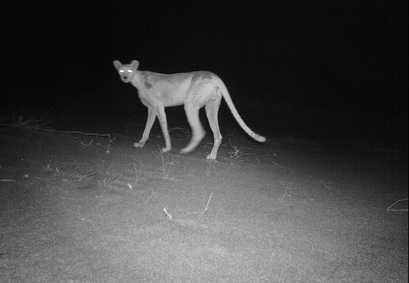 |
| A camera trap recently captured the elusive Saharan cheetah in a vast desert in Niger, Africa. Credit: Sahara Conservation Fund/WildCRU. By Jeanna Bryner, LiveScience Managing Editor |
Wednesday, December 15, 2010
Mice Created From Two Males
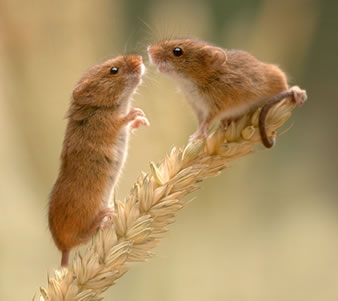
Gay mice couple gives birth to their own genetic child!
According to the study that was published in journal Biology of Reproduction, reproductive scientists in Texas were able to manipulate cells from a male (XY) mouse fetus to produce an induced pluripotent stem (iPS) cell line.
There iPS cells are adult cells that have undergone some genetic reprogramming in order to enter an embryonic stem cell-like state.
Some of the cells that were grown from this new line spontaneously lost their Y chromosome, turning them into XO cells.
Those XO cells were injected into embryos from donor female mice and transplanted into surrogate mouse moms who gave birth to babies with one X chromosome from the original male mouse.
Those babies grew and later mated with normal male mice. There offspring, both male and female, showed genetic contributions from two fathers.
The study was let by Richard R. Berhringer at the MD Anderson Cancer Center.
Researchers said that with a variation of their technique, “it may also to possible to generate sperm from a female done and produce viable male and female progeny with two mothers.”
However, the study cautioned that the ability to replicate the finding in humans was a long way off.
Looks like the first gay mice couple were even able to get their own child!
Monday, November 29, 2010
Top Ten Brains of The Digital Future: Prospect Debate

Two billion people online; half a billion on Facebook; the launch of the iPad, the explosion of digital publishing, the relentless expansion of mobile phone networks through the developing world—2010 has seen astonishing landmarks in the ongoing evolution of digital culture.
Next year will see even more—and an ever-more furious debate surrounding everything from net neutrality to copyright laws, digital business strategies, virtual property rights, the censorship of interactive media and the status of the increasingly complex identities the world’s citizens are building online.
Who are the great minds helping to create the culture of the internet and the world’s powerful digital media? Prospect’s January 2011 list will feature a" pick of the world’s digital thinkers"—the ones to watch if you want to understand the big ideas shaping the 21st century through technology.
There's an open debate for the audience :who you think ought to make the cut.I think it's a wise idea by Prospect magazine .I ought to think deeply in order to join the enthralling debate.
@prospectmagazine.co.ok
pic : Who will emerge as the next Steve Jobs or Bill Gates? " by : Joi Ito
Saturday, October 30, 2010
The Challenge Hypothesis
When Barack Obama won the American presidency in 2008 his supporters cheered, cried, hugged—and in many cases logged onto their computers to look at pornography( :)) ). And, lest Republicans crow about the decadence of their opponents, precisely the obverse happened when their man won in 2004.
That, at least, is the conclusion of a study by Patrick Markey of Villanova University, in Pennsylvania, and his wife Charlotte, who works at Rutgers, in New Jersey. The Markeys were looking for confirmation of a phenomenon called the challenge hypothesis. This suggests that males involved in a competition will experience a rise in testosterone levels if they win, and a fall if they lose.
The challenge hypothesis was first advanced to explain the mating behaviour of monogamous birds. In these species, males’ testosterone levels increase in the spring, to promote aggression against potential rivals. When the time comes for the males to settle down and help tend their young, their testosterone falls, along with their aggressive tendencies.
Something similar has since been found to apply to fish, lizards, ring-tailed lemurs, rhesus monkeys, chimpanzees—and humans. In many of these animals, though, there is a twist. It is not just that testosterone ramps up for breeding and ramps down for nurturing. Rather, its production is sensitive to a male’s success in the breeding competition itself. In men, then, levels of the hormone rise in preparation for a challenge and go up even more if that challenge is successfully completed. Failure, by contrast, causes the level to fall
Previous research has found these hormonal ups and downs in male wrestlers, martial artists, tennis players, chess players and even people playing a coin-flip game. In evolutionary terms, it makes sense. If a losing male continues to be aggressive, the chances are he will be seriously injured (it is unlikely natural selection could have foreseen competitive coin-tossing). Turning down his testosterone level helps ward off that risk. Conversely, the winner can afford to get really dominant, as the threat of retaliation has receded.
For most species, determining that this actually happens requires a lot of boring fieldwork. But the Markeys realised that in the case of people they could cut the tedium by asking what was going on in those parts of the web that provide a lot more traffic than their users will ever admit to, on the assumption that men fired up by testosterone have a greater appetite for pornography than those who are not.
To do this they first used a web service called WordTracker to identify the top ten search terms employed by people seeking pornography (“xvideos” was the politest among them). Then they asked a second service, Google Trends, to analyse how often those words were used in the week before and the week after an American election, broken down by state.
Their results, just published in Evolution and Human Behavior, were the same for all three of the elections they looked at—the 2004 and 2008 presidential contests, and the 2006 mid-terms (in which the Democrats made big gains in both houses of Congress). No matter which side won, searches for porn increased in states that had voted for the winners and decreased in those that had voted for the losers. The difference was not huge; it was a matter of one or two per cent. But it was consistent and statistically significant.
If the polls are right, then, next Tuesday’s mid-term elections will see red faces in the red states for those furtive surfers who are caught in the act. In the blue states, meanwhile, a fit of the blues will mean the screens stay switched off.
Subscribe to:
Posts (Atom)