Showing posts with label Nature. Show all posts

Wednesday, July 20, 2011

Wow

Great white sharks off Seal Island, South Africa


Marine researchers in South Africa had a narrow escape after a three-metre-long great white shark breached the surface of the sea and leapt into their boat, becoming trapped on deck for more than an hour.
The incident occurred while the research team was conducting a shark population study off Seal Island, near Mossel Bay, on South Africa's Cape coast.
Using sardines as bait to attract the predators, the seven-strong crew was able to observe four great whites. The animals are renowned locally for bursting through the surface as they prey on seals.
Dorien Schröder, team leader at Oceans Research, based at Mossel Bay, said that last Monday morning, after more than an hour of shark activity around the vessel, the Cheetah, the waters at the stern had been quiet for five minutes. "Next thing I know I hear a splash, and see a white shark breach out of the water from [the] side of the boat hovering, literally, over the crew member who was chumming [throwing food bait] on the port side," she said.
Schröder recounted how she pulled her colleague to safety before the shark, weighing about 500kg (half a ton) landed on top of the bait and fuel containers. At first half of its body was outside the boat but in a panic the shark thrashed its way further on to the vessel, cutting the fuel lines and damaging equipment before becoming trapped between the containers and the stern. The crew found safety at the bow of the boat.
As Schröder poured water over the shark's gills to keep it alive, another boat was sent out to the Cheetah. A rope from the second vessel was secured around the shark's tail, but repeated efforts to tow the fish into the water failed.
The rescue ship then towed Cheetah to the port with the shark still on deck. A hosepipe was placed in the fish's mouth to ventilate its gills, before it was lifted off the boat with a crane, then lowered back into the water.
Though the shark swam away it was unable to navigate its way out of the harbour and soon beached. With Oceans Research's co-director, Enrico Gennari, an expert on great white sharks, the team tried unsuccessfully to "walk" the shark back to sea. Finally they tied ropes to the shark's tail fin and behind its pectoral fin, and attached these ties to the rescue vessel, which towed the shark out through the harbour estuary. The ropes were then removed and the animal swam away.
Gennari said it was the first time he had heard of a great white shark jumping onto a research vessel. He estimated the predator would have had to have leapt about three metres out of the water to be able to land on the boat. A smaller vessel would have capsized, he said.
As for the cause of the shark's behaviour, Gennari said it was almost certainly an accident rather than an attack on the boat. In the low-visibility water the fish could have mistaken the vessel's shadow for prey, or been disturbed by another shark close by, he said.
"It's all speculation," he said. "But sometimes a shark breaches the surface when it feels another shark underneath it. They [move] like a flying fish and end up several metres away."
@Guardian
pic :A great white shark off Seal Island, South Africa. The animal on the Cheetah would have leapt three metres out of the water, scientists said. Photograph: Chris Brunskill Ltd/Rex Features

Saturday, December 25, 2010

Elusive Saharan Cheetah Captured In Photos

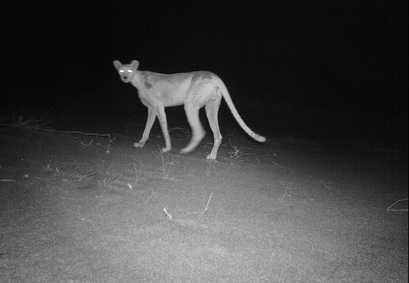
An elusive Saharan cheetah recently came into the spotlight in Niger, Africa, where a hidden camera snapped photos of the ghostly cat, whose pale coat and emaciated appearance distinguish it from other cheetahs.
In one of the images the sleek, light-colored cat with small spots on its coat and a small head is turning in the direction of the camera, its eyes aglow.
Its appearance, and how the Saharan cheetah (Acinonyx jubatus hecki) is genetically related to other cheetahs is open to question, said John Newby, CEO of the Sahara Conservation Fund (SCF), who is part of the team, along with SCF's Thomas Rabeil and others, who captured the camera-trap snapshots between July ad August. What they know about this species comes from the few photos they've managed to capture.

"I think we were more happy than surprised when the images turned up, because we knew cheetahs were in the general area because we had seen their tracks on several occasions," Newby said. "However, the area is so vast that picking up an animal as rare as this always entails a lot of luck and good judgment on where to place the cameras."
The animal is so rare and elusive scientists aren't sure how many even exist, though they estimate from the few observations they've made of the animal and tracks that fewer than 10 individuals call the vast desert of Termit and Tin Toumma in Niger home. Fewer than 200 cheetahs probably exist in the entire Sahara. [10 Species You Can Kiss Goodbye]
Losing this cheetah would also mean losing important genetic and biological diversity, as these animals have adaptations for survival in extreme desert conditions.
Their home can reach sizzling temperatures up to 113 degrees Fahrenheit (45 degrees Celsius), and is so parched no standing water exists. "They probably satisfy their water requirements through the moisture in their prey, and on having extremely effective physiological and behavioral adaptations," Newby said.
In an effort to conserve water and stay out of the heat, the Saharan cheetah is even more nocturnal than other cheetahs.
Spotting these cats in the wild has been a challenge. "They are incredibly shy and elusive animals," Newby said. In addition, they likely have broad home ranges since their prey - gazelles, hares, large birds and smaller rodents - are relatively scarce. Observations that have been made suggest they prefer caves and rock shelters as breeding dens.
Among the threats to the pale cat are scarcity of prey due to poaching and overuse, and conflicts with herders over stock harassment and killing of their animals, according to SCF. Apparently cheetah skins are prized as prayer rugs or used to make slippers.
"They are suspected of taking goats and even baby camels, and as a result are persecuted just like most other large predators," Newby said. "Work underway with local nomads is putting together the true picture of livestock predation in an attempt to reduce the arbitrary slaughter of carnivores that has massively reduced populations of cheetah and striped hyenas."
Newby and Rabeil say the camera-trap study will provide tangible evidence for the cheetah's existence in the Termit area.
"The more we know about the animal the better we can conserve it, including pinpointing key areas for extra protection," Newby said. "The cheetah's presence adds weight to arguments for the entire zone's protection as a nature reserve and strengthens our ability to raise support for conservation activities."
The Saharan cheetah is listed as critically endangered on the 2009 IUCN Red List of Threatened Species. (IUCN stands for International Union for Conservation of Nature.)

A hind image showing the Saharan cheetah in the Termit region of Niger, Africa, was captured recently by a camera trap. Credit: Sahara Conservation Fund/WildCRU.


The Saharan cheetah is smaller with a paler coat than other cheetahs. Here a photo of the Saharan cheetah captured by a camera trap in a vast desert in Niger, Africa. Credit: Sahara Conservation Fund/WildCRU.


Credit: Sahara Conservation Fund/WildCRU
A camera trap recently captured the elusive Saharan cheetah in a vast desert in Niger, Africa. Credit: Sahara Conservation Fund/WildCRU.


By Jeanna Bryner, LiveScience Managing Editor