Showing posts with label Europe. Show all posts

Sunday, June 3, 2012

c'est l'amour


Michael Haneke with Jean-Louis Trintignant, Adrien Brody and Emmanuelle Riva

Michael Haneke, right, with (from left) Jean-Louis Trintignant, Adrien Brody and Emmanuelle Riva after Amour won the Palme d'Or at Cannes. Photograph: Yves Herman/Reuters


The 65th Cannes film festival drew to a close with the director Michael Haneke being awarded the Palme d'Or for Amour.
His victory was greeted with acclaim but an understandable lack of surprise: Amour had been hotly tipped ever since it unspooled on the fifth day of the festival.
The jury, presided over by former Palme d'Or winner Nanni Moretti, gave the chief award to Haneke, saying the jury was not unanimous on any of the awards, but that many of the contending films were "more in love with their style than their characters"; this, presumably, was where Haneke differed.
Amour, which stars French veterans Jean-Louis Trintignant and Emmanuelle Riva as well as Isabelle Huppert, describes the relationship between an elderly married couple when one of them is incapacitated by a stroke.
The Palme d'Or is Haneke's second; his last was only three years ago for The White Ribbon. In this he joins a select company, including Emir Kusturica and the Dardenne brothers.

The Austrian director accepted the award in his characteristically low-key way, saying: "It's a harsh thing to have to contend with. It's something I had to contend with in my own family, and that's why I started to make this film."

Haneke also mentioned his own wife: "This film is an illustration of the promise we made to each other, if either one of us finds ourselves in the situation that is described in the film."
The Grand Jury prize, Cannes' second most prestigious award, was given to Matteo Garrone, the Italian director whose film Reality explored the effect of reality TV. Garrone's award was genuinely unexpected, perhaps reflecting the common cultural ground between him and the jury president.
British cinema scored a pleasant surprise as the bronze-medal Jury Prize went to Ken Loach's The Angels' Share, a whisky heist comedy set in Scotland. Loach, who is held in high esteem on the European festival circuit, took the opportunity to affirm his opposition to Europe-wide austerity economic policies when accepting his award; he elaborated on the issue afterwards in the winners' press conference.
"The characters in the film have no work, and the world tells them they have no worth," Loach said. "We are reminded of the situation in Europe where people are told they have to stay out of work, and stay of no value. So we are in solidarity with those against austerity – another world is possible."
A rare moment of levity was provided by Mexican director Carlos Reygadas, whose best director award was probably the biggest surprise of the night, after a string of negative reviews for his film Post Tenebras Lux. Reygadas bounced into the winners' press conference, punching the air, and stood balancing his award certificate on his head. British jury member Andrea Arnold had earlier defended his film to the hilt, saying it had "dared to fail".
Probably the most disappointed director on the night was Leos Carax, whose Holy Motors looked likely to scoop at least one award. Moretti said: "Opinions were divided within the jury over several films; some won awards, some did not."
But one popular winner was the young American, Benh Zeitlin, whose surreal coming of age film Beasts of the Southern Wild won the Camera d'Or for best first film. Zeitlin, the only American to win a major prize, explained that nearly all his cast and crew were first-timers too: "We were a lot of inexperienced people running fast into the unknown."
Former Bond villain Mads Mikkelsen also drew loud cheers when his best actor award was announced for the child-abuse-accusation drama The Hunt. Jury member Ewan McGregor said: "The wonder was in the subtlety."
@Guardian

Friday, May 4, 2012

France Peresidential Elections 2012: TV Debate

The Socialist François Hollande has emerged with the upper hand from a bruising TV duel with the rightwing president Nicolas Sarkozy, as the two held their last rallies in the final 24 hours of campaigning before Sunday's presidential vote.
The first opinion poll for LH2 Yahoo showed French viewers of the live TV debate found Hollande to be the more serious candidate and also the nicest, most sincere and closest to their daily concerns. Sarkozy was seen to have been more dynamic and competent. Hollande was most convincing on the issues that worry voters the most: jobs, making ends meet as well as education, while Sarkozy was seen to be better on Europe, immigration and reducing France's debt.
Over 17 million French people watched the almost three-hour live TV presidential debate, more than watch an X Factor final in the UK, but fewer than tuned in to watch Sarkozy take on the Socialist Ségolène Royal in 2007.
Sarkozy is trailing Hollande by five to eight points in the polls and a classic televised battle of the personalities had been seen as his last chance to turn the election around and win over the large majority of France's 6.4m far-right voters he needs to have a chance at re-election.
Pollsters were sceptical that Sarkozy, who at times had seemed riled and on the defensive, would have done so. French presidential debates do not usually yield an outright winner, and some called this a draw.
But most commentators felt Hollande had won on points, delivering the most memorable lines, including repeating: "I, as president of the republic …" 16 times in a bid to gain in leadership stature. Newspaper columnists felt the debate would not produce an "earthquake" for the struggling Sarkozy, the most unpopular president to seek re-election in France. Hollande was seen to have cemented his advance.
He was given a further boost when the centrist François Bayrou, who took 9% of the vote in the first round, broke with his party's tradition and said he would vote for him. This was a blow to Sarkozy, who needs to secure as many Bayrou voters as possible.
If the TV slanging match was full of bile – Sarkozy called Hollande "a little slanderer" and Hollande told him "you'd be hard pressed to pass yourself off as a victim" – the political reaction afterwards was just as laden with invective.
Nadine Morano, a rightwing minister and Sarkozy ally, said the exchange with Hollande had been like "extracting pus". Sarkozy's special adviser called Hollande "grotesque". Jean-Marc Ayrault, tipped as a possible Socialist prime minister, said Sarkozy had been aggressive. Hollande said the nature of the debate had reflected the fracture, aggressiveness and tensions in society "after five years of Sarkozy".
But Sarkozy insisted that the election was on a knife-edge and all was to play for. "The opinion polls are lying. An election has never been this open … It's even more open after the debate," he told French radio.
He then gave a highly personal interview seemingly to show himself as more human and close to the people, saying he was so "rubbish" at technology that he didn't know how to work the three TV remote controls at home, and suggesting if his wife, Carla Bruni, wasn't with him he could barely operate the television.
At his final major rally in Toulon, he said the "left and its laxity" had "ruined" France.
Hollande, before giving his final open-air rally in Toulouse, was deliberately cautious about Sunday's vote, warning that nothing was won. Some observers have predicted the result could be closer than polls suggest.
Meanwhile, media fact-checkers were poring over the highly technical parts of the TV debate, when the candidates hurled statistics at each other. One French site calculated that Sarkozy mentioned a figure every 47 seconds and Hollande mentioned one every 1 minute, 36 seconds, although not all were accurate.
The final runoff vote takes place on Sunday.

@Guardian
by Angelique Chrisafis

Thursday, June 16, 2011

The Katyn Wood Massacre


The first news of a massacre at Katyn Wood came in April 1943 when the Germans found a mass grave of 4,500 Polish soldiers in German-occupied Russia. The discovery at Katyn Wood was to greatly embarrass the Russian government.
The Russians responded to the German claims that Russia's secret police did it, by claiming that the massacre was carried out by the Germans themselves. In the context of the war - the Allies were fighting the Nazi war machine and Russia was a valued ally - the German version was not accepted by the British or other Allied governments. However, in the era of the Cold War, the Russian version was heavily scrutinised and questionned.
The first announcement of what had been found at Katyn Wood was made on Radio Berlin on April 13th, 1943.
"A report has reached us from Smolensk to the effect that the local inhabitants have mentioned to the German authorities the existence of a place where mass executions have been carried out by the Bolsheviks and where 10,000 Polish officers have been murdered by the Soviet Secret State Police. The German authorities went to a place called the Hill of Goats, a Russian health resort situated twelve kilometers west of Smolensk, where a gruesome discovery was made." Radio Berlin broadcast


The Germans claimed that they found a ditch 28 meters long and 16 meters wide at the Hill of Goats in which were 3,000 bodies piled up in layers of twelve. All the bodies were fully dressed in military uniform; some were bound and all had pistol shots to the back of their heads. The Germans believed that they would find 10,000 bodies (hence the figure in the broadcast) but eventually the final total was 4,500.
The Germans claimed that the bodies were in good condition and they even recognised a general Smorawinsky as one of the victims. The soil had done a great deal to preserve the bodies and any documentation found on them.
However, any information relating to this massacre made public during the war came from Goebbel's propaganda ministry and had to be treated as suspect by the Allies. In January 1943, the Russians had turned the tide of the war with the defeat of the Germans at Stalingrad - a victory Churchill had urged all on the Allied side to celebrate. As if in a knee-jerk reaction, any criticism about the Russians in Easter 1943 would not have been acceptable. Any connection between the massacre and the Germans, however, would have been more readily accepted by all those fighting against the Nazis.
But what exactly did happen at Katyn Wood?
When German forces attacked Poland in September 1939, the Blitzkrieg tactic tore great holes in the Polish defence. However, on September 17th, as part of the Ribbentrop-Molotov Pact, Russian forces also invaded Poland. The Russian leadership called on the Polish soldiers to rise up against their officers and political leaders as a punishment for getting the country into an unjust war. Those Polish officers and senior NCO's captured by the Red Army were arrested and deported to Russia.
It is known that they were taken to three camps in Russia - Kozelsk, Starobelsk and Ostashkov. One of the camps, Kozelsk, contained more than just officers. It contained arrested Polish university lecturers, surgeons, physicians, barristers and lawyers. One woman prisoner was held at Kozelsk - Janina Lewandowski. Her body was found at Katyn clothed in the uniform of the Polish Air Force. Ostashkov held officers - but it also held anybody from Poland who was considered to be 'bourgeois'. It seems that only Starobelsk held only officers from the Polish military.
To start with, the Russians attempted to 're-educate' the Poles in all three camps. Brigadier Zarubin of the Soviet Secret State Police was put in charge of this task. His efforts to promote the Soviet way of life probably had no chance. The Poles in the camp were forbidden to say Mass - which for a devout Roman Catholic nation was a major blow and it was almost certainly done secretly. Therefore, it is untenable to think that there were any takers for the Soviet view point which Zarubin was trying to sell. It seems that Zarubin reported his failure to Moscow and shortly after this a colonel from the Soviet Secret State Police turned up at all three camps. Just after the visit of this colonel, groups of prisoners were taken from the camps to an unknown destination.
In April 1940, all three camps were simultaneously cleared.
On June 22nd, 1941, Nazi Germany launched 'Operation Barbarossa'. The German military swept aside the Russian army and penetrated deep into Russia. Stalin, alarmed by the collapse of the Red Army, ordered that an amnesty should be granted to all Polish prisoners who were willing to fight against the Germans. On August 14th 1941, a Polish-Soviet military agreement was signed. However, no-one could account for the whereabouts of the officers held in Kozelsk, Starobelsk and Ostashkov. Winston Churchill himself wrote about the embarrassment such a disclosure brought on the Russian authorities.
The Polish government in exile, based in London, was especially concerned that the Russians explain where these men were. Stalin gave two answers. Initially, he claimed that the men had escaped to Manchuria. However, the authorities in Moscow - which was effectively Stalin - claimed that the men were held in territory that the Germans had taken in their lightning attack in June 1941 and that only the Germans could account for their whereabouts. This was to become the standard Moscow answer to the problem - the Germans were responsible.
Locals at Katyn Forest had long known that it was an area used by the secret police to execute those who had fallen out with Stalin's government. As early as 1929, the Soviet secret police had built a dacha there surrounded by barbed wire and armed guards. To keep out the locals, the secret police also used guard dogs to patrol the perimeter of the dacha.
On July 16th, 1941, Smolensk fell to the Germans. The Russian authorities had fled from Katyn and for the first time in years, the area was open 'to the public'. In 1942, Poles from the Todt Organisation arrived in the area to collect any form of scrap. As they worked on the Hill of Goats, they found the body of a dead Polish officer who was later buried in a dignified service. However, the winter for 1942-43 was severe and the ground at the Hill of Goats was frozen over.
In the Spring of 1943, a Russian peasant, Ivan Krivozertzev, read an article in a newspaper ('Novyj Put') regarding General Sikorski and his search for thousands of Polish officers whom he could not account for. Despite communism in Russia, Krivozertzev had maintained his religious beliefs and re-called what he had seen in Smolensk in 1940.
He had seen rail wagons coming into Smolensk station but being shunted into screened sidings. He had seen men being herded under armed guard into 'Black Ravens' - the local nickname for prison vehicles. Krivozertzev had also seen 'normal' prisoners being driven from Smolensk city in lorries with shovels and pick axes. Krivozertzev went to the Germans and told them that he believed the Polish officers would be found at the Hill of Goats. The Germans went to the forest and dug up mounds that had young fir trees on the top of them. These trees gave away an obvious secret as the rings on them indicated that they had been planted in April 1940.
The Germans started digging in the Hill of Goats and found the bodies of many men, still in military uniform, who had been shot in the back of the head with their hands tied behind their backs. The Germans also found the bodies of Russian men and women who had been shot long before 1940. Curiously, the Germans claimed that the way the Russians and Poles had been tied was identical and that whoever did both sets of murders was the same organisation. The 4,500 bodies that were exhumed came from Kozelsk - no-one knows what happened to the men held at Starobelsk and Ostashkov. Moscow announced its stance on April 14th 1943:

"The Polish prisoners in question were interned in the vicinity of Smolensk in special camps and were employed in road construction. In was impossible to evacuate them at the time of the approach of the German troops and, as a result, they fell into their hands. If, therefore, they have been found murdered, it means that they have been murdered by the Germans who, for reasons of provocation, now claim that the crime was committed by Soviet authorities."

On April 15th, the British government publically stated via the BBC that the Germans had told lies and that it accepted the Russian version. This caused the Polish government in exile to call for an independent inspection of Katyn - something the International Red Cross in Switzerland could do. The German and Polish government (in exile) agreed to this; Moscow did not. The Russians broke off all relations with Poland and set up a puppet Polish government in Moscow.
When Russia advanced into Europe and re-captured Katyn, it seemed as if the issue was solved as it was clear that the Russians were not going to allow any investigation into what happened at Katyn. At the Nuremburg trials, the murders were linked to the indictment against Goering and the Russians presented their evidence to 'prove' it was the Germans, but they were never probed and Katyn drifted into obscurity. At the final judgment of the International Tribunal, Katyn was not even mentioned.
For their part the Russians claimed that the massacre took place after it became obvious that the Wehrmacht was in full retreat after their defeat at Stalingrad and that it was carried out by the Nazis. They put up the following evidence gathered at Nuremburg:
The Germans did not allow any external authority to fully examine either the bodies or the grave sites. The Polish Commission, set up by the Nazis to examine the evidence, was only allowed to see what the Germans wanted them to see. One Bulgarian professor, Marko Markov, claimed that he was only allowed to dissect one body that was presented to him and that he could not conclude from this body that it had been in the ground for three years – as the Nazis tried to suggest to him that it had been. In his written report, Markov only wrote about what he found on the body – he did not give a conclusion as to how the body got into its state.
He and seven other experts were only allowed two half-a-day visits to the grave sites by the Germans. “It reminded me of a tourist trip”, claimed Markov.
The Russians also claimed that the issue of the three year old saplings was also easy to explain. They claimed that there was no evidence that they came from the grave mounds themselves and that they could have been gathered at any point from Katyn Wood and handed in as ‘evidence’.
The Russians also claimed that all the bullets found on the bodies were made by the German firm Geko. It was claimed that they were all Geko 7.65 mm bullets which only the German would have had access to.
Who committed the murders remained a mystery until 1990 when the Russian authorities admitted that it was the Russian Secret police (NKVD), that then spent much time and effort in attaching blame on the Germans.
@historylearningsite.co.uk

Pic : General Mieczyslaw Smorawinski

Thursday, March 24, 2011

Turkey-France Clash


Recep Tayyip Erdogan
Turkey has launched a bitter attack on French president Nicolas Sarkozy's and France's leadership of the military campaign against Libyan leader Muammar Gaddafi, accusing the French of lacking a conscience in their conduct in the Libyan operations.
The vitriolic criticism, from both the prime minister, Recep Tayyip Erdogan, and the president, Abdullah Gül followed attacks from the Turkish government earlier this week and signalled an orchestrated attempt by Ankara to wreck Sarkozy's plans to lead the air campaign against Gaddafi.
With France insisting that Nato should not be put in political charge of the UN-mandated air campaign, Turkey has come out emphatically behind sole Nato control of the operations.
The row came as France confirmed that one of its fighter jets had destroyed a Libyan air force plane, the first to breach the no-fly zone since it was imposed on 19 March. The Libyan G2/Galeb trainer aircraft was destroyed by an air-to-ground missile just after it landed at an air base near the rebel-held town of Misrata, a French military spokesman said.
The clash between Turkey and France over Libya is underpinned by acute frictions between Erdogan and Sarkozy, both impetuous and mercurial leaders who revel in the limelight, by fundamental disputes over Ankara's EU ambitions, and by economic interests in north Africa.
The confrontation is shaping up to be decisive in determining the outcome of the bitter infighting over who should inherit command of the Libyan air campaign from the Americans and could come to a head at a major conference in London next week of the parties involved.
Using incendiary language directed at France in a speech in Istanbul, Erdogan said: "I wish that those who only see oil, gold mines and underground treasures when they look in [Libya's] direction, would see the region through glasses of conscience from now on."
President Gül reinforced the Turkish view that France and others were being driven primarily by economic interests. "The aim [of the air campaign] is not the liberation of the Libyan people," he said. "There are hidden agendas and different interests."
Earlier this week, Claude Guéant, the French interior minister who was previously Sarkozy's chief adviser, outraged the Muslim world by stating that the French president was "leading a crusade" to stop Gaddafi massacring Libyans.
Erdogan denounced the use of the word crusade yesterday, blaming those, France chief among them, who are opposed to Turkey joining the EU.
Senior Nato officials are meeting in Brussels for the fourth day in a row to try to hammer out an agreement on who should assume command of the no-fly zone over Libya from the Americans who are determined to relinquish command within days.
Sarkozy has agreed to give Nato military planners operational command of the campaign, but refused to grant the alliance political and strategic control, insisting this should be vested in the broader "coalition of the willing" taking part.
Turkey has responded by blocking Nato planning operations for Libya while stressing that Nato should be given "sole command", senior Nato diplomats said.
Turkey, Nato's second biggest army after the US and its only Muslim member, appears bent on winning the argument. It is already taking part in Nato patrols in the Mediterranean to police an arms embargo on Libya. It wants to limit and shorten the air campaign and proscribe ground attacks on Libya by Nato aircraft. If Nato is given political command of the air effort, Turkey would be able to exercise a veto in a system run on consensus.
The US's top military officer in Europe, Admiral James Stavridis, Nato's supreme commander Europe, has gone to Ankara to try to mediate a deal.
The Turks are incensed at repeated snubs by Sarkozy. The French failed to invite Turkey to last Saturday's summit in Paris which presaged the air strikes. French fighters taking off from Corsica struck the first blows. The Turkish government accused Sarkozy of launching not only the no-fly zone, but his presidential re-election campaign.
While the dispute over Libya is substantive and political, it also appears highly personal, revealing the bad blood simmering between the French president and the Turkish prime minister.
Sarkozy went to Turkey last month for the first time in four years as president. But the visit was repeatedly delayed and then downgraded from a state presidential event. He stayed in Turkey for five hours.
"Relations between Turkey and France deserve more than this," complained Erdogan. "I will speak with frankness. We wish to host him as president of France. But he is coming as president of the G20, not as that of France."
While the German chancellor, Angela Merkel, is also opposed to Turkey joining the EU, she has voiced her objections moderately. Sarkozy has declared loudly that culturally Turkey does not belong in Europe, but in the Middle East.
France has blocked tranches of Ankara's EU negotiations on the grounds that it should not be seen as ever-fit for membership.

Tuesday, February 8, 2011

Turkey Figure

Prime Minister Recep Tayyip Erdogan of Turkey seems on a path to win his third election in a row, having effectively neutered a once-all-powerful military.
Arriving at a template that effectively integrates Islam, democracy and vibrant economics has been a near-impossible dream for Middle East reformers stretching back decades. To a large extent, Egypt’s inability to accommodate these three themes lies at the root of its current plight.
But no country in the region has come closer to accomplishing this trick, warts and all, than Turkey. As a result, diplomats and analysts have begun to present the still-incomplete Turkish experiment as a possible road map for Egypt.
“Turkey is the envy of the Arab world,” said Hugh Pope, project director for the Turkish office of the International Crisis Group. “It has moved to a robust democracy, has a genuinely elected leader who seems to speak for the popular mood, has products that are popular from Afghanistan to Morocco — including dozens of sitcoms dubbed into Arabic that are on TV sets everywhere — and an economy that is worth about half of the whole Arab world put together.”
The idea is not new. President Obama’s first trip as president to a Muslim country was to Turkey in April 2009, and he hailed its progress as a Middle East model. (His visit there preceded his better-remembered speech in Cairo by two months.)
Since then, the already wide distance separating these countries has grown. Turkey’s economy and its internationally competitive companies are expanding at a relentless pace. Meanwhile, its mildly Islamist prime minister, Recep Tayyip Erdogan, seems on a path to win his third election in a row, having effectively neutered a once-all-powerful military apparatus long seen as the guardian of secularism in the country.
It has not always been this way.
Indeed, when Hosni Mubarak came to power in Egypt in October 1981, after the assassination of President Anwar el-Sadat, Turkey was still being governed by its army, which one year earlier intervened to impose a sense of order on the country’s fractious political scene.
But while Mr. Mubarak, a military man himself, banked upon authoritarian rule, paying only lip service to democratic institutions and running rigged elections, the general behind the Turkish coup, Kenan Evren, moved to withdraw from politics. The constitution he imposed left the military considerable scope to meddle in political affairs, but it allowed civilian institutions to bloom.
On the economic front Egypt maintained state control, with many restrictions on foreign trade and domestic competition. By contrast, Turkey, which hopes to join the European Union, has opened up its economy and unleashed a dynamic private sector.
Today, with similarly sized populations of about 80 million, Turkey has an economy that is nearly four times the size of Egypt’s.
Its recent growth spurt has been driven by Mr. Erdogan, who came to power in 2003 and focused first on reducing deficits and bringing down inflation. Only after he demonstrated success in raising living standards did he feel confident enough to overcome opposition from the determinedly secular army and the cosmopolitan elite in Istanbul by introducing elements of Islam into Turkish public life.
He has been rewarded with broad popular support at home — demonstrated in September when Mr. Erdogan easily won a referendum that further diluted the military’s powers — and growing influence abroad.
In responding to the Egypt crisis, President Obama telephoned Prime Minister Erdogan twice in six days to discuss the unfolding events, and administration officials say they have been keeping in close contact with their Turkish counterparts at all levels.
“There’s no question that Turkey can play a role,” one administration official said. The official, speaking on grounds of anonymity, noted that Mr. Erdogan and Turkish leaders had publicly called for Mr. Mubarak to listen to what the protesters on the streets of Cairo had been saying — words that might have heartened democracy advocates in the Muslim world.
Turkey’s ability to thrive as a predominantly Muslim country that maintains diplomatic relations — though chilly — with Israel is one that American officials would like to see other Muslim nations develop.
But it is also true that actions taken by the Erdogan government against the Turkish news media have been a cause for some concern, a point made recently by the new American ambassador to Turkey, Francis J. Ricciardone Jr., who was ambassador to Egypt from 2005 to 2008.
With the Egyptian military likely to play the role of political guarantor in any transition from Mr. Mubarak’s rule, analysts suggest that Turkey might serve as a model for introducing new political parties, writing a constitution from scratch and ultimately stepping aside and letting the democratic process play out (as uncomfortable as that might be) — all of which the Turkish military has done since the 1980 coup.
“The military did not overplay its hand in Turkey,” said Soner Cagaptay, an analyst at the Washington Institute for Near East Policy. Mr. Cagaptay also said that even though Mr. Erdogan had made gains in pushing his Islamist agenda, the military served as an effective restraint.
“The relative moderation of Islamic parties in Turkey is due to the military,” he said.
There are still substantial differences between the countries. For the Turkish military, its organizing philosophy has always been preserving the secularist traditions that Turkey’s post-World War I founder, Kemal Ataturk, set in place. In Egypt, while the Muslim Brotherhood has been officially banned, the army has been seen more as the defender of the authoritarian status quo rather than secularism itself.
How the military in Egypt deals with the Muslim Brotherhood — by far the most powerful civic force in the country — will be crucial in determining the country’s political future.
Can it, as was the case in Turkey, encourage the formation of competing political parties? And can it encourage the moderate elements of the Muslim Brotherhood to come to the fore rather than its more militant factions?
Turkey may have a more direct role to play on that front. Mr. Erdogan’s party has already established ties to the Muslim Brotherhood — a result of Mr. Erdogan’s long and successful campaign to present himself as a dominant and increasingly anti-Israeli voice in the Middle East.
According to research by Dore Gold at the Jerusalem Center for Public Affairs, three members of the Muslim Brotherhood — two of whom serve in the Egyptian Parliament — were on the Turkish-sponsored ship that was attacked by Israeli forces on its way to deliver aid to the Gaza Strip in May.
“There is a great deal of ideological compatibility between the A.K.P. and the Muslim Brotherhood,” said Mr. Gold, a former top adviser to Prime Minister Benjamin Netanyahu of Israel, referring to Mr. Erdogan’s Justice and Development Party. “This is something to watch carefully.”
Perhaps, but in the end that could be a plus rather than a minus.
For all his Islamist sympathies, Mr. Erdogan is at root a pragmatist. As a young firebrand he was jailed for his antisecular rhetoric but now, after working within Turkey’s democratic framework rather than outside it, he is recognized as perhaps the Middle East’s most influential figure.

by : Landon Thomas Jr.

Tuesday, January 25, 2011

Meeting Between Platini And The Serie A Executives


The meeting arranged by Figc between Serie A teams’ executives and the Uefa President Michel Platini took place yesterday afternoon at the Hotel Parco dei Principi in Rome. They addressed several matters: from the financial fair play to the initiatives against violence, racism and corruption, from the future of European competitions to the Uefa strategies in view of the next four years presidency (2011 - 2015) for which Platini is the only candidate. Juventus President Andrea Agnelli and MD-sports GM Giuseppe Marotta attended the meeting.

After the conference, the latter spoke to media about Juventus condition and targets: «The title? Football is so changeable, but our main object is to qualify for the next Champions League, as already stated at the beginning of this season. Actually, it depends on our opponents’ progress, not only on our squad. The championship is still quite balanced. The difference consists in crucial scorers and, unfortunately, we suffered from many injuries, like that occurred to Fabio Quagliarella. Intervening in the transfer market? We won’t just go through the motions of doing operations, even because now there are no important names suitable for Juventus».
Asked about Del Piero’s contract renewal, Marotta responded that: «Alessandro is a real legend in Juventus, a serious professional who earned the club’s and supporters’ respect. We will deal with this topic as soon as possible».
Finally, about Calciopoli, he said that: «Juventus rely on sports justice. We hope that a deep and accurate verification of the events could be carried out, because there is still a vague situation. We also hope that the solution will be achieved quite quickly».

@Juventus.com

Wednesday, December 22, 2010

From Recovery To Expansion

As holiday shoppers drag stuffed bags from stores, and a Santa Claus stock market rally warms spirits and 401(k) accounts, economists are full of seasonal cheer and upping their expectations for 2011.

Most have cast aside any talk of a double-dip recession that was prevalent just about five months ago as housing plunged, European countries worried about paying debts and China started to put the brakes on growth. Now, many economists think the U.S. economy will grow at 3 percent or more in 2011, moving from the recovery phase to expansion.
For the first time since the economy began its cruel descent into the worst recession since the Depression, economists see evidence that gross domestic product, which is the size of the economy, finally will return to the $13.36 trillion level it left behind in 2007 and surpass that mark in the year ahead.
"It's taken us a very long time to get back to even," said Northern Trust economist Paul Kasriel. "It's been the weakest recovery since the recovery that began in April 1933."
Yet, in 2011, "I think people will worry less about losing their jobs, and if you have been out of work, you will start seeing better job opportunities," Kasriel said.
He thinks the economy will grow about 3.3 percent next year and that unemployment could drop to 8.5 percent by the end of 2011. As horrible as 8.5 percent sounds compared with the 5 percent jobless rate that predated the recession, it's an improvement over the recent 9.8 percent or 2009's peak at 10.1 percent.
With almost 17 percent of Americans unemployed or underemployed, it will take years of improved growth to absorb all the people who lost jobs during the last couple years. The economy must create about 150,000 jobs a month to start making a dent in unemployment, and it isn't there yet.
Still, optimism over 2011 has built as consumers have spent more than expected on holiday shopping and as surveys of corporate decision-makers, exports and industrial production have pointed to stronger growth. This month, after Congress extended unemployment benefits for 13 months and extended tax cuts for two years, economists reworked estimates. Many assume Americans will spend much of the extra money and add another one-half to 1 percentage point to GDP growth next year.
Macroeconomic Advisers, for example, had been predicting GDP would grow at 2.4 percent in early 2011 and rise to 3.7 percent for the year. As the firm has evaluated recent economic data, it has estimated growth in the first quarter next year at 3 percent and 4 percent for the year.
Although economists are encouraged by signs of improvement in the economy, they continue to see ongoing threats, including excessive debt in the U.S. and Europe and the possibility that the world's engine of growth, China, will fight inflation by slowing too much.
"The economic recovery will not bring economic health," JPMorgan economist Robert Mellman said in his 2011 forecast. "The boost to growth from lower taxes comes at the expense of a larger budget deficit, now forecast to be $1.5 trillion, or nearly 10 percent of GDP in 2011."
Further, he and other economists note that state and local governments, which provide about 13 percent of the nation's GDP, will have "fiscal challenges for the foreseeable future."
"State and local governments face the toughest budget outlook since the Great Depression," said Bank of America Merrill Lynch economist Ethan Harris. "The worst is yet to come."
As local governments struggle to pay their bills as property taxes fall along with real estate values, governments will have to slash payrolls and spending, cutting contracts with businesses and adding to the unemployed.
Since early fall, a strong stock market rally apparently has made people with jobs feel more comfortable about spending money. The Dow Jones industrial average is up 10.6 percent this year and has gained 76 percent since the 2009 lows. But while economists have been encouraged by spending, High Frequency Economist Ian Shepherdson said retail sales cannot keep rising at their recent pace because people are not getting pay increases.
"Disposable incomes are rising by only about 0.2 percent per month," he said.
And Americans are still digging out from record levels of debt, a process expected to take years. Although retail sales have been impressive, Shepherdson noted that less than half of all consumption involves retail, and that spending on services "has been subdued."
Some analysts also say it's difficult to understand if the economy is really on a sustainable path or just providing an illusion of strength as government stimulus, in the form of everything from tax cuts to unemployment benefits and the Federal Reserve's quantitative easing, put money into people's hands.
Deutsche Bank's fixed-income team told clients, "We think 2011 will be divided into two halves."
The first half represents a test, the analysts said: "Is the economy gaining sufficient traction that rates can begin some kind of steady normalization? The second half will be the answer."
Meanwhile, Morgan Stanley Asia Chairman Stephen Roach thinks 2011 will be a replay of 2010, with optimism early in the year, followed by fear about the aftershocks of the financial crisis.
"The rich countries of the developed world are hobbled by lingering post-crisis aftershocks," he said. "The United States, long the main engine of the global economy is low on fuel. … Europe now faces its own strain of post-crisis aftershocks."


                                                                            Gail MarksJarvis

                                                                           @Chicago Tribune

Saturday, December 18, 2010

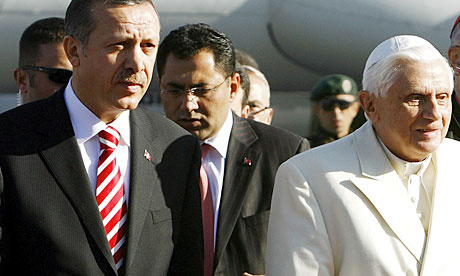
WikiLeaks: Pope wanted Muslim Turkey kept out of EU (?)

A WikiLeaks cable reports that Pope Benedict XVI, seen here being received by Turkish prime minister Recep Tayyip Erdogan in Ankara in 2006, 'might prefer to see Turkey develop a special relationship short of EU membership'.


The pope is responsible for the Vatican’s growing hostility towards Turkey joining the EU, previously secret cables sent from the US embassy to the Holy See in Rome claim.

In 2004 Cardinal Ratzinger, the future pope, spoke out against letting a Muslim state join, although at the time the Vatican was formally neutral on the question.
The Vatican’s acting foreign minister, Monsignor Pietro Parolin, responded by telling US diplomats that Ratzinger’s comments were his own rather than the official Vatican position.

The cable released by WikiLeaks shows that Ratzinger was the leading voice behind the Holy See’s unsuccessful drive to secure a reference to Europe’s “Christian roots” in the EU constitution. The US diplomat noted that Ratzinger “clearly understands that allowing a Muslim country into the EU would further weaken his case for Europe’s Christian foundations”.
But by 2006 Parolin was working for Ratzinger, now Pope Benedict XVI, and his tone had distinctly chilled. “Neither the pope nor the Vatican have endorsed Turkey’s EU membership per se,” he told the American charge d’affaires, “rather, the Holy See has been consistently open to accession, emphasising only that Turkey needs to fulfil the EU’s Copenhagen criteria to take its place in Europe.”
But he did not expect the demands on religious freedom to be fulfilled: “One great fear is that Turkey could enter the EU without having made the necessary advances in religious freedom. [Parolin] insisted that EU members – and the US – continue to press the [Turkish government] on these issues … He said that short of ‘open persecution’, it couldn’t get much worse for the Christian community in Turkey.”
The cables reveal the American government lobbying within Rome and Ankara for Turkish EU membership. “We hope a senior department official can visit the Holy See and encourage them to do more to push a positive message on Turkey and integration,” concluded the 2006 cable.
But by 2009, the American ambassador was briefing in advance of President Barack Obama’s visit, that “the Holy See’s position now is that as a non-EU member the Vatican has no role in promoting or vetoing Turkey’s membership. The Vatican might prefer to see Turkey develop a special relationship short of membership with the EU.”
Roman Catholicism is the only religion in the world with the status of a sovereign state, allowing the pope’s most senior clerics to sit at the top table with world leaders. The cables reveal the Vatican routinely wielding influence through diplomatic channels while sometimes denying it is doing so. The Vatican has diplomatic relations with 177 countries and has used its diplomatic status to lobby the US, United Nations and European Union in a concerted bid to impose its moral agenda through national and international parliaments.
The US charge d’affaires D Brent Hardt told Parolin, his diplomatic counterpart in Rome, of “the Holy See’s potential to influence Catholic countries to support a ban on human cloning” to which Parolin emphasised his agreement with the US position and promised to support fully UN efforts for such a ban.
On other global issues such as climate change, the Vatican sought to use its moral authority as leverage, while refusing itself to sign formal treaties, such as the Copenhagen accord, that require reporting commitments.
At a meeting in January this year Dr Paolo Conversi, the pope’s representative on climate change at the Vatican’s secretariat of state, told an American diplomat that the Vatican would “encourage other countries discreetly to associate themselves with the accord as opportunities arise”.
The Americans noted that Conversi’s offer to support the US, even if discreetly, was significant because the Vatican was often reluctant to appear to compromise its independence and moral authority by associating itself with particular lobbying efforts.
“Even more important than the Vatican’s lobbying assistance, however, is the influence the pope’s guidance can have on public opinion in countries with large Catholic majorities and beyond.”
The cables also reveal that the Vatican planned to use Poland as a trojan horse to spread Catholic family values through the structures of the European Union in Brussels.
The then US ambassador to the Holy See, Francis Rooney, briefed Washington in 2006, shortly after the election of Pope Benedict XVI, that “the Holy See hopes that Poland will hold the line at the EU on ‘life and family’ issues that arise” and would serve as a counterweight to western European secularism once the country had integrated into the EU.
The cable notes that Pope Benedict is preoccupied with Europe’s increasing psychological distance from its Christian roots.
“He has continued to focus on Poland’s potential in combating this trend. This was one of the themes of the visit of several groups of Polish bishops to the Vatican at the end of last year [2005]. ‘It’s a topic that always comes up,’ explained Monsignor Michael Banach, the Holy See minister of foreign affairs country director for Poland. He told us that the two sides recognised that the Polish bishops needed to exert leadership in the face of western European secularism.”
Across the Atlantic, the Vatican has told the Americans it wants to undermine the Venezuelan president, Hugo Chávez, in Latin America because of worries about the deterioration of Catholic power there. It fears Chávez is seriously damaging relations between the Catholic church and the state by identifying the church hierarchy as part of the privileged class.
Monsignor Angelo Accattino, in charge of Caribbean and Andean matters for the Vatican, said Obama should reach out to Cuba “in order to reduce the influence of Chávez and break up his cabal in Latin America”.In December last year, America’s adviser for western Europe at the UN, Robert Smolik, said the Vatican observer was “as always active and influential behind the scenes” and “lobbied actively and influentially in the corridors and in informal consultations, particularly on social issues”.
In 2001 another American diplomat to the Vatican stated: “The Holy See will continue to seek to play a role in the Middle East peace process while denying this intention.”


Source : Guardian

Sunday, December 12, 2010

Biograph mMR: MRI and PET are one

Body


At RSNA a new system was unveiled, Biograph™ mMR*, the world's first integrated whole-body molecular MR with simultaneous data acquisition technology, currently undergoing clinical-use testing in Europe.

With this system, Siemens has brought together state-of-the-art 3T MRI and PET technology to enable simultaneous acquisition of both modalities – exquisite morphology, function and metabolism assessed in a single image.
Along with this exciting launch, Siemens highlighted the new imaging software syngo.via** and the commitment to reduce radiation dose across the entire spectrum of imaging and therapy.

*Biograph mMR is pending 510(k) review and is not commercially available in the U.S.


**syngo.via can be used as a stand-alone device or together with a variety of syngo.via-based software options which are medical devices on their own rights. These products are pending regulatory clearance in some countries and therefore not yet commercially available in all countries. In particular the products are not yet available for sales in Brazil.

*** syngo.via can be used anywhere if the following prerequisites are met: Internet connection to a clinical network, DICOM compliance, meets minimum hardware requirements and adherence to local data security regulations.