Showing posts with label Turkey. Show all posts

Wednesday, May 16, 2012

More Than Meets The Eye II


Gerry: Gus Van Sant back to his experimental roots
Some fantastic material for my movie archive! I watched a number of great movies on my days off during recent months. I'd like to mention them. Moreover i added my personal scores which partly reflect how much i liked them. (I don't fully support the idea of rating artwork this way !) I've done so just to mark my initial personal impressions about each of these movies. My personal experience reveals the understanding and excitement about some artworks develop slowly. That's interesting to observe how my personal conception gradually changes by time. I'm willing to write a brief review about some of them in upcoming posts.


Hanna (2011) ; Joe Wright 6/10
The Trial (1962) ; Orson Welles 10/10
Les Asacias (2011) ; Pablo Giorgeli 7/10
The Holy Girl (2004) ; Lucrecia Martel 9/10
Gerry (2002) ; Guus Van Sant 10/10
Once Upon A Time in Anatolia (2011) ; Nuri Bilge Ceylan 9/10
Batman Begins (2005) ; Christopher Nolan 8/10
Army of Shadows (1969) ; Jean-Pierre Melville 9/10
A Good Heart (2009) ; Dagur Kari 6/10
My Sister's Keeper (2009) ; Nick Cassavetes 9/10
Angela's Ashes (1999) ; Alan Parker 6/10
A Christmas Carol (2009) ; Robert Zemeckis 8/10
Z (1969) ; Costa-Gavras 9/10

Thursday, March 24, 2011

Turkey-France Clash


Recep Tayyip Erdogan
Turkey has launched a bitter attack on French president Nicolas Sarkozy's and France's leadership of the military campaign against Libyan leader Muammar Gaddafi, accusing the French of lacking a conscience in their conduct in the Libyan operations.
The vitriolic criticism, from both the prime minister, Recep Tayyip Erdogan, and the president, Abdullah Gül followed attacks from the Turkish government earlier this week and signalled an orchestrated attempt by Ankara to wreck Sarkozy's plans to lead the air campaign against Gaddafi.
With France insisting that Nato should not be put in political charge of the UN-mandated air campaign, Turkey has come out emphatically behind sole Nato control of the operations.
The row came as France confirmed that one of its fighter jets had destroyed a Libyan air force plane, the first to breach the no-fly zone since it was imposed on 19 March. The Libyan G2/Galeb trainer aircraft was destroyed by an air-to-ground missile just after it landed at an air base near the rebel-held town of Misrata, a French military spokesman said.
The clash between Turkey and France over Libya is underpinned by acute frictions between Erdogan and Sarkozy, both impetuous and mercurial leaders who revel in the limelight, by fundamental disputes over Ankara's EU ambitions, and by economic interests in north Africa.
The confrontation is shaping up to be decisive in determining the outcome of the bitter infighting over who should inherit command of the Libyan air campaign from the Americans and could come to a head at a major conference in London next week of the parties involved.
Using incendiary language directed at France in a speech in Istanbul, Erdogan said: "I wish that those who only see oil, gold mines and underground treasures when they look in [Libya's] direction, would see the region through glasses of conscience from now on."
President Gül reinforced the Turkish view that France and others were being driven primarily by economic interests. "The aim [of the air campaign] is not the liberation of the Libyan people," he said. "There are hidden agendas and different interests."
Earlier this week, Claude Guéant, the French interior minister who was previously Sarkozy's chief adviser, outraged the Muslim world by stating that the French president was "leading a crusade" to stop Gaddafi massacring Libyans.
Erdogan denounced the use of the word crusade yesterday, blaming those, France chief among them, who are opposed to Turkey joining the EU.
Senior Nato officials are meeting in Brussels for the fourth day in a row to try to hammer out an agreement on who should assume command of the no-fly zone over Libya from the Americans who are determined to relinquish command within days.
Sarkozy has agreed to give Nato military planners operational command of the campaign, but refused to grant the alliance political and strategic control, insisting this should be vested in the broader "coalition of the willing" taking part.
Turkey has responded by blocking Nato planning operations for Libya while stressing that Nato should be given "sole command", senior Nato diplomats said.
Turkey, Nato's second biggest army after the US and its only Muslim member, appears bent on winning the argument. It is already taking part in Nato patrols in the Mediterranean to police an arms embargo on Libya. It wants to limit and shorten the air campaign and proscribe ground attacks on Libya by Nato aircraft. If Nato is given political command of the air effort, Turkey would be able to exercise a veto in a system run on consensus.
The US's top military officer in Europe, Admiral James Stavridis, Nato's supreme commander Europe, has gone to Ankara to try to mediate a deal.
The Turks are incensed at repeated snubs by Sarkozy. The French failed to invite Turkey to last Saturday's summit in Paris which presaged the air strikes. French fighters taking off from Corsica struck the first blows. The Turkish government accused Sarkozy of launching not only the no-fly zone, but his presidential re-election campaign.
While the dispute over Libya is substantive and political, it also appears highly personal, revealing the bad blood simmering between the French president and the Turkish prime minister.
Sarkozy went to Turkey last month for the first time in four years as president. But the visit was repeatedly delayed and then downgraded from a state presidential event. He stayed in Turkey for five hours.
"Relations between Turkey and France deserve more than this," complained Erdogan. "I will speak with frankness. We wish to host him as president of France. But he is coming as president of the G20, not as that of France."
While the German chancellor, Angela Merkel, is also opposed to Turkey joining the EU, she has voiced her objections moderately. Sarkozy has declared loudly that culturally Turkey does not belong in Europe, but in the Middle East.
France has blocked tranches of Ankara's EU negotiations on the grounds that it should not be seen as ever-fit for membership.

Tuesday, February 8, 2011

Turkey Figure

Prime Minister Recep Tayyip Erdogan of Turkey seems on a path to win his third election in a row, having effectively neutered a once-all-powerful military.
Arriving at a template that effectively integrates Islam, democracy and vibrant economics has been a near-impossible dream for Middle East reformers stretching back decades. To a large extent, Egypt’s inability to accommodate these three themes lies at the root of its current plight.
But no country in the region has come closer to accomplishing this trick, warts and all, than Turkey. As a result, diplomats and analysts have begun to present the still-incomplete Turkish experiment as a possible road map for Egypt.
“Turkey is the envy of the Arab world,” said Hugh Pope, project director for the Turkish office of the International Crisis Group. “It has moved to a robust democracy, has a genuinely elected leader who seems to speak for the popular mood, has products that are popular from Afghanistan to Morocco — including dozens of sitcoms dubbed into Arabic that are on TV sets everywhere — and an economy that is worth about half of the whole Arab world put together.”
The idea is not new. President Obama’s first trip as president to a Muslim country was to Turkey in April 2009, and he hailed its progress as a Middle East model. (His visit there preceded his better-remembered speech in Cairo by two months.)
Since then, the already wide distance separating these countries has grown. Turkey’s economy and its internationally competitive companies are expanding at a relentless pace. Meanwhile, its mildly Islamist prime minister, Recep Tayyip Erdogan, seems on a path to win his third election in a row, having effectively neutered a once-all-powerful military apparatus long seen as the guardian of secularism in the country.
It has not always been this way.
Indeed, when Hosni Mubarak came to power in Egypt in October 1981, after the assassination of President Anwar el-Sadat, Turkey was still being governed by its army, which one year earlier intervened to impose a sense of order on the country’s fractious political scene.
But while Mr. Mubarak, a military man himself, banked upon authoritarian rule, paying only lip service to democratic institutions and running rigged elections, the general behind the Turkish coup, Kenan Evren, moved to withdraw from politics. The constitution he imposed left the military considerable scope to meddle in political affairs, but it allowed civilian institutions to bloom.
On the economic front Egypt maintained state control, with many restrictions on foreign trade and domestic competition. By contrast, Turkey, which hopes to join the European Union, has opened up its economy and unleashed a dynamic private sector.
Today, with similarly sized populations of about 80 million, Turkey has an economy that is nearly four times the size of Egypt’s.
Its recent growth spurt has been driven by Mr. Erdogan, who came to power in 2003 and focused first on reducing deficits and bringing down inflation. Only after he demonstrated success in raising living standards did he feel confident enough to overcome opposition from the determinedly secular army and the cosmopolitan elite in Istanbul by introducing elements of Islam into Turkish public life.
He has been rewarded with broad popular support at home — demonstrated in September when Mr. Erdogan easily won a referendum that further diluted the military’s powers — and growing influence abroad.
In responding to the Egypt crisis, President Obama telephoned Prime Minister Erdogan twice in six days to discuss the unfolding events, and administration officials say they have been keeping in close contact with their Turkish counterparts at all levels.
“There’s no question that Turkey can play a role,” one administration official said. The official, speaking on grounds of anonymity, noted that Mr. Erdogan and Turkish leaders had publicly called for Mr. Mubarak to listen to what the protesters on the streets of Cairo had been saying — words that might have heartened democracy advocates in the Muslim world.
Turkey’s ability to thrive as a predominantly Muslim country that maintains diplomatic relations — though chilly — with Israel is one that American officials would like to see other Muslim nations develop.
But it is also true that actions taken by the Erdogan government against the Turkish news media have been a cause for some concern, a point made recently by the new American ambassador to Turkey, Francis J. Ricciardone Jr., who was ambassador to Egypt from 2005 to 2008.
With the Egyptian military likely to play the role of political guarantor in any transition from Mr. Mubarak’s rule, analysts suggest that Turkey might serve as a model for introducing new political parties, writing a constitution from scratch and ultimately stepping aside and letting the democratic process play out (as uncomfortable as that might be) — all of which the Turkish military has done since the 1980 coup.
“The military did not overplay its hand in Turkey,” said Soner Cagaptay, an analyst at the Washington Institute for Near East Policy. Mr. Cagaptay also said that even though Mr. Erdogan had made gains in pushing his Islamist agenda, the military served as an effective restraint.
“The relative moderation of Islamic parties in Turkey is due to the military,” he said.
There are still substantial differences between the countries. For the Turkish military, its organizing philosophy has always been preserving the secularist traditions that Turkey’s post-World War I founder, Kemal Ataturk, set in place. In Egypt, while the Muslim Brotherhood has been officially banned, the army has been seen more as the defender of the authoritarian status quo rather than secularism itself.
How the military in Egypt deals with the Muslim Brotherhood — by far the most powerful civic force in the country — will be crucial in determining the country’s political future.
Can it, as was the case in Turkey, encourage the formation of competing political parties? And can it encourage the moderate elements of the Muslim Brotherhood to come to the fore rather than its more militant factions?
Turkey may have a more direct role to play on that front. Mr. Erdogan’s party has already established ties to the Muslim Brotherhood — a result of Mr. Erdogan’s long and successful campaign to present himself as a dominant and increasingly anti-Israeli voice in the Middle East.
According to research by Dore Gold at the Jerusalem Center for Public Affairs, three members of the Muslim Brotherhood — two of whom serve in the Egyptian Parliament — were on the Turkish-sponsored ship that was attacked by Israeli forces on its way to deliver aid to the Gaza Strip in May.
“There is a great deal of ideological compatibility between the A.K.P. and the Muslim Brotherhood,” said Mr. Gold, a former top adviser to Prime Minister Benjamin Netanyahu of Israel, referring to Mr. Erdogan’s Justice and Development Party. “This is something to watch carefully.”
Perhaps, but in the end that could be a plus rather than a minus.
For all his Islamist sympathies, Mr. Erdogan is at root a pragmatist. As a young firebrand he was jailed for his antisecular rhetoric but now, after working within Turkey’s democratic framework rather than outside it, he is recognized as perhaps the Middle East’s most influential figure.

by : Landon Thomas Jr.

Saturday, December 18, 2010

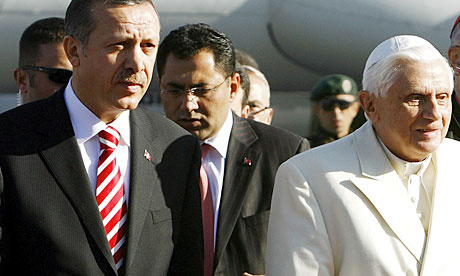
WikiLeaks: Pope wanted Muslim Turkey kept out of EU (?)

A WikiLeaks cable reports that Pope Benedict XVI, seen here being received by Turkish prime minister Recep Tayyip Erdogan in Ankara in 2006, 'might prefer to see Turkey develop a special relationship short of EU membership'.


The pope is responsible for the Vatican’s growing hostility towards Turkey joining the EU, previously secret cables sent from the US embassy to the Holy See in Rome claim.

In 2004 Cardinal Ratzinger, the future pope, spoke out against letting a Muslim state join, although at the time the Vatican was formally neutral on the question.
The Vatican’s acting foreign minister, Monsignor Pietro Parolin, responded by telling US diplomats that Ratzinger’s comments were his own rather than the official Vatican position.

The cable released by WikiLeaks shows that Ratzinger was the leading voice behind the Holy See’s unsuccessful drive to secure a reference to Europe’s “Christian roots” in the EU constitution. The US diplomat noted that Ratzinger “clearly understands that allowing a Muslim country into the EU would further weaken his case for Europe’s Christian foundations”.
But by 2006 Parolin was working for Ratzinger, now Pope Benedict XVI, and his tone had distinctly chilled. “Neither the pope nor the Vatican have endorsed Turkey’s EU membership per se,” he told the American charge d’affaires, “rather, the Holy See has been consistently open to accession, emphasising only that Turkey needs to fulfil the EU’s Copenhagen criteria to take its place in Europe.”
But he did not expect the demands on religious freedom to be fulfilled: “One great fear is that Turkey could enter the EU without having made the necessary advances in religious freedom. [Parolin] insisted that EU members – and the US – continue to press the [Turkish government] on these issues … He said that short of ‘open persecution’, it couldn’t get much worse for the Christian community in Turkey.”
The cables reveal the American government lobbying within Rome and Ankara for Turkish EU membership. “We hope a senior department official can visit the Holy See and encourage them to do more to push a positive message on Turkey and integration,” concluded the 2006 cable.
But by 2009, the American ambassador was briefing in advance of President Barack Obama’s visit, that “the Holy See’s position now is that as a non-EU member the Vatican has no role in promoting or vetoing Turkey’s membership. The Vatican might prefer to see Turkey develop a special relationship short of membership with the EU.”
Roman Catholicism is the only religion in the world with the status of a sovereign state, allowing the pope’s most senior clerics to sit at the top table with world leaders. The cables reveal the Vatican routinely wielding influence through diplomatic channels while sometimes denying it is doing so. The Vatican has diplomatic relations with 177 countries and has used its diplomatic status to lobby the US, United Nations and European Union in a concerted bid to impose its moral agenda through national and international parliaments.
The US charge d’affaires D Brent Hardt told Parolin, his diplomatic counterpart in Rome, of “the Holy See’s potential to influence Catholic countries to support a ban on human cloning” to which Parolin emphasised his agreement with the US position and promised to support fully UN efforts for such a ban.
On other global issues such as climate change, the Vatican sought to use its moral authority as leverage, while refusing itself to sign formal treaties, such as the Copenhagen accord, that require reporting commitments.
At a meeting in January this year Dr Paolo Conversi, the pope’s representative on climate change at the Vatican’s secretariat of state, told an American diplomat that the Vatican would “encourage other countries discreetly to associate themselves with the accord as opportunities arise”.
The Americans noted that Conversi’s offer to support the US, even if discreetly, was significant because the Vatican was often reluctant to appear to compromise its independence and moral authority by associating itself with particular lobbying efforts.
“Even more important than the Vatican’s lobbying assistance, however, is the influence the pope’s guidance can have on public opinion in countries with large Catholic majorities and beyond.”
The cables also reveal that the Vatican planned to use Poland as a trojan horse to spread Catholic family values through the structures of the European Union in Brussels.
The then US ambassador to the Holy See, Francis Rooney, briefed Washington in 2006, shortly after the election of Pope Benedict XVI, that “the Holy See hopes that Poland will hold the line at the EU on ‘life and family’ issues that arise” and would serve as a counterweight to western European secularism once the country had integrated into the EU.
The cable notes that Pope Benedict is preoccupied with Europe’s increasing psychological distance from its Christian roots.
“He has continued to focus on Poland’s potential in combating this trend. This was one of the themes of the visit of several groups of Polish bishops to the Vatican at the end of last year [2005]. ‘It’s a topic that always comes up,’ explained Monsignor Michael Banach, the Holy See minister of foreign affairs country director for Poland. He told us that the two sides recognised that the Polish bishops needed to exert leadership in the face of western European secularism.”
Across the Atlantic, the Vatican has told the Americans it wants to undermine the Venezuelan president, Hugo Chávez, in Latin America because of worries about the deterioration of Catholic power there. It fears Chávez is seriously damaging relations between the Catholic church and the state by identifying the church hierarchy as part of the privileged class.
Monsignor Angelo Accattino, in charge of Caribbean and Andean matters for the Vatican, said Obama should reach out to Cuba “in order to reduce the influence of Chávez and break up his cabal in Latin America”.In December last year, America’s adviser for western Europe at the UN, Robert Smolik, said the Vatican observer was “as always active and influential behind the scenes” and “lobbied actively and influentially in the corridors and in informal consultations, particularly on social issues”.
In 2001 another American diplomat to the Vatican stated: “The Holy See will continue to seek to play a role in the Middle East peace process while denying this intention.”


Source : Guardian

Thursday, November 4, 2010

Leadership and Leitkultur


Since the end of August Germany has been roiled by waves of political turmoil over integration, multiculturalism and the role of the “Leitkultur,” or guiding national culture. This discourse is in turn reinforcing trends toward increasing xenophobia among the broader population.
These trends have been apparent for many years in studies and survey data that show a quiet but growing hostility to immigrants. Yet it is as though they have only now found a voice: the usual stereotypes are being flushed out of the bars and onto the talk shows, and they are echoed by mainstream politicians who want to capture potential voters who are otherwise drifting off toward the right. Two events have given rise to a mixture of emotions that are no longer easy to locate on the scale from left to right — a book by a board member of Germany’s central bank and a recent speech by the German president.
It all began with the advance release of provocative excerpts from “Germany Does Away With Itself,” a book that argues that the future of Germany is threatened by the wrong kind of immigrants, especially from Muslim countries. In the book, Thilo Sarrazin, a politician from the Social Democratic Party who sat on the Bundesbank board, develops proposals for demographic policies aimed at the Muslim population in Germany. He fuels discrimination against this minority with intelligence research from which he draws false biological conclusions that have gained unusually wide publicity.
In sharp contrast to the initial spontaneous objections from major politicians, these theses have gained popular support. One poll found that more than a third of Germans agreed with Mr. Sarrazin’s prognosis that Germany was becoming “naturally more stupid on average” as a result of immigration from Muslim countries.
After half-hearted responses in the press by a handful of psychologists who left the impression that there might be something to these claims after all, there was a certain shift in mood in the news media and among politicians toward Mr. Sarrazin. It took several weeks for Armin Nassehi, a respected sociologist, to take the pseudoscientific interpretation of the relevant statistics apart in a newspaper article. He demonstrated that Mr. Sarrazin adopted the kind of “naturalizing” interpretation of measured differences in intelligence that had already been scientifically discredited in the United States decades ago.
But this de-emotionalizing introduction of objectivity into the discussion came too late. The poison that Mr. Sarrazin had released by reinforcing cultural hostility to immigrants with genetic arguments seemed to have taken root in popular prejudices. When Mr. Nassehi and Mr. Sarrazin appeared at the House of Literature in Munich, a mob atmosphere developed, with an educated middle-class audience refusing even to listen to objections to Mr. Sarrazin’s arguments.
Amid the controversy, Mr. Sarrazin was forced to resign from the Bundesbank board. But his ouster, combined with the campaign against political correctness started by the right, only helped to strip his controversial arguments of their odious character. Criticism against him was perceived as an overreaction. Hadn’t the outraged chancellor, Angela Merkel, denounced the book without having read it? Wasn’t she now doing an about-face, by telling young members of her Christian Democratic Union party that multiculturalism was dead in Germany? And hadn’t the chairman of the Social Democrats, Sigmar Gabriel, the only prominent politician to counter the substance of Mr. Sarrazin’s claims with astute arguments, met with resistance from within his own party when he proposed expelling the unloved comrade?
The second disturbing media event in recent weeks was the reaction to a speech by the newly elected German president, Christian Wulff. As the premier of Lower Saxony, Mr. Wulff had been the first to appoint a German woman of Turkish origin as a member of his cabinet.
In his speech earlier this month on the anniversary of German unification, he took the liberty of reaffirming the commonplace notion, which former presidents had already affirmed, that not only Christianity and Judaism but “Islam also belongs in Germany.”
After the speech the president received a standing ovation in the Bundestag from the assembled political notables. But the next day the conservative press homed in on his assertion about Islam’s place in Germany. The issue has since prompted a split within his own party, the Christian Democratic Union. It is true that, although the social integration of Turkish guest workers and their descendants has generally been a success in Germany, in some economically depressed areas there continue to be problematic immigrant neighborhoods that seal themselves off from mainstream society. But these problems have been acknowledged and addressed by the German government. The real cause for concern is that, as the Sarrazin and Wulff incidents show, cool-headed politicians are discovering that they can divert the social anxieties of their voters into ethnic aggression against still weaker social groups.
The best example is Bavaria’s premier, Horst Seehofer, who has declared “immigrants from other cultures” to be detrimental and has called for a halt to immigration “from Turkey and Arab countries.” Although statistics show a net outflow of people of Turkish origin, Mr. Seehofer invokes the phobic image of unregulated masses of social parasites crowding into our welfare state networks as a way of building support for his own political aims.


Social and political developments in Germany, given its ghastly history, do not necessarily have the same significance as in other countries. So, are there grounds for concern that the “old” mindsets could undergo a revival?
It depends on what we mean by “old.” What we are seeing is not a revival of the mentalities of the 1930s. Instead, it is a rekindling of controversies of the early 1990s, when thousands of refugees arrived from the former Yugoslavia, setting off a debate on asylum seekers. The Christian Democratic Union and its Bavarian sister party, the Christian Social Union, then endorsed the position that Germany was “not a country of immigration.” At that time hostels for refugees went up in flames and even the Social Democrats gave ground, agreeing in Parliament to a shabby compromise on asylum law.
That dispute was already stimulated by the feeling of an endangered national culture, which had to assert itself as the leitkultur that all newcomers must follow. Yet the controversy of the 1990s was also driven by the fact that Germany had recently reunited and had reached the final stage in an arduous path toward a mentality that provides the necessary underpinning of a liberal understanding of the Constitution.
To the present day, the idea of the leitkultur depends on the misconception that the liberal state should demand more of its immigrants than learning the language of the country and accepting the principles of the Constitution. We had, and apparently still have, to overcome the view that immigrants are supposed to assimilate the “values” of the majority culture and to adopt its “customs.”
That we are experiencing a relapse into this ethnic understanding of our liberal constitution is bad enough. It doesn’t make things any better that today leitkultur is defined not by “German culture” but by religion. With an arrogant appropriation of Judaism — and an incredible disregard for the fate the Jews suffered in Germany — the apologists of the leitkultur now appeal to the “Judeo-Christian tradition,” which distinguishes “us” from the foreigners.
Nevertheless I do not have the impression that the appeals to the leitkultur signal anything more than a rearguard action or that the lapse of an author into the snares of the controversy over nature versus nurture has given enduring and widespread impetus to the more noxious mixture of xenophobia, racist feelings of superiority and social Darwinism. The problems of today have set off the reactions of yesterday — but not those of the day before.
I don’t underestimate the scale of the accumulated nationalistic sentiment, a phenomenon not confined to Germany. But in the light of current events, another trend is of greater concern: the growing preference for unpolitical figures on the political scene, which recalls a dubious trait of German political culture, the rejection of political parties and party politics.
During the parliamentary election of the federal president last summer, Joachim Gauck, the politically inexperienced and non-party-affiliated civil rights campaigner, stood as the opposing candidate to Mr. Wulff, the career politician. Against the majority in the electoral college, Mr. Gauck, a Protestant minister with a history of opposition to the old East German regime, won the hearts of the broader population, and almost won the election.
The same yearning for charismatic figures who stand above the political infighting can be seen in the puzzling popularity of the aristocratic defense minister, Karl-Theodor zu Guttenberg, who, with not much more than his family background, polished manners and a judicious wardrobe, has managed to overshadow Ms. Merkel’s reputation.


Of even greater concern is the sort of street protests we are now witnessing in Stuttgart, where tens of thousands of people have come out against the federal railway corporation’s plan to demolish the old central train station. The protests that have been continuing for months are reminiscent of the spontaneity of the extraparliamentary opposition of the 1960s. Unlike then, though, today people from all age groups and sectors of the population are taking to the streets. The immediate aim is a conservative one: preserving a familiar world in which politics intervenes as the executive arm of supposed economic progress.
In the background, however, there is a deeper conflict brewing over our country’s understanding of democracy. The state government of Baden-Württemberg, where Stuttgart is located, sees the protests narrowly, as simply a question of whether government is legally permitted to plan such long-term megaprojects. In the midst of the turmoil the president of the Federal Constitutional Court rushed to the project’s defense by arguing that the public had already voted to approve it 15 years ago, and thus had no more say in its execution.
But it has since emerged that the authorities did not, in fact, provide sufficient information at the time, and thus citizens did not have an opportunity to develop an informed opinion on which they could have based their votes. To insist that they should have no further say in the development is to rely on a formalistic understanding of democracy. The question is this: Does participation in democratic procedures have only the functional meaning of silencing a defeated minority, or does it have the deliberative meaning of including the arguments of citizens in the democratic process of opinion- and will-formation?
The motivations underlying each of the three phenomena — the fear of immigrants, attraction to charismatic nonpoliticians and the grass-roots rebellion in Stuttgart — are different. But they meet in the cumulative effect of a growing uneasiness when faced with a self-enclosed and ever more helpless political system. The more the scope for action by national governments shrinks and the more meekly politics submits to what appear to be inevitable economic imperatives, the more people’s trust in a resigned political class diminishes.
The United States has a president with a clear-headed political vision, even if he is embattled and now meets with mixed feelings. What is needed in Europe is a revitalized political class that overcomes its own defeatism with a bit more perspective, resoluteness and cooperative spirit. Democracy depends on the belief of the people that there is some scope left for collectively shaping a challenging future.


By : Jurgen Habermas
@NYTIMES
Image : Thilo Sarrazin
Thanks to Hossein for sharing the article