Prime Minister Recep Tayyip Erdogan of Turkey seems on a path to win his third election in a row, having effectively neutered a once-all-powerful military.
Arriving at a template that effectively integrates Islam, democracy and vibrant economics has been a near-impossible dream for Middle East reformers stretching back decades. To a large extent, Egypt’s inability to accommodate these three themes lies at the root of its current plight.
But no country in the region has come closer to accomplishing this trick, warts and all, than Turkey. As a result, diplomats and analysts have begun to present the still-incomplete Turkish experiment as a possible road map for Egypt.
“Turkey is the envy of the Arab world,” said Hugh Pope, project director for the Turkish office of the International Crisis Group. “It has moved to a robust democracy, has a genuinely elected leader who seems to speak for the popular mood, has products that are popular from Afghanistan to Morocco — including dozens of sitcoms dubbed into Arabic that are on TV sets everywhere — and an economy that is worth about half of the whole Arab world put together.”
The idea is not new. President Obama’s first trip as president to a Muslim country was to Turkey in April 2009, and he hailed its progress as a Middle East model. (His visit there preceded his better-remembered speech in Cairo by two months.)
Since then, the already wide distance separating these countries has grown. Turkey’s economy and its internationally competitive companies are expanding at a relentless pace. Meanwhile, its mildly Islamist prime minister, Recep Tayyip Erdogan, seems on a path to win his third election in a row, having effectively neutered a once-all-powerful military apparatus long seen as the guardian of secularism in the country.
It has not always been this way.
Indeed, when Hosni Mubarak came to power in Egypt in October 1981, after the assassination of President Anwar el-Sadat, Turkey was still being governed by its army, which one year earlier intervened to impose a sense of order on the country’s fractious political scene.
But while Mr. Mubarak, a military man himself, banked upon authoritarian rule, paying only lip service to democratic institutions and running rigged elections, the general behind the Turkish coup, Kenan Evren, moved to withdraw from politics. The constitution he imposed left the military considerable scope to meddle in political affairs, but it allowed civilian institutions to bloom.
On the economic front Egypt maintained state control, with many restrictions on foreign trade and domestic competition. By contrast, Turkey, which hopes to join the European Union, has opened up its economy and unleashed a dynamic private sector.
Today, with similarly sized populations of about 80 million, Turkey has an economy that is nearly four times the size of Egypt’s.
Its recent growth spurt has been driven by Mr. Erdogan, who came to power in 2003 and focused first on reducing deficits and bringing down inflation. Only after he demonstrated success in raising living standards did he feel confident enough to overcome opposition from the determinedly secular army and the cosmopolitan elite in Istanbul by introducing elements of Islam into Turkish public life.
He has been rewarded with broad popular support at home — demonstrated in September when Mr. Erdogan easily won a referendum that further diluted the military’s powers — and growing influence abroad.
In responding to the Egypt crisis, President Obama telephoned Prime Minister Erdogan twice in six days to discuss the unfolding events, and administration officials say they have been keeping in close contact with their Turkish counterparts at all levels.
“There’s no question that Turkey can play a role,” one administration official said. The official, speaking on grounds of anonymity, noted that Mr. Erdogan and Turkish leaders had publicly called for Mr. Mubarak to listen to what the protesters on the streets of Cairo had been saying — words that might have heartened democracy advocates in the Muslim world.
Turkey’s ability to thrive as a predominantly Muslim country that maintains diplomatic relations — though chilly — with Israel is one that American officials would like to see other Muslim nations develop.
But it is also true that actions taken by the Erdogan government against the Turkish news media have been a cause for some concern, a point made recently by the new American ambassador to Turkey, Francis J. Ricciardone Jr., who was ambassador to Egypt from 2005 to 2008.
With the Egyptian military likely to play the role of political guarantor in any transition from Mr. Mubarak’s rule, analysts suggest that Turkey might serve as a model for introducing new political parties, writing a constitution from scratch and ultimately stepping aside and letting the democratic process play out (as uncomfortable as that might be) — all of which the Turkish military has done since the 1980 coup.
“The military did not overplay its hand in Turkey,” said Soner Cagaptay, an analyst at the Washington Institute for Near East Policy. Mr. Cagaptay also said that even though Mr. Erdogan had made gains in pushing his Islamist agenda, the military served as an effective restraint.
“The relative moderation of Islamic parties in Turkey is due to the military,” he said.
There are still substantial differences between the countries. For the Turkish military, its organizing philosophy has always been preserving the secularist traditions that Turkey’s post-World War I founder, Kemal Ataturk, set in place. In Egypt, while the Muslim Brotherhood has been officially banned, the army has been seen more as the defender of the authoritarian status quo rather than secularism itself.
How the military in Egypt deals with the Muslim Brotherhood — by far the most powerful civic force in the country — will be crucial in determining the country’s political future.
Can it, as was the case in Turkey, encourage the formation of competing political parties? And can it encourage the moderate elements of the Muslim Brotherhood to come to the fore rather than its more militant factions?
Turkey may have a more direct role to play on that front. Mr. Erdogan’s party has already established ties to the Muslim Brotherhood — a result of Mr. Erdogan’s long and successful campaign to present himself as a dominant and increasingly anti-Israeli voice in the Middle East.
According to research by Dore Gold at the Jerusalem Center for Public Affairs, three members of the Muslim Brotherhood — two of whom serve in the Egyptian Parliament — were on the Turkish-sponsored ship that was attacked by Israeli forces on its way to deliver aid to the Gaza Strip in May.
“There is a great deal of ideological compatibility between the A.K.P. and the Muslim Brotherhood,” said Mr. Gold, a former top adviser to Prime Minister Benjamin Netanyahu of Israel, referring to Mr. Erdogan’s Justice and Development Party. “This is something to watch carefully.”
Perhaps, but in the end that could be a plus rather than a minus.
For all his Islamist sympathies, Mr. Erdogan is at root a pragmatist. As a young firebrand he was jailed for his antisecular rhetoric but now, after working within Turkey’s democratic framework rather than outside it, he is recognized as perhaps the Middle East’s most influential figure.
by : Landon Thomas Jr.
Showing posts with label Egypt. Show all posts
Showing posts with label Egypt. Show all posts
Tuesday, February 8, 2011


Saturday, February 5, 2011
Christians Protect Muslims while they perform prayer in Egypt!
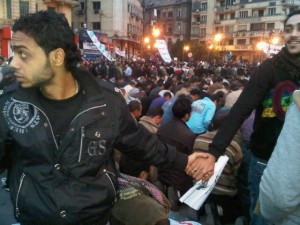
Yep, Christians shielded Muslims while they perform the prayer in Egypt.
Sounds chilling.
I reckon its the favor returned back.
Favor how?
Lets date back to Christmas on Dec 2010. Churches in Egypt were attacked by unknown groups and the atmosphere was very nervous among the local Christians. But they got assistance from local Muslims who protected them during the Christmas and now they got the favor back.
There’s a quote in Muslim terminology,
“When God decides to protect you, help will come to you from everywhere”.
Anyway i have uploaded the image of the Christians shielding Muslims.
by Shane @ ThFire.com
Cairo's biggest protest yet demands Mubarak's immediate departure

The queue was a dozen wide and hundreds deep; it snaked past the pair of bronze lions at the mouth of Qasr El Nile bridge and fanned out across the river. Cairo has witnessed gunfire, molotov cocktails and backstreet anarchy over the past week, but today people flooded in to show the world something different.
"We are the heart of the Egyptian people, the ones who make this country work," said Samar Atallah, a 29-year-old anti-Mubarak protester. "We're here for peace. We are not hundreds, we are not thousands, we are millions."
Peace – alongside solid, stable community organisation – was the hallmark of Egypt's "day of departure", an event which produced the biggest turnout yet in Egypt's 11-day-old national uprising. The target of that uprising was yet to be toppled as night drew in, but at times, amid the impromptu tea stalls, the neat rows of first aid tents and the well-manned security cordons, that almost didn't seem to matter. At the centre of a city that is rife with chaos, Tahrir square had become an oasis of calm.
As a mark of how secure this anti-Mubarak stronghold has become after days of fierce fighting with armed supporters of the current regime, Egypt's defence minister walked among the hundreds of thousands who packed the square. Hussein Tantawi was welcomed by the crowds, who chanted 'Marshal, we are your sons of liberation'.
But after state TV accused those in Tahrir of fomenting unrest and being in the pay of unnamed foreign powers, Tantawi's message – that the government was responding to the people's demands and they could now go home – got a colder reception.
"The tragedy is in the lies told about us by the regime," said Amr, a 32-year-old protester who preferred not to supply his full name. "Do people really believe these lies? It's propaganda. This is our moment, our time, Mubarak has to go. He will never know how we feel. We want to live, not to struggle."
Tantawi wasn't the only diplomatic celebrity in the square. Amr Moussa, the secretary general of the Arab League, also joined the throng. Moussa is one of those in the frame to succeed Mubarak, who continues to cling on to power despite the rapid draining of international support away from his regime and the continuing paralysis of Egypt's economy. When asked about any potential campaign for the leadership, Moussa said he was "at the disposal" of his countrymen.
But high-level political manoeuvring was only a small part of Tahrir's story, as hundreds of thousands of people swept in to make a stand against a three-decade-old dictatorship that is still clinging on for dear life. After the "days of rage" this was something altogether different, a festival of singing, socialising and solidarity, as speakers addressed different corners of the crowd and food and drink was passed round freely amongst those present.
On the fringes of the square though, reminders of the violence that has wreaked havoc across downtown Cairo in recent days still lay scattered across the roadway. "At the height of it all we were dealing with 10 patients a minute," said Dr Samar Sewilam, one of the dozens of volunteer doctors who have set up field hospitals in the square to treat those injured in clashes with the beltagi – thugs who have stormed those inside the barricades day and night in attacks which appear to be orchestrated by the government.
"Those throwing missiles from the outside are using sharp rocks which split the face into two pieces," explained Sewilam. "99% of the patients I've treated go back to the front line to continue the fight. They ask me to stitch them up and then they instantly return. 'Just stitch me up and let me go back,' they always say."
Nearby, those not reassured by the regime's public proclamations of reconciliation worked on fortifying the security cordons around the square and constructing crude defensive shields. Some wore dustbin lids taped to their heads, preparations for what they fear could be a renewed night of violence.
"I'm scared of what's going on, you can see we're standing here peacefully but look what the government has been doing to us," said Mohamed Abas, a 32-year-old engineer stationed near Talaat Harb street, where pro-Mubarak supporters congregated in the distance. "They've been coming here for us for days, so of course I'm scared."
Most around him eschewed talk of clashes though, preferring to dwell instead on the positive aspects of the remarkable scenes unfolding in a city where, only two weeks ago, protests of more than a few dozen were virtually non-existent. "You're witnessing the beginning of the first popular Egyptian revolution," beamed Mohsena Tawfik, a legendary Egyptian actress. "It's a symbol against corruption and repression not just for our country but for the whole Arab world."
The peaceful energy inside the square contrasted sharply with the neighbourhoods surrounding it, where the ongoing absence of police and the presence of pro-Mubarak gangs have left many streets highly volatile. For the second day running foreign journalists were targeted by both the army and vigilante mobs; many protesters reported being physically harassed by those supportive of the regime as they left nearby metro stations and attempted to approach Tahrir.
Inside, as midday struck, hundreds of thousands bent down to pray, a moment of silence to remember the scores of protesters who have lost their lives in the past fortnight. As they rose, the chants against their president that have filled this square for days rang out with renewed energy. "Mubarak leave now!" bellowed Tahrir. "The people want this regime to fall."
What shape that fall and its aftermath should take is the subject of increased focus amongst protesters, many of whom are aiming to give their demands a firmer shape without compromising the non-hierarchical nature of their uprising so far.
The Guardian has received a copy of four specific demands laid down by a loose coalition of 300 youth co-ordinators who helped plan the initial demonstrations last week against Mubarak and his regime. They include not just the removal of Mubarak but also the disassembling of the entire NDP elite around him, precluding a smooth transition should vice-president Omar Suleiman, a close Mubarak ally, take the helm once the president leaves.
The document also calls for the formation of a committee made up of judges, youth leaders and the military which will appoint a transitional government, plus a founding council of intellectuals and constitutional experts who will draw up a new constitution and put it to the Egyptian people in a referendum. Finally it demands free and fair elections at a local and national level once the new constitution has been implemented.
@Guardian
Subscribe to:
Posts (Atom)