Showing posts with label Spain. Show all posts

Saturday, April 30, 2011

The Royals Need To Earn Their Keep


Amid the flag-waving and the street parties to celebrate the marriage of Prince William and Kate Middleton today, bigger questions about the relevance of the monarchy to modern Britain lurk like uninvited guests. Extravagant living in a time of austerity abrades public sensibilities; unearned privilege is resented, while snobbery and elitism are seen as dangerously outmoded. The usual arguments in support of the monarchy — continuity, tradition and dignity — are no longer enough. The royals need to earn their keep.
While only a small minority here favor a republican government, many Britons hope the wedding might signal the dawning of a more populist monarchy. This is the marriage of a senior royal prince and a commoner — the first in 350 years — that spans the class divide and is, it seems, a marriage for love. These two met in college, have lived in a shared house with friends, and plan to spend at least the first few years of their married life in northern Wales, with William continuing his service as a search-and-rescue pilot for the Royal Air Force. They have caught the public’s imagination not because of outdated deference to royalty but because of their appearance of normality and togetherness even amid the strictures of royal protocol and the frenzy of press coverage.
Comparisons have of course been drawn to the wedding of William’s parents, Prince Charles and Lady Diana Spencer. Diana was young, aristocratic, naïve and intimidated, whereas Kate is older, middle-class, educated, respected by her groom and undoubtedly wiser to the pressures that will surround her. But the circumstances are similar: in 1981, as now, Britain was mired in economic difficulty and the public was expected to welcome the opulence of the ceremony as a respite from hardship.
To understand how a wedding could accomplish that, it is instructive to look much further back than 1981 — to a time before royal weddings meant much at all to ordinary Britons.
Consider Mary Tudor’s 1554 marriage to Philip of Spain. Officials feared that the public might object to the queen, herself half-Spanish, marrying a Spanish prince. And so the nuptials were performed some 50 miles from London, at Winchester Cathedral. It was an alliance born of the mutual strategic interest forged by the marriage of Mary’s parents, Henry VIII and Katherine of Aragon.
Royal marriages had long been arranged for diplomatic and political reasons. In 1420, Henry V married Catherine of Valois in an attempt at peace with France during the Hundred Years’ War; in 1589, James I married Anne of Denmark to establish a strong Protestant alliance in Europe; in 1625, Charles I married Henrietta Maria of France during a brief period when England’s pro-Spanish policy was replaced by a pro-French one.
Under the Stuarts, royal brides were mainly Catholic, which jarred a Protestant nation. The monarchs of the German House of Hanover, which acceded in 1714, invariably wed Germans of similar rank.
What finally changed all this was a remaking — indeed a rebranding — of the monarchy in 1917. England and Germany were at war, so another marriage to a German was out of the question. Instead, what was then the House of Saxe-Coburg-Gotha was renamed the House of Windsor, and George V decreed that his children could now “marry English men and English women.” In that moment the all-British monarchy was born. And royal weddings became big events to be celebrated publicly and patriotically.
When the future George VI married Lady Elizabeth Bowes-Lyon in 1923, wedding fever engulfed the country. Newspapers and magazines scrutinized every detail: the dress, the guests, the venue. A million people lined the route from Buckingham Palace to Westminster Abbey. There were fireworks and parties in the streets.
The wedding of Charles and Diana followed this tradition. The ceremony was moved from the abbey to the larger St. Paul’s Cathedral, and much of the country watched on television. Celebratory merchandise, from mugs and plates to plastic trays and tea towels, were sold worldwide. The royal family had become the ultimate British brand.
As the wedding unfolds today, many people here will be keenly aware that this is a spectacle to which they, the taxpayers, have contributed. Britons want to see their royals demonstrating “value for money,” to be seen to be in touch, to have a greater ethos of service and to be more than vacuous figureheads propped up by pomp and pageantry. In a democratic age of mass media, maintaining public favor has never been more critical.
Queen Elizabeth II’s longevity — next year will be her 60th on the throne — has in many ways suspended public discussion of the reform and modernization of the monarchy.
This might prove to be the biggest threat to the royal future: more than half of Britons now believe William should succeed the queen. With Charles first in line, there is a real prospect that William and Kate will not become king and queen until they are middle-aged. By then, the honeymoon will be over, their public appeal will surely have waned and the new “classless” monarchy that their marriage symbolized may well have arrived too late.
@NYTIMES

Friday, February 11, 2011

Interview:Heartbeat of Barcelona and Spain

Barcelona's Xavi interviewed ahead of their Champions League match against Arsenal
Many have described Barcelona's 5-0 win over Real Madrid last November as the greatest performance ever. Even Wayne Rooney admits that he stood up in his living room and started applauding.

[Xavi's face lights up]. Yeah? Really? Rooney? That makes me proud. Rooney, wow! Rooney is extraordinary, he could play for Barcelona. And before people imagine headlines like "Xavi says Rooney to join Barcelona" – although, I'd love him to! – what I mean is that he's our kind of player. That game was wonderful, the best I've played. The feeling of superiority was incredible – and against Real Madrid! They didn't touch the ball. Madre mía, what a match! In the dressing room, we gave ourselves a standing ovation.
You mention Barcelona's dominance of possession. It's tempting to conclude that we've never seen a team with an identity – for better or worse – as clear as the current Barcelona and Spain teams. It's all about possession. And that's your identity – one that seems to have become dominant.
It's good that the reference point for world football right now is Barcelona, that it's Spain. Not because it's ours but because of what it is. Because it's an attacking football, it's not speculative, we don't wait. You pressure, you want possession, you want to attack. Some teams can't or don't pass the ball. What are you playing for? What's the point? That's not football. Combine, pass, play. That's football – for me, at least. For coaches, like, I don't know, [Javier] Clemente or [Fabio] Capello, there's another type of football. But it's good that Barcelona's style is now a model, not that.
But some claimed Spain were boring at the World Cup. You kept winning 1-0.
That's upside down. It's not that we were boring, it is the other team that was. What did Holland look for? Penalties. Or [Arjen] Robben on the break. Bam, bam, bam. Of course we were boring – the opposition made it that way. Paraguay? What did they do? Built a spectacularly good defensive system and waited for chances – from dead balls. Up it goes, rebound, loose ball. It's harder than people realise when you've got a guy behind you who's two metres tall and right on top of you.
So, what's the solution?
Think quickly, look for spaces. That's what I do: look for spaces. All day. I'm always looking. All day, all day. [Xavi starts gesturing as if he is looking around, swinging his head]. Here? No. There? No. People who haven't played don't always realise how hard that is. Space, space, space. It's like being on the PlayStation. I think shit, the defender's here, play it there. I see the space and pass. That's what I do.
That's at the heart of the Barcelona model and runs all the way through the club, doesn't it? When you beat Madrid, eight of the starting XI were youth-team products and all three finalists in this year's Ballon d'Or were too – Lionel Messi, Andrés Iniesta and you.
Some youth academies worry about winning, we worry about education. You see a kid who lifts his head up, who plays the pass first time, pum, and you think, 'Yep, he'll do.' Bring him in, coach him. Our model was imposed by [Johan] Cruyff; it's an Ajax model. It's all about rondos [piggy in the middle]. Rondo, rondo, rondo. Every. Single. Day. It's the best exercise there is. You learn responsibility and not to lose the ball. If you lose the ball, you go in the middle. Pum-pum-pum-pum, always one touch. If you go in the middle, it's humiliating, the rest applaud and laugh at you.
Your Barcelona team-mate Dani Alves said that you don't play to the run, you make the run by obliging team-mates to move into certain areas. "Xavi," he said, "plays in the future."
They make it easy. My football is passing but, wow, if I have Dani, Iniesta, Pedro, [David] Villa … there are so many options. Sometimes, I even think to myself: man, so-and-so is going to get annoyed because I've played three passes and haven't given him the ball yet. I'd better give the next one to Dani because he's gone up the wing three times. When Leo [Messi] doesn't get involved, it's like he gets annoyed … and the next pass is for him.
You're talking about style over success but not only can they go together, they have to go together, don't they? Arsenal play great football, Arsène Wenger is a hugely respected coach, but they've not won anything for years. Could that happen at Barcelona?
Almost impossible. If you go two years without winning, everything has to change. But you change names, not identity. The philosophy can't be lost. Our fans wouldn't understand a team that sat back and played on the break. Sadly, people only look at teams through success. Now, success has validated our approach. I'm happy because, from a selfish point of view, six years ago I was extinct; footballers like me were in danger of dying out. It was all: two metres tall, powerful, in the middle, knockdowns, second balls, rebounds … but now I see Arsenal and Villarreal and they play like us.
Do you see yourself as a defender of the faith? An ideologue?
It was that or die. I'm a romantic. I like the fact that talent, technical ability, is valued above physical condition now. I'm glad that's the priority; if it wasn't, there wouldn't be the same spectacle. Football is played to win but our satisfaction is double. Other teams win and they're happy, but it's not the same. The identity is lacking. The result is an impostor in football. You can do things really, really well – last year we were better than Inter Milan – but did not win. There's something greater than the result, more lasting. A legacy. Inter won the Champions League but no one talks about them. People discovered me since Euro 2008, but I've been playing the same way for years. It is true, though, that I have grown in confidence and tranquillity. And that comes with success.
Has English football suffered because it embraces a different footballing culture?
It has changed; the style's a bit more technical. But before it was direct, it was about the second ball, the typical No9 was a Crouch or a Heskey and there was no football. Carragher, boom, up top; Terry, boom, up top. I think it's changing: Barry, Lampard, Gerrard, Carrick … they are players who treat the ball well. You see them now and think, Christ, they are trying to play.
Is Paul Scholes the English Xavi?
[Xavi interrupts, almost bursting with enthusiasm] Paul Scholes! A role model. For me – and I really mean this – he's the best central midfielder I've seen in the last 15, 20 years. I've spoken to Xabi Alonso about him. He's spectacular, he has it all: the last pass, goals, he's strong, he doesn't lose the ball, vision. If he'd been Spanish he might have been rated more highly. Players love him.
England seems to mistrust technical players.
It's a pity. Talent has to be the priority. Technical ability. Always, always. Sure, you can win without it but it's talent that makes the difference. Look at the teams: Juventus, who makes the difference? Krasic. Del Piero. Liverpool? Gerrard, or Torres before. Talento. Talento. When you look at players and ask yourself who's the best: talento. Cesc, Nasri, Ryan Giggs – that guy is a joy, incredible. Looking back, I loved John Barnes and Chris Waddle was buenísimo. [Open-mouthed, eyes gleaming] Le Tissier! Although their style was different I liked Roy Keane and Paul Ince together, too. That United team was great – my English team. If I'd gone anywhere, it would have been there.
In England do we overrate physical players? You mention Carragher, Terry …
Whoa! Wait! Be careful. They're fundamental. We've got Puyol. Technically he might not be the best but it's incredible the way he defends. Carragher and Terry are necessary, brilliant, but they have to adapt to technical football [not the other way round]. For me, that comes naturally – or for Messi, Iniesta or Rooney. Others have to work at it. For them it's harder to lift their head up and play a pass – but they have to.
But when a player is offered to a club, the first question is: "how tall is he?"
Have you seen [the Villarreal winger] Santi Cazorla? You think I'm small, he's up to here on me [Xavi signals his chest]. And yet he's brilliant. Messi is the same and he's the best player in the world. Maybe it's the culture, I don't know, but in England you're warriors. You watch Liverpool and Carragher wins the ball and boots it into the stands and the fans applaud. There's a roar! They'd never applaud that here.
Next week you play Arsenal again in the Champions League last 16. Are they different? A kind of Barcelona-lite?
Arsenal are a great team. When I watch Arsenal, I see Barça. I see Cesc carry the game, Nasri, Arshavin. The difference between them and us is we have more players who think before they play, quicker. Education is the key. Players have had 10 or 12 years here. When you arrive at Barça the first thing they teach you is: think. Think, think, think. Quickly. [Xavi starts doing the actions, looking around himself.] Lift your head up, move, see, think. Look before you get the ball. If you're getting this pass, look to see if that guy is free. Pum. First time. Look at [Sergio] Busquets – the best midfielder there is playing one-touch. He doesn't need more. He controls, looks and passes in one touch. Some need two or three and, given how fast the game is, that's too slow. Alves, one touch. Iniesta, one touch. Messi, one touch. Piqué, one touch. Busi [Busquets], me … seven or eight players with one touch. Fast. In fact, [the youth coach] Charly [Rexach] always used to say: a mig toc. Half a touch.
Arsenal-Barcelona always provokes questions about Cesc Fábregas's future.
If I'd ever gone to another club, I'd have been thinking about Barcelona – the link is strong. The same is happening to him. But now there's a problem: now he's expensive. But I think that a footballer ends up playing where he wants. He has to end up here.
That's not what Arsenal fans want to hear and some have accused Barcelona players, you included, of stirring trouble. Last summer there were so many remarks supposedly coming out of Barcelona …
Really? I hardly spoke then. I imagine they wouldn't have liked that. [Xavi pauses, adding quietly, almost shamefacedly] You know, often footballers don't think. We're selfish, we don't realise. I also say it because I'm thinking of Cesc. He wants to come here. Barcelona has always been his dream. But of course he's Arsenal's captain, the standard bearer, a leader. This situation is a putada [bummer] for him. He's at a club that plays his style with Wenger who has treated him well, taught him, raised him. Cesc respects him. If he'd been at, say, Blackburn it might have been easier to leave. Look, the truth is: I want him to come here. Of course. Barcelona have a very clear style and not many footballers fit. It's not easy. But Cesc fits it perfectly.
Would he replace you, though?
I don't see new players as a threat; I don't say "this is my patch". I'm more: "bring them here, let them play". The more talent in the middle, the better. Four or five years ago [people said] me and Iniesta couldn't play together. We can't play together? Look how that one turned out.
Last year, you beat Arsenal comfortably …
Yes, but this year they're much better. I think it's a disadvantage for us that we played last year. They had [too] much respect for us. It was as if they let us have the ball; we always had it, home and away. The game in London could have been a 4-0 we dominated so much – but it finished 2-2. This year will be different.
What was your reaction to the draw?
I was happy. I like the fact that we'll see a great game. Arsenal aren't the kind of team that come to try to putear you [piss you off, break up the game, destroy the match]. If it was Chelsea, you might think Madre mía, they're going to leave the initiative to you, wait deep, close up, play on the break with Drogba and Malouda. But, no, I think Arsenal will want the ball. There will be more of a game. As a fan I'd definitely pay for a ticket to see this game. Manchester United or Chelsea would play in a more speculative way. They would leave us the ball. Arsenal won't.
Does English football attract you? Spanish players always return from there raving about it.
It's incredible. Una pasada. Now that is football. England really is the birthplace, the heart and soul of football. If Barcelona had Liverpool's fans, or Arsenal's, or United's, we'd have won 20 Champions Leagues, hahaha! OK, so that's an exaggeration but I've never seen anything like it. We won 3-1 at Liverpool once and we were both applauded off the pitch. In England, footballers are respected more, the game is more noble, there's less cheating. Every Spaniard who goes loves it – and comes back a better player. If I had ever left it would have been to England.
The final is at Wembley, which makes it even more special for Barcelona, doesn't it? Last year it was special because it was at the Bernabéu but Wembley is the scene of the Dream Team's one European Cup. And this feels like a year in which you are being constantly compared to them …
In 1992, I was 12 and my brothers went but my parents wouldn't let me. I was in tears but it made no difference. I'd love to play at Wembley. It's special for Barça – and for everyone in football. Last year was more morbosa [about the rivalry with Real Madrid, almost a little dirty, titillating]. This year is more nostalgic, more classic. And I'm more of a nostalgic. Me? I'm a romantic.
@Guardian
Photo : Solarpix.com

Saturday, December 18, 2010

Hero of El Derbi Barcelones !


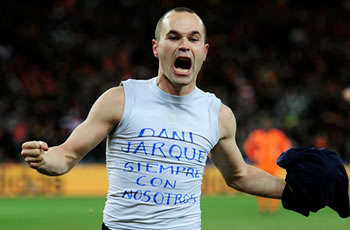
It’s a glorious coincidence, almost destiny, that Andres Iniesta’s last league game of 2010 will take place at Estadi Cornella-El Prat. There is absolutely no better way to celebrate the end of the historic year in Spanish football history than seeing San Andres treated to the most emotional reception by Espanyol supporters.
Iniesta is applauded at almost every ground in the country since scoring the winner in the World Cup Final against the Netherlands, and yet this one will be special. "Dani Jarque: siempre con nosotros” (always with us), the words on Iniesta’s shirt revealed moments after the ball met the net, are the most beautiful and most significant words ever to grace the biggest sporting event. They are the extract of true sportsmanship, they helped to make the world a better place.
Too many World Cup finals are remembered for wrong and negative reasons: Zinedine Zidane’s assault on Marco Materazzi (or vice versa, depending on which side you take), was the shameful scene in 2006; Ronaldo’s mysterious illness completely overshadowed the 1998 final, and remains a sad reminder that business is more important than sports for many key officials; 1994 was a drab affair between Brazil and Italy, the first ever final to feature no goals, and the first to be decided by the lottery of the shoot-out.
The 1990 final is always be remembered for the dreadful Argentinean side, and the dive by Rudi Voeller that finished them off. And 2010 was only minutes away from joining the list.It was destined to be an anti-climax to a poor tournament, ruined by defensive tactics and, more importantly, by the Jabulani disaster. Then came the moment that changed it all. The most memorable picture from South Africa is a positive one. Iniesta did it almost single-shirtedly. That shirt was presented to Espanyol president Daniel Sanchez Llibre last month.
Some would claim that Iniesta shouldn’t have been on the pitch in extra-time after his stupid retaliation on Mark Van Bommel. They are absolutely right. That was a red-card offence, but even the most passionate Oranje supporters must admit the game of football was lucky Howard Webb chose not to send him off. It could have been a victory for one of the dirtiest players ever. It could have made Van Bommel the new Zidane/Materazzi. Those could be the scenes forever engraved in or memories. Instead, Dani Jarque lifted the World Cup.
It must be mentioned that Iniesta was booked for taking his shift off. That should go down as the biggest travesty in the game. The man who made such a moving tribute to a departed friend was cautioned and given the same punishment Nigel De Jong got for his kung-fu kick on Xabi Alonso. If FIFA were sensible, the automatic yellow card for shirt-lifting would be abolished there and then. If Webb were a bit braver, he would follow his instincts and keep the card in his pocket. But that is just an afterthought. The booking didn’t really matter for San Andres at that moment.

For many, Iniesta became the symbol of honesty and modesty; of team unity and togetherness. When asked about his thoughts after the final whistle, he dedicated the win to Jarque again, and that was probably an even bigger tribute. It really felt like Spain had 24 players in their squad in South Africa. Maybe even 25, as Antonio Puerta was also paid homage by many players.
This is going to be a very special Saturday. Iniesta is about to take to the field Jarque didn’t live to play on. For many Espanyol supporters in the stands, their late captain will be wearing number 8 in Barcelona shirt. They will let him know about it. And then the curtain will fall on 2010, the year that belongs to the two friends, former team-mates in Spain's U-17, U-19, U-20 and U-21 selections.
Gracias, Andres! Gràcies, Andres! Thank you, Andres!

Tuesday, November 30, 2010

این شکست است، نه تحقیر

:« سال گذشته که با اینتر به اینجا آمدم، در ابتدا شکست خوردیم ولی بعد باز هم بازگشتیم و این ما بودیم که به فینال لیگ قهرمانان اروپا رسیدیم.باید شخصیت داشت؛ وقتی به عنوان قهرمانی می رسی، می توانی ازشادی گریه کنی ولی وقتی 5 بار دروازه تیمت را باز می کنند، باید با انگیزه تمرین، بازی و پیروزی به زندگی ادامه دهی.»


Sunday, October 31, 2010

Football Without Sir Alex ?


Real Madrid manager Jose Mourinho insists that "only a special manager" can fill Sir Alex Ferguson's shoes at Manchester United when the Scot calls it a day.

The Red Devils boss will be 69 years old in December, and there has been speculation concerning who could replace him in the Old Trafford hot-seat after his retirement.

And Mourinho is not surprised that several managers have been linked with the potential job opening at the club. There have been reports that Everton manager David Moyes and Barcelona's Pep Guardiola have both been linked with the position.

However, the Portuguese coach does not envision Ferguson walking away from United in the near future.

"Football without Alex Ferguson? I’m not sure that will happen any day soon," Mourinho told The Mirror.

"The man lives and breathes football and Manchester United is his club.

"His hunger and desire to win the biggest trophies remains so I cannot see the day he considers walking away from football approaching.

"Like Real Madrid, the Manchester United job is special and only a special manager is good enough to take the job on if and when it does become available.

"Of course, jobs like that don’t become available every day so the interest will be vast. Like Madrid, it’s a job everyone will want."

Real were one of the clubs linked with a move for Wayne Rooney after the forward had expressed a desire to leave Old Trafford. But the 25-year-old recently did a u-turn and signed a five-year contract with his employers.

And the former Chelsea boss insists that the outcome was never going to be any different.

He said:"Could I ever see him leaving? Never. He is Manchester United through and through and he is working with one of the best coaches in football. He’s a great player but he belongs to United. I wasn’t surprised to see him stay, I expected it.

"There was no way Alex Ferguson would have considered selling him, not to anyone. If you take the decision to leave a club like United there are not many options open to you. Few clubs come any bigger."

For now, however, Mourinho remains intent on guiding the Bernabeu boys to silverware.

"Madrid is a special club and came to me at special time in my career," he said. "After winning my second Champions League and after my success at Chelsea and Inter, the Real job and the challenge to be successful was very appealing.

"I came to a team that had had no success for two years and faced the challenge of a very special Barcelona team and some of the great clubs in Europe in the Champions League.

"Despite everything and all the success I have enjoyed, my desire to continue winning remains. I love a challenge and this is a huge challenge for me.

"Madrid didn’t win the Champions league for 10 years, the Spanish Cup for 19 years and haven’t won the Championship for three. So there is a great deal of work to be done. I love the pressure and that is immediate at a club like this because failure doesn’t sit comfortably with anyone."

Mourinho also believes that he has about 15 years of management left in him, insisting that retirement is not something he will consider anytime in the near future.

"I still have at least 10 or 15 years left in football management," he said. "Naturally a day will come when my circumstances change and I will want to lead a quieter life.

"But it is not something I will be giving any consideration too for a long time to come."


@mirrorfootball

Friday, September 24, 2010

Berba Bicycle kick: 38%


Which Of The Following Is The Best Goal Of The Week?
Lionel Messi (Barcelona)
 
8.9%
Thomas Muller (Bayern Munich)
 
16.14%
Aparesida Edmar (Metalist Kharkiv)
 
2.46%
Joaozinho (Levski Sofia)
 
4.57%
Artjoms Rudnevs (Lech Poznan)
 
2.6%
Hatem Ben Arfa (Newcastle)
 
2.66%
Jari Litmanen (FC Lahti)
 
20.07%
Diego (Wolfsburg)
 
2.34%
Charles Nevuche (Zakarpattia)
 
1.42%
Dimitar Berbatov (Manchester United)
 
38.84%
 
 from GOAL.COM POLL